Loading...
Hayato Ikeda vs Heungseon Daewongun
Hayato Ikeda leads by 7.5 pts · 2 figures compared
…
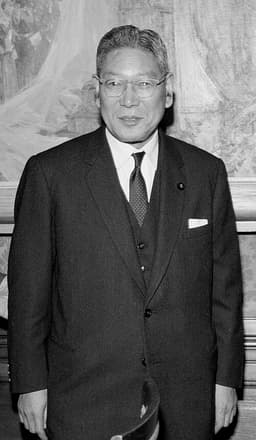
Hayato Ikeda
Politician · Modern
56.3Total

Heungseon Daewongun
Politician · Modern
48.8Total
Basic Information
Born
1899
1820
Died
1965
1898
Era
Modern
Modern
Nationality
Japan
Korea
Occupation
Politician
Politician
Civilization
Eastern
Eastern
Score Comparison
Military (10%)
12.5
13.5
Political (20%)
78.0
61.3
Influence (20%)
59.0
54.9
Legacy (20%)
52.0
46.7
Leadership (15%)
79.8
62.2
Strategy (15%)
35.9
35.3
TOTAL
56.3
48.8
Hayato Ikeda — Complete Timeline
1960 AD
Launch of the Income-Doubling PlanReform
Prime Minister Hayato Ikeda announced the 'Income-Doubling Plan' in December 1960, a ten-year economic program aiming to double the national income through rapid industrial growth, increased productivity, and expanded trade. The plan successfully guided Japan's high-growth era, achieving its target in seven years and transforming the country into an economic powerhouse.
Economic PolicyGrowthJapan
Impact: nationalconstructive
Liberalization of Trade and CapitalReform◆ Major
Ikeda's government pursued gradual liberalization of trade and capital flows, aligning Japan with international economic norms. This included joining the General Agreement on Tariffs and Trade (GATT) and the International Monetary Fund (IMF) Article VIII, which required removing restrictions on current account transactions, boosting foreign trade.
Trade PolicyLiberalizationEconomic Integration
Impact: nationalconstructive
Political Reconciliation with the OppositionPolitical Action
After the violent protests against the US-Japan Security Treaty in 1960, Ikeda adopted a 'low posture' approach, seeking dialogue with the opposition Socialist Party. He focused on economic growth and social welfare to reduce political polarization, successfully stabilizing Japanese politics during his tenure.
Political StrategyStabilityJapan
Impact: nationalconstructive
Heungseon Daewongun — Complete Timeline
1864 AD
Regency for King GojongPolitical Action◆ Major
Heungseon Daewongun became regent for his young son King Gojong, effectively ruling Joseon. He implemented isolationist policies, suppressing Christianity and resisting foreign trade and influence.
RegencyIsolationismJoseon
Impact: national
1865 AD
Construction of Gyeongbokgung PalaceCultural◆ Major
Heungseon Daewongun initiated the reconstruction of Gyeongbokgung Palace, which had been destroyed during the Japanese invasions. The project drained state finances but restored a symbol of royal authority.
PalaceReconstructionArchitecture
Impact: nationalconstructive
1866 AD
French Campaign against KoreaWar◆ Major
In response to the persecution of Catholics, a French naval force attacked Ganghwa Island. Heungseon Daewongun's forces repelled the French, leading to a Korean victory and reinforcing isolationist policies.
FranceGanghwaVictory
Impact: regionalconstructive
Persecution of CatholicsPolitical Action◆ Major
Heungseon Daewongun ordered a widespread persecution of Roman Catholics in Joseon, executing thousands of converts and French missionaries. This led to the French campaign against Korea in 1866.
PersecutionChristianityFrance
Impact: nationaldestructive
Expert Analysis
Origins
Hayato Ikeda was born on December 3, 1899, in Takehara, Hiroshima Prefecture, Japan, into a family of sake brewers. He studied law at Kyoto Imperial University, graduating in 1925, and entered the Ministry of Finance. His early career in finance shaped his economic focus. Heungseon Daewongun (Yi Ha-eung) was born on December 21, 1820, in Seoul, Joseon, as a member of the royal Yi clan. His father was Prince Namyeon. He grew up in a period of factional strife and foreign threats, influencing his later isolationist policies. He passed the civil service exam but never held high office until becoming regent.
Rise to Power
Ikeda rose through the Ministry of Finance, becoming Vice Minister in 1947. He entered politics in 1949 as a member of the Liberal Party. He served as Minister of Finance under Prime Minister Shigeru Yoshida, playing a key role in post-war economic recovery. In 1960, after the resignation of Nobusuke Kishi amid protests over the US-Japan Security Treaty, Ikeda became prime minister. He adopted a 'low posture' to reduce political tension. Heungseon Daewongun became regent in 1864 when his son, Gojong, ascended the throne at age 12. He outmaneuvered rival factions, including the Andong Kim clan, to secure his position. He ruled as de facto monarch until Gojong came of age in 1873.
Leadership & Governance
Ikeda's leadership focused on economic growth and political stability. His signature policy, the Income-Doubling Plan (1960), aimed to double national income in ten years through tax cuts, infrastructure investment, and industrial expansion. He pursued trade liberalization, joining GATT in 1963 and OECD in 1964. His 'low posture' approach reduced conflict with opposition parties, leading to a more stable political environment. Heungseon Daewongun implemented isolationist policies, closing Joseon to foreign influence. He persecuted Catholics, executing thousands and French missionaries, leading to the French Campaign against Korea (1866). He also rebuilt Gyeongbokgung Palace, a massive project that drained state finances. His governance was authoritarian and anti-foreign. Ikeda's political strategy scored 78.0, while Daewongun's scored 61.3.
Triumph & Tragedy
Ikeda's greatest success was the Income-Doubling Plan, which spurred Japan's rapid economic growth, achieving an average 10% GDP growth per year in the 1960s. Japan's economy became the second-largest in the world. His greatest failure was the lack of social safety nets; rapid growth led to pollution and regional disparities. He also failed to address the US-Japan Security Treaty's unpopularity fully. Heungseon Daewongun's triumph was repelling the French invasion in 1866, preserving Joseon's independence. He also strengthened the monarchy by reducing factional power. His tragedy was the isolationist policy that left Korea vulnerable to modernization. The persecution of Catholics damaged relations with Western powers. The Gyeongbokgung reconstruction drained resources, weakening the state. He was later sidelined by Queen Min and King Gojong.
Character & Destiny
Ikeda was pragmatic, cautious, and detail-oriented. He prioritized economic growth as a means to political stability. His 'low posture' reflected a desire to avoid conflict. His character led to sustained economic expansion but also to environmental neglect. Heungseon Daewongun was stubborn, xenophobic, and authoritarian. His isolationist stance stemmed from a fear of foreign domination. His persecution of Catholics showed his uncompromising nature. This character led to short-term victories but long-term isolation, leaving Korea unprepared for Japanese colonialism. Ikeda's leadership score of 79.8 reflects his effective governance; Daewongun's 62.2 indicates more rigid leadership.
Legacy
Ikeda's Income-Doubling Plan transformed Japan into an economic superpower. His policies set the foundation for Japan's post-war prosperity. He is remembered as a technocratic leader who prioritized growth. The plan influenced other Asian economies. Daewongun's legacy is mixed. He is seen as a defender of Korean sovereignty against foreign encroachment but also as a reactionary who hindered modernization. The Gyeongbokgung Palace remains a symbol of his rule. His isolationist policies are criticized for leaving Korea weak. Ikeda's influence score is 59.0, Daewongun's 54.9.
Conclusion
Hayato Ikeda had a greater impact on his nation's trajectory. His economic policies propelled Japan into global prominence, achieving sustained growth and raising living standards. Heungseon Daewongun's isolationism, while temporarily preserving independence, ultimately left Korea vulnerable and underdeveloped. Ikeda's total score of 56.3 versus Daewongun's 48.8 reflects this. Ikeda's strategy score (35.9) is similar to Daewongun's (35.3), but Ikeda's political acumen and leadership were superior. In the long term, Ikeda's vision of economic growth proved more transformative than Daewongun's defensive conservatism.
Rankings
🥇
Hayato IkedaLeader
Mil: 12.5Pol: 78.0Inf: 59.0
56.3
🥈
Heungseon Daewongun
Mil: 13.5Pol: 61.3Inf: 54.9
48.8
+7.5 behind
How This Comparison Works
Algorithm
Each figure is scored on 6 dimensions (0—100 scale) based on structured historical data: Military (10%), Political (20%), Influence (20%), Legacy (20%), Leadership (15%), Strategy (15%). The weighted total produces the final ranking.
Data Sources
Scores are computed from structured sub-indicators in the database. Scale factors adjust for era (Ancient ×0.85, Modern ×1.0) and civilization size (Eastern ×1.05, Other ×0.80) to account for differences in population and military scale.
Maximum 3 Figures
Comparisons are limited to 2—3 figures to ensure readability and statistical meaningfulness.
Error Margins
±5 points per dimension — Sub-scores are derived from historical records with inherent uncertainty. Two figures within 5 points on a dimension should be considered roughly equivalent in that area.
Total Score Accuracy
±3 points overall — The weighted combination of 6 dimensions produces a total score with approximately ±3 points of uncertainty. Differences of less than 3 points are not statistically significant— the figures are effectively tied.
Known Limitations
- Historical records are incomplete and uneven across civilizations
- Figures from oral-tradition societies may be underrepresented
- Occupation labels can misclassify multi-role figures
- Scores measure capability and impact, not moral character
- Quantitative scoring is a comparison tool, not absolute truth
Capability Radar
Military (10%) — Battles & Warfare
Battles
16
14
Win Rate
16
16
Expansion
21
21
Political (20%) — Governance & Reform
Reform
75
65
Diplomacy
70
30
Economy
85
35
Influence (20%) — Cultural & Global Reach
Cultural
30
40
Global
55
20
Legacy (20%) — Historical Impact
Historical
65
50
Longevity
55
30
Leadership (15%) — Power & Stability
Tenure
60
40
Stability
70
20
Strategy (15%) — Tactics & Innovation
Strategy
23
23
Tactics
26
29
Reform
28
26
Similar Comparisons
Comments & Discussion
No comments yet. Be the first to share your thoughts!