Loading...
Henry II of France vs King Sobhuza II
King Sobhuza II leads by 1.8 pts · 2 figures compared
…
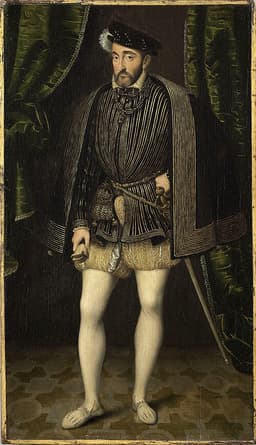
Henry II of France
Emperor · Modern
55.5Total

King Sobhuza II
Emperor · Modern
57.3Total
Basic Information
Born
1519
1899
Died
1559
1982
Era
Modern
Modern
Nationality
France
Eswatini
Occupation
Emperor
Emperor
Civilization
Western
Other
Score Comparison
Military (10%)
45.0
20.0
Political (20%)
68.0
59.3
Influence (20%)
60.0
60.0
Legacy (20%)
48.3
55.0
Leadership (15%)
53.2
81.7
Strategy (15%)
57.5
54.3
TOTAL
55.5
57.3
Henry II of France — Complete Timeline
1557 AD
Battle of St. QuentinWar◆ Major
Henry II's French army was decisively defeated by Spanish forces under Emmanuel Philibert of Savoy at St. Quentin. The defeat forced Henry to negotiate the Treaty of Cateau-Cambr
Italian WarsBattleDefeat
Impact: regionaldestructive
1559 AD
Treaty of Cateau-CambrésisPolitical Action◆ Major
Henry II signed the Treaty of Cateau-Cambr
TreatyItalian WarsPeace
Impact: regional
Death in a jousting accidentOther◆ Major
Henry II was mortally wounded during a jousting tournament held to celebrate the Treaty of Cateau-Cambr
DeathAccidentSuccession Crisis
Impact: nationaltragic
King Sobhuza II — Complete Timeline
1921 AD
Ascended to the throne as King of SwazilandPolitical Action
Sobhuza II was crowned King of Swaziland (now Eswatini) on December 22, 1921, at age 22. He succeeded his father, King Bhunu, and began a reign that would last 82 years.
CoronationLong Reign
Impact: national
1963 AD
Led opposition to the 1963 constitutionPolitical Action◆ Major
Sobhuza II opposed the British-imposed 1963 constitution, which limited his powers and established a parliamentary system. He petitioned the British government for a return to traditional rule.
Constitutional ConflictTraditionalism
Impact: national
1968 AD
Led Swaziland to independencePolitical Action
Sobhuza II led Swaziland to independence from Britain on September 6, 1968. He became the head of state, with a constitution that established a Westminster-style parliamentary system.
IndependenceFounding Monarch
Impact: nationalconstructive
1973 AD
Repealed the 1968 constitutionPolitical Action
Sobhuza II repealed the 1968 constitution and assumed absolute power, banning political parties. He justified this as necessary to preserve Swazi tradition and prevent ethnic conflict, establishing a traditional monarchy.
Constitutional RepealAbsolute Monarchy
Impact: nationaldestructive
1978 AD
Established the Tinkhundla systemReform◆ Major
Sobhuza II introduced the Tinkhundla system of governance, a traditional-based electoral system where chiefs and local councils elect members of parliament. This system remains in place in Eswatini today.
Governance ReformTraditional System
Impact: national
1981 AD
Celebrated 60th jubileeCultural
Sobhuza II celebrated his 60th year on the throne in 1981, becoming the longest-reigning monarch in recorded history. The event was marked by national celebrations and international recognition.
JubileeLongevity Record
Impact: national
Expert Analysis
Origins
Henry II of France was born on March 31, 1519, in Saint-Germain-en-Laye, the son of King Francis I and Claude of France. As the second son, he was not initially expected to inherit the throne, but the death of his elder brother Francis in 1536 made him dauphin. Henry was raised in the French court, receiving a military and humanist education. He was deeply influenced by his father’s rivalry with the Habsburgs, which shaped his foreign policy. His marriage to Catherine de' Medici in 1533 was a political alliance, but his long-term mistress Diane de Poitiers wielded considerable influence over him.
King Sobhuza II was born on July 22, 1899, in Zombodze, Swaziland (now Eswatini), the son of King Bhunu and Lomawa Ndwandwe. He was named Sobhuza after his great-grandfather, a revered Swazi king. His father died when Sobhuza was an infant, and a regency council ruled until he came of age. He was educated at Swazi national schools and later at Lovedale College in South Africa. His upbringing immersed him in Swazi traditions, which later informed his governance. He ascended the throne officially on December 22, 1921, at age 22.
Rise to Power
Henry II became king of France upon his father's death on March 31, 1547. He continued the Italian Wars against the Habsburgs, seeking to assert French claims in Italy. His early reign saw successes, such as the capture of Calais from the English in 1558, but his military campaigns were costly. The decisive defeat at the Battle of St. Quentin on August 10, 1557, where the French army was crushed by Spanish forces under Emmanuel Philibert of Savoy, forced Henry to negotiate. The resulting Treaty of Cateau-Cambrésis in 1559 ended the Italian Wars, with France renouncing claims to Italy but retaining Calais and the Three Bishoprics.
Sobhuza II’s rise was gradual, shaped by his long regency and early challenges. He initially ruled as a constitutional monarch under British colonial oversight. In the 1920s and 1930s, he worked to consolidate his authority, often clashing with the British administration over land rights and traditional governance. His opposition to the British-imposed 1963 constitution, which limited his powers, led him to petition the British government and eventually to lead Swaziland to independence on September 6, 1968. The independence constitution established a Westminster-style parliamentary system, but Sobhuza soon moved to dismantle it.
Leadership & Governance
Henry II governed France as an absolute monarch, but his leadership was heavily influenced by powerful nobles and his mistress. He continued his father’s centralizing policies, strengthening the monarchy and the administration. He enforced the Edict of Châteaubriant (1551) against Protestantism, intensifying religious persecution. His governance score of 53.2 reflects a mixed record: he maintained royal authority but failed to address growing religious tensions. His military strategy (57.5) was competent but not exceptional, as the defeat at St. Quentin shows.
Sobhuza II’s leadership style blended tradition and autocracy. He scored 81.7 in leadership, the highest among his metrics. After independence, he repealed the 1968 constitution in 1973 and assumed absolute power, banning political parties. He justified this as necessary to preserve Swazi culture and unity. He introduced the Tinkhundla system, a traditional-based electoral system where chiefs and local councils elect members of parliament. This system remains in place today. His political score of 59.3 reflects his ability to maintain stability but at the cost of democratic freedoms.
Triumph & Tragedy
Henry II’s greatest triumph was the capture of Calais in 1558, ending English rule on the continent after 200 years. The Treaty of Cateau-Cambrésis, while a compromise, secured peace and recognized French gains. However, his tragedy came in 1559: during a jousting tournament to celebrate the treaty, a lance fragment pierced his eye and entered his brain, causing his death after ten days of agony. This accident ended his reign abruptly and plunged France into a period of instability under his young sons.
Sobhuza II’s greatest triumph was leading Swaziland to independence peacefully, becoming one of Africa’s longest-serving monarchs. His reign of 82 years is the longest verified in history. He successfully preserved Swazi traditions and united the country. However, his tragedy was the repeal of the constitution and the suppression of political pluralism. By banning political parties and concentrating power, he stifled democratic development, and his legacy includes authoritarian rule that has been criticized for human rights abuses.
Character & Destiny
Henry II was known for his piety, chivalry, and attachment to his mistress. He was a capable but not brilliant ruler, often deferring to others. His death in a jousting accident is seen as a symbol of the futility of his chivalric ideals. Historians note that his reign was a transitional period, setting the stage for the French Wars of Religion. His influence score of 60.0 reflects his role in ending the Italian Wars but not shaping long-term trends.
Sobhuza II was a traditionalist who valued stability and cultural continuity. He was patient and politically astute, using his long reign to outlast colonial rule and consolidate power. His decision to repeal the constitution was controversial but consistent with his belief in absolute monarchy. He is remembered as the father of the Swazi nation, but also as an autocrat. His legacy score of 55.0 balances his achievements with the costs of his rule.
Legacy
Henry II’s legacy is mixed. He ended the Italian Wars, but his death led to a power vacuum. The religious persecution he intensified contributed to the French Wars of Religion. His political score of 68.0 indicates some success in state-building, but his military (45.0) and strategy (57.5) scores are modest. He is often overshadowed by his father and sons.
Sobhuza II’s legacy is profound in Eswatini. He founded the modern state, established the Tinkhundla system, and reigned for 82 years. His influence (60.0) and legacy (55.0) scores reflect his impact on a small nation. He is revered as a unifier, but his authoritarian turn has left a contested legacy. His total score of 57.3 marginally exceeds Henry’s 55.5.
Conclusion
While Henry II of France had a higher political score (68.0 vs. 59.3) and was a key player in European dynastic conflicts, King Sobhuza II had a greater overall impact measured by leadership (81.7) and longevity. Sobhuza’s 82-year reign fundamentally shaped a nation, whereas Henry’s reign was cut short and did not prevent future turmoil. The score gap of 1.8 points in Sobhuza’s favor supports the conclusion that Sobhuza II had a more significant and lasting influence on his country, despite operating on a smaller stage. Henry II’s accidental death and the subsequent wars diminish his legacy, while Sobhuza’s consistent rule provided stability. Thus, King Sobhuza II is the more impactful ruler.
Rankings
🥇
King Sobhuza IILeader
Mil: 20.0Pol: 59.3Inf: 60.0
57.3
🥈
Henry II of France
Mil: 45.0Pol: 68.0Inf: 60.0
55.5
+1.8 behind
How This Comparison Works
Algorithm
Each figure is scored on 6 dimensions (0—100 scale) based on structured historical data: Military (10%), Political (20%), Influence (20%), Legacy (20%), Leadership (15%), Strategy (15%). The weighted total produces the final ranking.
Data Sources
Scores are computed from structured sub-indicators in the database. Scale factors adjust for era (Ancient ×0.85, Modern ×1.0) and civilization size (Eastern ×1.05, Other ×0.80) to account for differences in population and military scale.
Maximum 3 Figures
Comparisons are limited to 2—3 figures to ensure readability and statistical meaningfulness.
Error Margins
±5 points per dimension — Sub-scores are derived from historical records with inherent uncertainty. Two figures within 5 points on a dimension should be considered roughly equivalent in that area.
Total Score Accuracy
±3 points overall — The weighted combination of 6 dimensions produces a total score with approximately ±3 points of uncertainty. Differences of less than 3 points are not statistically significant— the figures are effectively tied.
Known Limitations
- Historical records are incomplete and uneven across civilizations
- Figures from oral-tradition societies may be underrepresented
- Occupation labels can misclassify multi-role figures
- Scores measure capability and impact, not moral character
- Quantitative scoring is a comparison tool, not absolute truth
Capability Radar
Military (10%) — Battles & Warfare
Battles
55
5
Win Rate
45
5
Expansion
50
5
Political (20%) — Governance & Reform
Reform
45
70
Diplomacy
55
65
Economy
50
60
Influence (20%) — Cultural & Global Reach
Cultural
45
60
Global
45
40
Legacy (20%) — Historical Impact
Historical
50
65
Longevity
40
85
Leadership (15%) — Power & Stability
Tenure
60
95
Stability
40
80
Strategy (15%) — Tactics & Innovation
Strategy
55
5
Tactics
50
5
Reform
40
5
Similar Comparisons
Comments & Discussion
No comments yet. Be the first to share your thoughts!