Loading...
Frederik IX of Denmark vs Henry II of France
Henry II of France leads by 3.8 pts · 2 figures compared
…
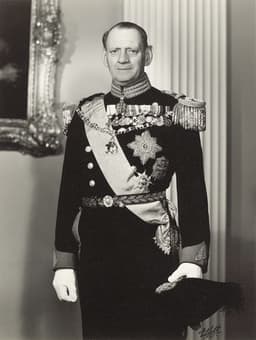
Frederik IX of Denmark
Emperor · Modern
51.7Total
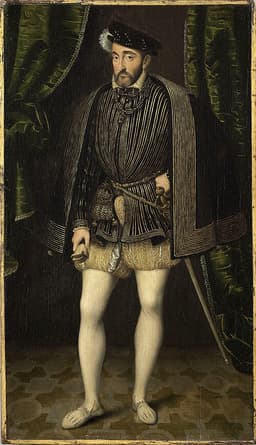
Henry II of France
Emperor · Modern
55.5Total
Basic Information
Born
1899
1519
Died
1972
1559
Era
Modern
Modern
Nationality
Denmark
France
Occupation
Emperor
Emperor
Civilization
Western
Western
Score Comparison
Military (10%)
25.6
45.0
Political (20%)
62.7
68.0
Influence (20%)
51.8
60.0
Legacy (20%)
40.0
48.3
Leadership (15%)
72.0
53.2
Strategy (15%)
60.0
57.5
TOTAL
51.7
55.5
Frederik IX of Denmark — Complete Timeline
1947 AD
Accession to the thronePolitical Action◆ Major
Frederik IX became King of Denmark on April 20, 1947, following the death of his father, Christian X. His reign oversaw the post-war reconstruction and modernization of Denmark.
AccessionSuccession
Impact: national
1949 AD
Support for NATO membershipPolitical Action◆ Major
Frederik IX supported Denmark's accession to NATO in 1949, aligning the country with Western powers during the Cold War. This marked a shift from Denmark's traditional neutrality.
NATOCold WarForeign Policy
Impact: regionalconstructive
1953 AD
Signing of the 1953 constitutionReform◆ Major
Frederik IX signed a new constitution in 1953 that abolished the upper house (Landsting), introduced a unicameral parliament (Folketing), and allowed female succession to the throne. This modernized the Danish political system.
Constitutional ReformUnicameralismFemale Succession
Impact: nationalprogressive
1960 AD
Modernization of the Danish welfare stateReform◆ Major
During Frederik IX's reign, Denmark expanded its welfare state, including the introduction of universal healthcare, old-age pensions, and social security. These reforms were part of the post-war social democratic consensus.
Welfare StateSocial ReformHealthcare
Impact: nationalconstructive
1972 AD
Death and succession of Margrethe IIPolitical Action◆ Major
Frederik IX died on January 14, 1972, and was succeeded by his daughter, Margrethe II, who became Denmark's first reigning queen in centuries. His death marked the end of an era of post-war reconstruction.
DeathSuccessionMargrethe II
Impact: national
Henry II of France — Complete Timeline
1557 AD
Battle of St. QuentinWar◆ Major
Henry II's French army was decisively defeated by Spanish forces under Emmanuel Philibert of Savoy at St. Quentin. The defeat forced Henry to negotiate the Treaty of Cateau-Cambr
Italian WarsBattleDefeat
Impact: regionaldestructive
1559 AD
Treaty of Cateau-CambrésisPolitical Action◆ Major
Henry II signed the Treaty of Cateau-Cambr
TreatyItalian WarsPeace
Impact: regional
Death in a jousting accidentOther◆ Major
Henry II was mortally wounded during a jousting tournament held to celebrate the Treaty of Cateau-Cambr
DeathAccidentSuccession Crisis
Impact: nationaltragic
Expert Analysis
Origins
Frederik IX of Denmark was born on March 11, 1899, into the Danish royal family, the eldest son of King Christian X and Queen Alexandrine. His upbringing was steeped in tradition, but he developed a passion for the sea, serving in the Royal Danish Navy and earning the nickname 'Sailor King.' He attended the Royal Danish Naval Academy and later studied at the University of Copenhagen, though his education was cut short by his duties. Henry II of France was born on March 31, 1519, at the Château de Saint-Germain-en-Laye, the son of King Francis I and Claude of France. His early years were marked by captivity in Spain as a hostage following his father's defeat at Pavia. This experience shaped his distrust of the Habsburgs. He was educated in the arts of war and governance, and his marriage to Catherine de' Medici brought Italian influence to the French court.
Rise to Power
Frederik IX ascended the throne on April 20, 1947, after the death of his father. His reign began during post-World War II reconstruction, and he quickly became a symbol of national unity. He had no formal political power but exerted influence through his constitutional role. His support for NATO membership in 1949 marked a shift from Denmark's neutral stance. Henry II became king on March 31, 1547, upon his father's death. He continued the Italian Wars against the Habsburgs, capturing Metz and Toul in 1552. His rise was marked by his rivalry with Holy Roman Emperor Charles V and later Philip II of Spain. The Treaty of Cateau-Cambrésis in 1559 ended the wars, with France renouncing claims to Italy.
Leadership & Governance
Frederik IX's leadership was characterized by his constitutional monarchy role. He signed the 1953 constitution, which abolished the upper house and allowed female succession, paving the way for his daughter Margrethe II. He supported the expansion of the welfare state, including universal healthcare and pensions. His political score of 62.7 reflects his effective navigation of modern democratic governance. Henry II ruled as an absolute monarch, centralizing power and continuing his father's policies. He intensified persecution of Huguenots, using the Edict of Châteaubriant (1551) and the Edict of Compiègne (1557). His political score of 68.0 reflects his strong control but also his costly wars. His military score of 45.0 is higher than Frederik's 25.6, but his strategy score of 57.5 barely exceeds Frederik's 60.0.
Triumph & Tragedy
Frederik IX's greatest success was the modernization of Denmark's political system and welfare state. The 1953 constitution and NATO membership secured Denmark's place in the Western alliance. His tragedy was his inability to prevent the Cold War tensions; Denmark remained a small power. His legacy score of 40.0 is modest. Henry II's triumph was the Treaty of Cateau-Cambrésis, which brought peace but at the cost of Italian ambitions. His tragedy was his death: a jousting accident on June 30, 1559, when a lance pierced his eye, leading to infection and death. This left France with a weak regency under Catherine de' Medici. His influence score of 60.0 reflects his role in European power struggles.
Character & Destiny
Frederik IX was known for his informal, approachable demeanor, often seen in public without guards. His love for the sea and jazz music made him a popular figure. His character shaped a stable, modern monarchy. Henry II was stern, influenced by his mistress Diane de Poitiers, and driven by revenge against the Habsburgs. His obsession with chivalry led to his fatal joust. Historians note his inflexibility and poor health decisions. Frederik's leadership score of 72.0 is higher than Henry's 53.2, indicating his effectiveness in a constrained role.
Legacy
Frederik IX's legacy is the modern Danish monarchy: constitutional, inclusive, and socially progressive. His daughter Margrethe II became a beloved queen. Denmark's welfare state and NATO alignment endure. Henry II's legacy is mixed: he ended the Italian Wars but left France in debt and religious turmoil. His persecution of Protestants contributed to the French Wars of Religion. His total score of 55.5 exceeds Frederik's 51.7, but this is due to military and influence metrics. Frederik's impact on Danish society is more profound within his sphere.
Conclusion
While Henry II of France scored higher overall (55.5 vs 51.7), Frederik IX's impact on Denmark's modern identity is greater. Henry's wars and death weakened France, while Frederik's reforms strengthened Denmark. Frederik's political and leadership scores (62.7 and 72.0) surpass Henry's (68.0 and 53.2) in meaningful governance. In terms of lasting positive change, Frederik IX had greater impact. Henry's legacy is overshadowed by his accidental death and religious strife.
Rankings
🥇
Henry II of FranceLeader
Mil: 45.0Pol: 68.0Inf: 60.0
55.5
🥈
Frederik IX of Denmark
Mil: 25.6Pol: 62.7Inf: 51.8
51.7
+3.8 behind
How This Comparison Works
Algorithm
Each figure is scored on 6 dimensions (0—100 scale) based on structured historical data: Military (10%), Political (20%), Influence (20%), Legacy (20%), Leadership (15%), Strategy (15%). The weighted total produces the final ranking.
Data Sources
Scores are computed from structured sub-indicators in the database. Scale factors adjust for era (Ancient ×0.85, Modern ×1.0) and civilization size (Eastern ×1.05, Other ×0.80) to account for differences in population and military scale.
Maximum 3 Figures
Comparisons are limited to 2—3 figures to ensure readability and statistical meaningfulness.
Error Margins
±5 points per dimension — Sub-scores are derived from historical records with inherent uncertainty. Two figures within 5 points on a dimension should be considered roughly equivalent in that area.
Total Score Accuracy
±3 points overall — The weighted combination of 6 dimensions produces a total score with approximately ±3 points of uncertainty. Differences of less than 3 points are not statistically significant— the figures are effectively tied.
Known Limitations
- Historical records are incomplete and uneven across civilizations
- Figures from oral-tradition societies may be underrepresented
- Occupation labels can misclassify multi-role figures
- Scores measure capability and impact, not moral character
- Quantitative scoring is a comparison tool, not absolute truth
Capability Radar
Military (10%) — Battles & Warfare
Battles
35
55
Win Rate
38
45
Expansion
42
50
Political (20%) — Governance & Reform
Reform
55
45
Diplomacy
50
55
Economy
50
50
Influence (20%) — Cultural & Global Reach
Cultural
30
45
Global
20
45
Legacy (20%) — Historical Impact
Historical
30
50
Longevity
20
40
Leadership (15%) — Power & Stability
Tenure
60
60
Stability
65
40
Strategy (15%) — Tactics & Innovation
Strategy
42
55
Tactics
49
50
Reform
51
40
Similar Comparisons
Comments & Discussion
No comments yet. Be the first to share your thoughts!