Loading...
Henry II of France vs Mutaga IV
Henry II of France leads by 14.5 pts · 2 figures compared
…
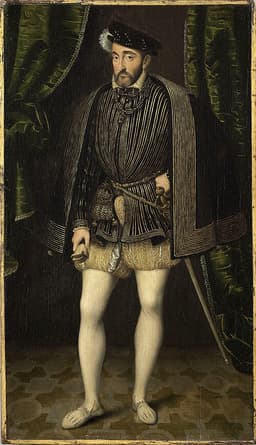
Henry II of France
Emperor · Modern
55.5Total

Mutaga IV
Emperor · Modern
41.0Total
Basic Information
Born
1519
1880
Died
1559
1915
Era
Modern
Modern
Nationality
France
Burundi
Occupation
Emperor
Emperor
Civilization
Western
Other
Score Comparison
Military (10%)
45.0
20.0
Political (20%)
68.0
29.3
Influence (20%)
60.0
47.9
Legacy (20%)
48.3
37.5
Leadership (15%)
53.2
51.9
Strategy (15%)
57.5
54.3
TOTAL
55.5
41.0
Henry II of France — Complete Timeline
1557 AD
Battle of St. QuentinWar◆ Major
Henry II's French army was decisively defeated by Spanish forces under Emmanuel Philibert of Savoy at St. Quentin. The defeat forced Henry to negotiate the Treaty of Cateau-Cambr
Italian WarsBattleDefeat
Impact: regionaldestructive
1559 AD
Treaty of Cateau-CambrésisPolitical Action◆ Major
Henry II signed the Treaty of Cateau-Cambr
TreatyItalian WarsPeace
Impact: regional
Death in a jousting accidentOther◆ Major
Henry II was mortally wounded during a jousting tournament held to celebrate the Treaty of Cateau-Cambr
DeathAccidentSuccession Crisis
Impact: nationaltragic
Mutaga IV — Complete Timeline
1908 AD
Ascended to the throne under German colonial administrationPolitical Action◆ Major
Mutaga IV became mwami of Burundi after the death of his father Mwezi IV Gisabo, but his rule was heavily circumscribed by German colonial authorities. He was installed with German approval and governed under the supervision of German residents, limiting his autonomy.
SuccessionColonial RuleMonarchy
Impact: regional
1910 AD
Implemented German administrative reformsReform◆ Major
Mutaga IV cooperated with German officials to implement administrative reforms, including the establishment of a centralized tax system and the appointment of chiefs loyal to the colonial administration. These reforms weakened traditional clan structures and integrated Burundi into the German colonial economy.
Colonial ReformAdministrationTaxation
Impact: regionaldestructive
1915 AD
Died under mysterious circumstancesPolitical Action◆ Major
Mutaga IV died suddenly at the age of 35, with some accounts suggesting he was poisoned by rivals within the royal court or by colonial agents. His death created a succession crisis, as his son was a minor, leading to a regency that further weakened the monarchy.
DeathSuccession CrisisRumor
Impact: regionaltragic
1916 AD
Ruled during the transition from German to Belgian rulePolitical Action◆ Major
During World War I, Belgian forces from the Congo invaded and occupied German East Africa, including Burundi. Mutaga IV remained on the throne under Belgian military occupation, as the territory was placed under Belgian administration by the League of Nations mandate in 1922.
World War IBelgian RuleOccupation
Impact: regional
Expert Analysis
Origins
Henry II of France was born in 1519 at the Château de Saint-Germain-en-Laye, the second son of King Francis I and Claude of France. His upbringing was shaped by the Italian Wars—his father was captured at the Battle of Pavia in 1525, and Henry spent four years as a hostage in Spain (1526–1530). This experience instilled a deep hostility toward the Habsburgs. He married Catherine de' Medici in 1533, a political alliance that brought Italian influence to the French court.
Mutaga IV was born around 1892 in Burundi, the son of Mwezi IV Gisabo, the mwami (king) who had resisted German colonization. Mutaga's early life coincided with the German conquest of Burundi (1896–1903). He was educated in traditional Burundian customs but also exposed to German colonial administration after his father's submission in 1903. His background was one of diminished sovereignty, as the mwami's authority became subject to German oversight.
Rise to Power
Henry II became Dauphin of France in 1536 after the death of his older brother Francis. He ascended the throne in 1547 upon his father's death. His reign was dominated by the continuation of the Italian Wars against the Habsburgs. He allied with German Protestant princes and the Ottoman Empire to counter Charles V and later Philip II of Spain. Key turning points included the capture of Metz in 1552 and the Battle of Renty in 1554, where French forces held their own. However, his military campaigns were costly and ultimately inconclusive.
Mutaga IV became mwami in 1908 after his father's death, but his accession was controlled by German colonial authorities. He was installed with German approval, and his rule was a tool of indirect rule. He rose to power not through military conquest but through colonial endorsement. His authority was limited: German officials made key decisions, and Mutaga's role was to implement their policies, such as tax collection and labor recruitment.
Leadership & Governance
Henry II centralized royal authority, continuing his father's policies. He created the 'Chambre Ardente' to prosecute heresy, intensifying religious persecution against Protestants. He also reformed the tax system and strengthened the bureaucracy. However, his governance was marked by inconsistency: he relied heavily on favorites like the Constable Anne de Montmorency and the Guise family, leading to factionalism. His military leadership scored 45.0, reflecting his inability to achieve decisive victories. The Treaty of Cateau-Cambrésis in 1559 ended the Italian Wars with France renouncing claims to Italy, a strategic failure that scored 57.5 in strategy.
Mutaga IV ruled as a colonial puppet. He implemented German administrative reforms, including a centralized tax system and the appointment of chiefs loyal to the colonial power. His leadership score of 51.9 reflects his ability to maintain his position under foreign domination, but his political score of 29.3 indicates his limited autonomy. He cooperated with German and later Belgian authorities, which preserved the monarchy but undermined traditional institutions. His governance was more about survival than innovation.
Triumph & Tragedy
Henry II's greatest triumph was the capture of Metz, Toul, and Verdun in 1552, securing the 'Three Bishoprics' for France. These territories remained French for centuries. His greatest tragedy was his death in a jousting accident in 1559, at age 40. A lance fragment pierced his eye and entered his brain, causing a slow death. This accident plunged France into a period of weak regency under Catherine de' Medici, leading to the Wars of Religion. His failure to secure a lasting peace or a strong succession was a major failure.
Mutaga IV's triumph was maintaining the Burundian monarchy through a turbulent period of colonial transition. He remained on the throne during World War I when Belgian forces replaced German rule. His tragedy was his mysterious death at age 35, possibly poisoned by rivals or colonial agents. He left no strong successor, and his reign saw the erosion of traditional authority. His legacy score of 37.5 reflects the limited impact of his rule.
Character & Destiny
Henry II was known for his stubbornness and passion for jousting, which directly caused his death. He was a devoted husband to Catherine de' Medici but had a powerful mistress, Diane de Poitiers. His character was shaped by his captivity in Spain: he emerged with a deep hatred for the Habsburgs, which drove his foreign policy. This obsession led to costly wars and ultimately a peace that abandoned his Italian ambitions. Historians assess him as a capable but unlucky ruler, with a total score of 55.5.
Mutaga IV was a figurehead, with little room to exercise personal agency. His character was likely pragmatic, cooperating with colonial powers to survive. However, his mysterious death suggests he may have attempted to assert independence, provoking a backlash. His total score of 41.0 reflects his constrained circumstances and limited achievements.
Legacy
Henry II's legacy is mixed. He is remembered for the Treaty of Cateau-Cambrésis, which ended decades of war, and for the acquisition of the Three Bishoprics. However, his death triggered the French Wars of Religion, which devastated France. His influence score of 60.0 reflects his role in shaping French foreign policy, but his legacy score of 48.3 indicates that his achievements were overshadowed by the chaos that followed.
Mutaga IV's legacy is that of a colonial intermediary. He is remembered in Burundi as a king who preserved the monarchy under difficult conditions, but his cooperation with colonial powers is criticized. The transition from German to Belgian rule under his reign set the stage for later ethnic divisions. His influence score of 47.9 and legacy score of 37.5 show that his impact was limited and largely negative.
Conclusion
Henry II of France had a greater impact than Mutaga IV, with a total score of 55.5 versus 41.0. Henry's actions shaped European geopolitics: his wars and the subsequent peace treaty affected the balance of power for decades. Mutaga IV, by contrast, was a passive figure whose reign was defined by external forces. While Henry II's legacy is flawed, his influence on French history and the Italian Wars is significant. Mutaga IV's rule was largely symbolic. Therefore, Henry II is the more consequential historical figure.
Rankings
🥇
Henry II of FranceLeader
Mil: 45.0Pol: 68.0Inf: 60.0
55.5
🥈
Mutaga IV
Mil: 20.0Pol: 29.3Inf: 47.9
41.0
+14.5 behind
How This Comparison Works
Algorithm
Each figure is scored on 6 dimensions (0—100 scale) based on structured historical data: Military (10%), Political (20%), Influence (20%), Legacy (20%), Leadership (15%), Strategy (15%). The weighted total produces the final ranking.
Data Sources
Scores are computed from structured sub-indicators in the database. Scale factors adjust for era (Ancient ×0.85, Modern ×1.0) and civilization size (Eastern ×1.05, Other ×0.80) to account for differences in population and military scale.
Maximum 3 Figures
Comparisons are limited to 2—3 figures to ensure readability and statistical meaningfulness.
Error Margins
±5 points per dimension — Sub-scores are derived from historical records with inherent uncertainty. Two figures within 5 points on a dimension should be considered roughly equivalent in that area.
Total Score Accuracy
±3 points overall — The weighted combination of 6 dimensions produces a total score with approximately ±3 points of uncertainty. Differences of less than 3 points are not statistically significant— the figures are effectively tied.
Known Limitations
- Historical records are incomplete and uneven across civilizations
- Figures from oral-tradition societies may be underrepresented
- Occupation labels can misclassify multi-role figures
- Scores measure capability and impact, not moral character
- Quantitative scoring is a comparison tool, not absolute truth
Capability Radar
Military (10%) — Battles & Warfare
Battles
55
5
Win Rate
45
5
Expansion
50
5
Political (20%) — Governance & Reform
Reform
45
10
Diplomacy
55
20
Economy
50
10
Influence (20%) — Cultural & Global Reach
Cultural
45
10
Global
45
5
Legacy (20%) — Historical Impact
Historical
50
15
Longevity
40
10
Leadership (15%) — Power & Stability
Tenure
60
30
Stability
40
15
Strategy (15%) — Tactics & Innovation
Strategy
55
5
Tactics
50
5
Reform
40
5
Similar Comparisons
Comments & Discussion
No comments yet. Be the first to share your thoughts!