Loading...
Henry Pelham vs Julius Caesar
Julius Caesar leads by 24.6 pts · 2 figures compared
…
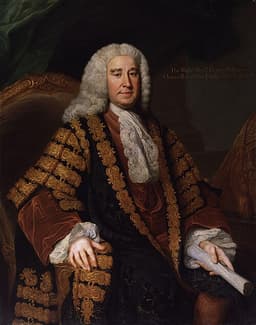
Henry Pelham
Politician · Modern
58.2Total

Julius Caesar
General · Ancient
82.8Total
Basic Information
Born
1694
-100
Died
1754
-44
Era
Modern
Ancient
Nationality
Great Britain
Roman Republic
Occupation
Politician
General
Civilization
Western
Western
Score Comparison
Military (10%)
49.9
88.0
Political (20%)
70.0
78.0
Influence (20%)
57.2
85.0
Legacy (20%)
49.2
82.0
Leadership (15%)
78.0
80.0
Strategy (15%)
43.9
85.0
TOTAL
58.2
82.8
Henry Pelham — Complete Timeline
1744 AD
Management of the War of the Austrian SuccessionWar◆ Major
As Prime Minister, Pelham directed British military and financial support for the Pragmatic Sanction, funding campaigns in Europe and North America. The war ended with the Treaty of Aix-la-Chapelle in 1748, which returned Louisbourg to France, a decision criticized in Britain.
WarDiplomacyTreaty
Impact: global
1749 AD
Consolidation of the British National DebtReform◆ Major
As Prime Minister, Pelham oversaw the reduction of the interest rate on the British national debt from 4% to 3%, saving the government
FinanceDebt ManagementEconomic Reform
Impact: nationalconstructive
1753 AD
Passage of the Jew Bill of 1753Political Action
Pelham's government passed the Jewish Naturalization Act, allowing foreign-born Jews to become British subjects. Widespread public opposition forced its repeal the following year, damaging Pelham's political standing.
LegislationReligious ToleranceRepeal
Impact: nationalprogressive
Julius Caesar — Complete Timeline
58 BC
Gallic WarsWar◆ Major
Caesar, as proconsul of Gaul, launched a series of campaigns that conquered all of Gaul (modern France, Belgium, and parts of Switzerland). He fought numerous battles, including against the Helvetii, the Belgae, and the Gallic chieftain Vercingetorix. The wars brought immense wealth and a loyal army to Caesar.
Gallic WarsConquestRoman Expansion
Impact: regional
49 BC
Crossing the RubiconPolitical Action◆ Major
Caesar led Legio XIII across the Rubicon River into Italy, defying the Roman Senate's order to disband his army. This act triggered a civil war against Pompey and the Optimates, ultimately leading to Caesar's dictatorship and the end of the Roman Republic.
Roman Civil WarEnd of RepublicPower Struggle
Impact: global
48 BC
Battle of PharsalusWar◆ Major
Caesar's outnumbered army defeated the larger forces of Pompey the Great at Pharsalus in Greece. Caesar's tactical use of a reserve line to counter Pompey's cavalry charge proved decisive. Pompey fled to Egypt, where he was assassinated, leaving Caesar as the undisputed master of the Roman world.
Roman Civil WarBattleDecisive Victory
Impact: regional
44 BC
Appointment as Dictator for LifePolitical Action◆ Major
The Roman Senate appointed Caesar dictator perpetuo (dictator for life), granting him unprecedented personal power. This move concentrated military, legislative, and judicial authority in one person, effectively ending the Roman Republic's traditional system of checks and balances and alarming many senators.
DictatorshipEnd of RepublicPower Consolidation
Impact: regionaldestructive
Assassination on the Ides of MarchPolitical Action◆ Major
A group of Roman senators, led by Marcus Junius Brutus and Gaius Cassius Longinus, stabbed Caesar to death at a meeting of the Senate in the Theatre of Pompey. The assassination was intended to restore the Republic, but instead triggered another civil war that led to the rise of the Roman Empire.
AssassinationRoman PoliticsEnd of Republic
Impact: globaldestructive
Expert Analysis
henry-pelham-vs-julius-caesar
# The Conqueror and the Accountant
On a March morning in 44 BCE, Julius Caesar fell beneath twenty-three dagger strokes in the Senate chamber of Rome. The most powerful man in the Western world died bleeding on marble, his blood mixing with the dust of a Republic he had strangled and a Empire he had birthed. Just over seventeen centuries later, in 1754, Henry Pelham died quietly in his bed at Arlington Street, London, a Prime Minister who had never commanded an army, never crossed a forbidden river, never been called a tyrant or a god. One life ended in spectacular violence, the other in quiet domesticity. Yet both men shaped the destiny of nations. The question is not merely who was greater, but why the paths of power diverge so dramatically—and what that tells us about the nature of leadership itself.
Origins
Julius Caesar was born into the chaos of the late Roman Republic, a world of civil wars, senatorial corruption, and ambitious men who treated the state as a prize to be won. His family, the Julii, claimed descent from the goddess Venus, but they were not among Rome’s richest or most powerful. Caesar’s father died when he was sixteen, leaving him to navigate a treacherous political landscape where survival demanded audacity. He learned early that in Rome, glory was the currency of power, and glory came from war.
Henry Pelham, by contrast, was born in 1694 into the settled stability of post-Glorious Revolution England. His father was a baronet, his brother the Duke of Newcastle, and the family’s wealth came from land, not conquest. Pelham grew up in a world of parliamentary debates, Whig politics, and the careful management of estates. Where Caesar learned to wield a sword, Pelham learned to balance a ledger. One man’s training ground was the battlefield; the other’s was the Treasury.
Rise to Power
Caesar’s ascent was meteoric and ruthless. He climbed the Roman political ladder—the *cursus honorum*—with calculated speed, borrowing vast sums to fund public spectacles that bought him popularity. His real leap came when he secured command of Gaul in 58 BCE. Over eight years, he conquered a territory larger than Italy itself, slaughtering perhaps a million people and enslaving another million. The Gallic Wars made him a legend, but they also made him a threat. When the Senate ordered him to disband his army, Caesar instead crossed the Rubicon River in 49 BCE, igniting a civil war that ended with him as dictator.
Pelham’s rise was quieter but no less skillful. He entered Parliament in 1717, served as Secretary at War and Paymaster of the Forces, and became Prime Minister in 1743 after the fall of the Carteret ministry. His power came not from conquest but from coalition-building, from managing the delicate balance of Whig factions, and from the trust of King George II. Where Caesar seized power, Pelham was entrusted with it.
Leadership & Governance
Their styles of rule could not have been more different. Caesar was a military genius—his score of 88 in military strategy reflects campaigns that are still studied in war colleges today. He fought in Germany, Britain, and Egypt, winning battles against overwhelming odds through speed, discipline, and personal courage. He led from the front, sharing the hardships of his soldiers, and his *Commentaries on the Gallic War* remain a masterpiece of propaganda and self-fashioning.
But Caesar was also a reformer. As dictator, he overhauled the Roman calendar (giving us the Julian calendar), granted citizenship to provincials, initiated public works projects, and restructured debt laws. His political score of 78, while lower than his military rating, understates his impact: he destroyed the Republic, but he also laid the foundations for the imperial system that would endure for centuries.
Pelham, by contrast, never led an army. His military score of 37.5 reflects a man who managed war from London rather than fighting it. But his political and leadership scores—66.6 and 84.2 respectively—tell a different story. Pelham’s great achievement was the consolidation of the British national debt in 1749. After the expensive War of the Austrian Succession (1740–1748), he reduced the interest rate from 4% to 3%, saving the government hundreds of thousands of pounds annually and stabilizing British finances for generations. It was not glamorous work, but it was transformative. A nation’s credit, Pelham understood, was as vital as an army.
Triumph & Tragedy
Caesar’s greatest triumph was his conquest of Gaul, a feat that made Rome the undisputed master of the Mediterranean world. His greatest tragedy was his assassination on the Ides of March, 44 BCE, at the hands of men he had pardoned and promoted. He had centralized too much power, humiliated too many senators, and made himself too obviously a king in all but name. His murder did not restore the Republic—it plunged Rome into another civil war—but it revealed the fatal flaw in his ambition: he could conquer the world, but he could not conquer the distrust of his peers.
Pelham’s triumph was quieter: the passage of the Jew Bill of 1753, which allowed foreign-born Jews to become British subjects. It was a reform driven by economic pragmatism and Enlightenment principles, but it provoked a furious backlash. Opponents accused Pelham of betraying Christianity, and the bill was repealed the following year. Pelham died in 1754, before he could see his broader financial reforms bear fruit. His tragedy was that he was a competent administrator in an age that remembered only conquerors.
Character & Destiny
Caesar was driven by an insatiable hunger for glory. He wrote of himself in the third person, cultivated an image of divine favor, and pushed relentlessly against every limit. His personality—arrogant, generous to allies, merciless to enemies, and utterly convinced of his own destiny—shaped every decision he made. He pardoned his enemies because he believed he was above petty revenge; he crossed the Rubicon because he could not imagine submitting to the Senate’s will. That same personality made his assassination inevitable.
Pelham was driven by duty and caution. He was not a visionary or a revolutionary; he was a manager who believed in stability, compromise, and the slow accumulation of good governance. His nickname was “the quiet man,” and he avoided confrontation whenever possible. His personality—patient, methodical, unglamorous—shaped a different kind of legacy: not the transformation of the world, but the preservation of a system.
Legacy
Caesar’s legacy is immeasurable. His name became synonymous with imperial power—*Kaiser* in German, *Tsar* in Russian. His military tactics are still taught. His reforms outlasted his murder. The Roman Empire, which he did not live to see, was his creation. His score of 82 in legacy reflects a man who changed the course of Western civilization.
Pelham’s legacy is more modest but no less real. His financial reforms helped make Britain the world’s leading economic power in the eighteenth century. The stable debt market he created financed the wars that built the British Empire. His score of 67.7 in legacy reflects a man who worked in the background, but whose work made possible the achievements of more famous men.
Conclusion
What separates the conqueror from the accountant is not talent—both were brilliant in their domains—but the nature of the world they inhabited. Caesar lived in an age when power was won by the sword, when a single man could remake a civilization through force of will. Pelham lived in an age when power was won by persuasion, when the greatest victories were won in committee rooms and Treasury ledgers. Caesar’s violence made him memorable; Pelham’s competence made him effective.
Perhaps the deepest lesson is this: greatness is not a single quality but a relationship between a person and their time. Caesar would have been lost in Pelham’s Parliament; Pelham would have been devoured in Caesar’s Senate. Each man played the hand history dealt him, and each left the world different from how he found it. The conqueror died on marble, remembered forever. The accountant died in bed, almost forgotten. But the empires they built—one of iron, one of credit—endure still.
Rankings
🥇
Julius CaesarLeader
Mil: 88.0Pol: 78.0Inf: 85.0
82.8
🥈
Henry Pelham
Mil: 49.9Pol: 70.0Inf: 57.2
58.2
+24.6 behind
How This Comparison Works
Algorithm
Each figure is scored on 6 dimensions (0—100 scale) based on structured historical data: Military (10%), Political (20%), Influence (20%), Legacy (20%), Leadership (15%), Strategy (15%). The weighted total produces the final ranking.
Data Sources
Scores are computed from structured sub-indicators in the database. Scale factors adjust for era (Ancient ×0.85, Modern ×1.0) and civilization size (Eastern ×1.05, Other ×0.80) to account for differences in population and military scale.
Maximum 3 Figures
Comparisons are limited to 2—3 figures to ensure readability and statistical meaningfulness.
Error Margins
±5 points per dimension — Sub-scores are derived from historical records with inherent uncertainty. Two figures within 5 points on a dimension should be considered roughly equivalent in that area.
Total Score Accuracy
±3 points overall — The weighted combination of 6 dimensions produces a total score with approximately ±3 points of uncertainty. Differences of less than 3 points are not statistically significant— the figures are effectively tied.
Known Limitations
- Historical records are incomplete and uneven across civilizations
- Figures from oral-tradition societies may be underrepresented
- Occupation labels can misclassify multi-role figures
- Scores measure capability and impact, not moral character
- Quantitative scoring is a comparison tool, not absolute truth
Capability Radar
Military (10%) — Battles & Warfare
Battles
29
95
Win Rate
34
92
Expansion
32
97
Political (20%) — Governance & Reform
Reform
70
90
Diplomacy
60
85
Economy
85
82
Influence (20%) — Cultural & Global Reach
Cultural
30
88
Global
45
94
Legacy (20%) — Historical Impact
Historical
55
95
Longevity
40
96
Leadership (15%) — Power & Stability
Tenure
65
75
Stability
75
60
Strategy (15%) — Tactics & Innovation
Strategy
39
94
Tactics
42
96
Reform
46
88
Similar Comparisons
Comments & Discussion
No comments yet. Be the first to share your thoughts!