Loading...
Henry Pelham vs Qiying
Henry Pelham leads by 18.2 pts · 2 figures compared
…
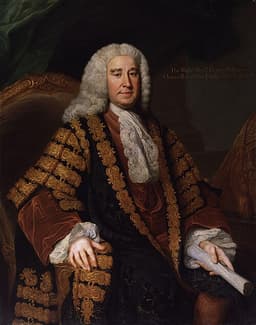
Henry Pelham
Politician · Modern
58.2Total

Qiying
Politician · Modern
40.0Total
Basic Information
Born
1694
1787
Died
1754
1858
Era
Modern
Modern
Nationality
Great Britain
China
Occupation
Politician
Politician
Civilization
Western
Eastern
Score Comparison
Military (10%)
49.9
23.5
Political (20%)
70.0
25.0
Influence (20%)
57.2
50.2
Legacy (20%)
49.2
41.7
Leadership (15%)
78.0
55.3
Strategy (15%)
43.9
26.5
TOTAL
58.2
40.0
Henry Pelham — Complete Timeline
1744 AD
Management of the War of the Austrian SuccessionWar◆ Major
As Prime Minister, Pelham directed British military and financial support for the Pragmatic Sanction, funding campaigns in Europe and North America. The war ended with the Treaty of Aix-la-Chapelle in 1748, which returned Louisbourg to France, a decision criticized in Britain.
WarDiplomacyTreaty
Impact: global
1749 AD
Consolidation of the British National DebtReform◆ Major
As Prime Minister, Pelham oversaw the reduction of the interest rate on the British national debt from 4% to 3%, saving the government
FinanceDebt ManagementEconomic Reform
Impact: nationalconstructive
1753 AD
Passage of the Jew Bill of 1753Political Action
Pelham's government passed the Jewish Naturalization Act, allowing foreign-born Jews to become British subjects. Widespread public opposition forced its repeal the following year, damaging Pelham's political standing.
LegislationReligious ToleranceRepeal
Impact: nationalprogressive
Qiying — Complete Timeline
1842 AD
Negotiation of the Treaty of NanjingPolitical Action
Qiying, as Qing plenipotentiary, negotiated and signed the Treaty of Nanjing with Britain, ending the First Opium War. The treaty ceded Hong Kong, opened five treaty ports, and imposed an indemnity, marking the start of the unequal treaty system.
Opium WarTreatyDiplomacy
Impact: globaltragic
1844 AD
Negotiation of the Treaty of WanghiaPolitical Action◆ Major
Qiying negotiated the Treaty of Wanghia with the United States, granting Americans extraterritoriality and most-favored-nation status. This further eroded Qing sovereignty and set a precedent for other Western powers.
TreatyDiplomacyExtraterritoriality
Impact: globaltragic
1858 AD
Execution by the Qing CourtPolitical Action
Qiying was executed by the Qing court for his failure to negotiate effectively with the British during the Second Opium War. His death reflected the court's dissatisfaction with his handling of foreign affairs.
ExecutionOpium WarScapegoat
Impact: nationaltragic
Expert Analysis
Origins
Henry Pelham was born in 1694 into the English aristocracy, the younger son of Sir Thomas Pelham, 1st Baronet. He was educated at Westminster School and Hart Hall, Oxford, though he left without a degree. His early political career was shaped by his family's Whig connections, and he entered Parliament in 1717. Pelham's formative experiences included serving as a junior minister under Robert Walpole, learning the intricacies of fiscal policy and patronage.
Qiying, born in 1787 into the Manchu ruling class of the Qing dynasty, was a member of the Aisin Gioro clan. He passed the imperial examinations and served in various administrative posts, including governor of Henan and Jiangsu. His early career was marked by competence in managing local affairs, but he lacked experience in foreign relations, which would prove critical. By the 1840s, he was a senior official in the Qing court, trusted with delicate negotiations.
Rise to Power
Pelham rose steadily through the Whig ranks, serving as Paymaster of the Forces from 1730 to 1743, where he gained a reputation for financial probity. In 1743, after the fall of the Carteret ministry, Pelham became First Lord of the Treasury and effectively Prime Minister. His rise was aided by his brother, the Duke of Newcastle, who managed political patronage. A key turning point was the 1745 Jacobite rising, which Pelham handled with fiscal restraint, avoiding excessive borrowing.
Qiying's rise culminated in his appointment as Imperial Commissioner and plenipotentiary in 1842, tasked with ending the First Opium War. He was chosen for his diplomatic skills and willingness to compromise, unlike his predecessor Lin Zexu. His negotiation of the Treaty of Nanjing in August 1842 made him the face of Qing capitulation, opening five ports and ceding Hong Kong. This event defined his career and his subsequent fall.
Leadership & Governance
Pelham's leadership style was pragmatic and conciliatory. He focused on fiscal stability, reducing the national debt interest from 4% to 3%, saving £1.2 million annually. He managed the War of the Austrian Succession by funding allies rather than committing large British forces, a strategy that scored 43.9 in strategy. His governance emphasized parliamentary consensus, avoiding the confrontational approach of predecessors. Pelham's political score of 70.0 reflects his ability to maintain power for a decade.
Qiying's governance was reactive and concessionary. He believed in accommodating foreign demands to preserve the dynasty, signing treaties that granted extraterritoriality and most-favored-nation status to Western powers. His leadership score of 55.3 is undermined by his inability to strengthen China's position. The Treaty of Wanghia (1844) with the US further eroded sovereignty. Qiying's approach lacked long-term strategy, scoring only 26.5 in that category.
Triumph & Tragedy
Pelham's greatest triumph was the consolidation of the national debt, which stabilized British finances and allowed for future economic growth. He also managed to keep Britain out of major continental entanglements. However, his failure to secure a decisive victory in the War of the Austrian Succession led to the Treaty of Aix-la-Chapelle (1748), which many saw as inconclusive. His Jew Bill of 1753, intended to liberalize naturalization, was repealed after public outcry, a political misstep.
Qiying's triumph was ending the First Opium War, which prevented further military disaster. However, the treaties he signed created long-term humiliation and economic exploitation. His greatest tragedy was his execution in 1858 by the Qing court for failing to prevent the Second Opium War. The court blamed him for diplomatic weakness, though he was a scapegoat for systemic decay. His legacy score of 41.7 reflects this mixed outcome.
Character & Destiny
Pelham was cautious, detail-oriented, and fiscally conservative. His character shaped his destiny as a steady administrator rather than a transformative leader. He died in office in 1754, having avoided major scandals. Historical assessments, such as those by John Brewer, note his competence in managing the fiscal-military state. His leadership score of 78.0 reflects his effectiveness in maintaining stability.
Qiying was pragmatic but weak-willed, prioritizing short-term peace over long-term strength. His willingness to concede to foreign demands made him useful to the Qing court during crisis but also made him a target when those concessions proved insufficient. His execution illustrates the brutal fate of officials who failed in the face of Western imperialism. Historians like John K. Fairbank have portrayed him as a tragic figure caught between an inflexible court and aggressive foreigners.
Legacy
Pelham's legacy is the foundation of Britain's financial supremacy in the 18th century. His debt consolidation model influenced later policies, such as those of William Pitt the Younger. He is remembered as a capable manager, though overshadowed by his brother Newcastle and later figures. His political score of 70.0 and influence of 57.2 reflect his moderate but lasting impact.
Qiying's legacy is synonymous with the unequal treaties that defined China's century of humiliation. The Treaty of Nanjing set a precedent for extraterritoriality and tariff controls that lasted until 1943. His name is often invoked as a symbol of diplomatic weakness. His influence score of 50.2 is tempered by the negative connotation. In China, he is not celebrated, but his actions accelerated the self-strengthening movement.
Conclusion
Henry Pelham had greater impact than Qiying, as measured by his total score of 58.2 versus 40.0. Pelham's fiscal reforms strengthened the British state, enabling its global expansion. Qiying's concessions weakened China, contributing to its decline. While Pelham's achievements were administrative and Qiying's were diplomatic, Pelham's positive contribution to his nation's power contrasts with Qiying's role in undermining sovereignty. The 18.2-point gap reflects the difference between a leader who built a stable fiscal system and one who presided over national humiliation.
Rankings
🥇
Henry PelhamLeader
Mil: 49.9Pol: 70.0Inf: 57.2
58.2
🥈
Qiying
Mil: 23.5Pol: 25.0Inf: 50.2
40.0
+18.2 behind
How This Comparison Works
Algorithm
Each figure is scored on 6 dimensions (0—100 scale) based on structured historical data: Military (10%), Political (20%), Influence (20%), Legacy (20%), Leadership (15%), Strategy (15%). The weighted total produces the final ranking.
Data Sources
Scores are computed from structured sub-indicators in the database. Scale factors adjust for era (Ancient ×0.85, Modern ×1.0) and civilization size (Eastern ×1.05, Other ×0.80) to account for differences in population and military scale.
Maximum 3 Figures
Comparisons are limited to 2—3 figures to ensure readability and statistical meaningfulness.
Error Margins
±5 points per dimension — Sub-scores are derived from historical records with inherent uncertainty. Two figures within 5 points on a dimension should be considered roughly equivalent in that area.
Total Score Accuracy
±3 points overall — The weighted combination of 6 dimensions produces a total score with approximately ±3 points of uncertainty. Differences of less than 3 points are not statistically significant— the figures are effectively tied.
Known Limitations
- Historical records are incomplete and uneven across civilizations
- Figures from oral-tradition societies may be underrepresented
- Occupation labels can misclassify multi-role figures
- Scores measure capability and impact, not moral character
- Quantitative scoring is a comparison tool, not absolute truth
Capability Radar
Military (10%) — Battles & Warfare
Battles
29
12
Win Rate
34
15
Expansion
32
18
Political (20%) — Governance & Reform
Reform
70
10
Diplomacy
60
20
Economy
85
10
Influence (20%) — Cultural & Global Reach
Cultural
30
10
Global
45
20
Legacy (20%) — Historical Impact
Historical
55
30
Longevity
40
20
Leadership (15%) — Power & Stability
Tenure
65
40
Stability
75
10
Strategy (15%) — Tactics & Innovation
Strategy
39
26
Tactics
42
25
Reform
46
31
Similar Comparisons
Comments & Discussion
No comments yet. Be the first to share your thoughts!