Loading...
Henry St John vs Julius Caesar
Julius Caesar leads by 25.2 pts · 2 figures compared
…
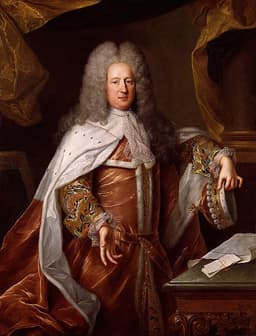
Henry St John
Politician · Modern
57.6Total

Julius Caesar
General · Ancient
82.8Total
Basic Information
Born
1678
-100
Died
1751
-44
Era
Modern
Ancient
Nationality
England
Roman Republic
Occupation
Politician
General
Civilization
Western
Western
Score Comparison
Military (10%)
50.0
88.0
Political (20%)
68.0
78.0
Influence (20%)
58.0
85.0
Legacy (20%)
50.0
82.0
Leadership (15%)
74.0
80.0
Strategy (15%)
42.9
85.0
TOTAL
57.6
82.8
Henry St John — Complete Timeline
1710 AD
Appointed Secretary of State and created Viscount BolingbrokePolitical Action◆ Major
Queen Anne appointed Henry St John as Secretary of State for the Northern Department and created him Viscount Bolingbroke. He became a leading Tory minister, responsible for foreign policy and the negotiation of the Treaty of Utrecht.
Secretary of StateToryQueen Anne
Impact: nationalconstructive
1715 AD
Fled to France and joined the Jacobite courtPolitical Action◆ Major
Fearing impeachment by the new Whig government, Bolingbroke fled to France. He became Secretary of State to the Jacobite pretender James Francis Edward Stuart, serving the exiled court and plotting the restoration of the Stuart monarchy.
ExileJacobiteStuart
Impact: nationaldestructive
1723 AD
Returned to England and pardonedPolitical Action
Bolingbroke was allowed to return to England after receiving a pardon from George I. He was barred from sitting in the House of Lords but remained politically active as a writer and pamphleteer, influencing the opposition to Walpole.
ReturnPardonPolitical writer
Impact: national
Julius Caesar — Complete Timeline
58 BC
Gallic WarsWar◆ Major
Caesar, as proconsul of Gaul, launched a series of campaigns that conquered all of Gaul (modern France, Belgium, and parts of Switzerland). He fought numerous battles, including against the Helvetii, the Belgae, and the Gallic chieftain Vercingetorix. The wars brought immense wealth and a loyal army to Caesar.
Gallic WarsConquestRoman Expansion
Impact: regional
49 BC
Crossing the RubiconPolitical Action◆ Major
Caesar led Legio XIII across the Rubicon River into Italy, defying the Roman Senate's order to disband his army. This act triggered a civil war against Pompey and the Optimates, ultimately leading to Caesar's dictatorship and the end of the Roman Republic.
Roman Civil WarEnd of RepublicPower Struggle
Impact: global
48 BC
Battle of PharsalusWar◆ Major
Caesar's outnumbered army defeated the larger forces of Pompey the Great at Pharsalus in Greece. Caesar's tactical use of a reserve line to counter Pompey's cavalry charge proved decisive. Pompey fled to Egypt, where he was assassinated, leaving Caesar as the undisputed master of the Roman world.
Roman Civil WarBattleDecisive Victory
Impact: regional
44 BC
Appointment as Dictator for LifePolitical Action◆ Major
The Roman Senate appointed Caesar dictator perpetuo (dictator for life), granting him unprecedented personal power. This move concentrated military, legislative, and judicial authority in one person, effectively ending the Roman Republic's traditional system of checks and balances and alarming many senators.
DictatorshipEnd of RepublicPower Consolidation
Impact: regionaldestructive
Assassination on the Ides of MarchPolitical Action◆ Major
A group of Roman senators, led by Marcus Junius Brutus and Gaius Cassius Longinus, stabbed Caesar to death at a meeting of the Senate in the Theatre of Pompey. The assassination was intended to restore the Republic, but instead triggered another civil war that led to the rise of the Roman Empire.
AssassinationRoman PoliticsEnd of Republic
Impact: globaldestructive
Expert Analysis
henry-st-john-vs-julius-caesar
# The Crossing and the Flight
On a January morning in 49 BCE, Julius Caesar stood at the banks of the Rubicon River, a small stream separating his province of Gaul from Italy proper. He knew that crossing meant civil war, the destruction of the Republic he had served, and almost certain death if he failed. He crossed anyway. Seventeen centuries later, on a March night in 1715, Henry St John, Viscount Bolingbroke, slipped across the English Channel in the opposite direction—fleeing his homeland, abandoning his political allies, and seeking refuge in the court of a deposed king. One man strode toward destiny; the other fled from ruin. What made the difference?
Origins
Caesar was born into the patrician Julian clan, a family with ancient lineage but diminished political clout. His father died when he was sixteen, leaving him to navigate the treacherous waters of Roman politics without a patron. The Rome of his youth was a republic in convulsion—the Social Wars, the rise of Sulla's dictatorship, and the constant threat of class conflict between patricians and plebeians. Caesar learned early that survival meant audacity. He refused Sulla's order to divorce his wife, went into hiding, and only returned after his mother's family interceded.
Bolingbroke was born Henry St John in 1678, into the English gentry—landed, comfortable, but not aristocratic. His father was a Privy Councillor under William III, and young Henry inherited both wealth and connections. The England of his youth was emerging from the Glorious Revolution, a nation that had deposed one king and invited another. Politics here was a game of patronage, party loyalty, and parliamentary maneuvering—not military conquest. Where Caesar learned to command legions, Bolingbroke learned to craft speeches and forge alliances in smoke-filled rooms.
Rise to Power
Caesar's path was forged in blood and debt. He served as a military tribune, then quaestor in Spain, then aedile—spending enormous sums on public games to win popular favor. His election as pontifex maximus in 63 BCE, at age thirty-seven, gave him religious authority. But the turning point came when he formed the First Triumvirate with Pompey and Crassus in 60 BCE. This unofficial alliance gave him command of Gaul, where he spent the next eight years conquering a territory that would make him fabulously wealthy and give him a veteran army personally loyal to him.
Bolingbroke's rise was swifter but more fragile. He entered Parliament in 1701, and his oratorical brilliance quickly caught the attention of the Tories. In 1710, Queen Anne appointed him Secretary of State for the Northern Department and created him Viscount Bolingbroke—a peerage that should have secured his position. He helped negotiate the Treaty of Utrecht in 1713, ending the War of the Spanish Succession. But when Queen Anne died in 1714 and the Hanoverian George I ascended the throne, the Whigs took power. Bolingbroke, a known Jacobite sympathizer, now faced impeachment and probable execution.
Leadership & Governance
Caesar governed through personal magnetism, calculated generosity, and ruthless efficiency. As dictator, he reformed the calendar, extended citizenship to provincials, launched public works projects, and centralized administration. He pardoned his enemies—until they plotted against him again. His military genius lay in speed: he marched his legions faster than anyone thought possible, built bridges across the Rhine in ten days, and besieged Alesia with fortifications that still astound engineers. But his political wisdom was flawed. He believed his personal authority could substitute for institutional legitimacy, and he underestimated the depth of republican sentiment among the Senate.
Bolingbroke governed through words and ideas. His political philosophy, articulated in works like *The Idea of a Patriot King*, argued for a monarch above party factions who would rule for the national interest. His leadership was intellectual rather than martial—he had no military score to speak of, his strategy rating of 35.3 reflecting a mind attuned to diplomacy, not battle. His brief tenure as Secretary of State showed competence but no revolutionary vision. Where Caesar transformed the world, Bolingbroke merely tried to save a faction.
Triumph & Tragedy
Caesar's greatest triumph was the conquest of Gaul, a feat that doubled Roman territory and made him the most powerful man in the Republic. His greatest tragedy came on the Ides of March, 44 BCE, when sixty senators stabbed him to death in the Senate chamber. He had ignored warnings, dismissed his bodyguard, and walked into the trap with the fatalism of a man who believed his destiny was written.
Bolingbroke's triumph was the Treaty of Utrecht, which secured British interests and ended a costly war. His tragedy was the flight to France in 1715, where he became Secretary of State to the Jacobite pretender—a role that branded him a traitor. When he finally returned to England in 1723, pardoned but barred from the House of Lords, he was a ghost in his own country. He died in 1751, remembered by a few, mourned by fewer.
Character & Destiny
Caesar was driven by an insatiable need for glory. He wrote his own commentaries, controlled his own narrative, and believed that fame was the only immortality worth pursuing. “I came, I saw, I conquered,” he wrote of a minor victory—a phrase that captures his blend of arrogance and efficiency. His character made him bold to the point of recklessness, and his destiny was to destroy the old order to build a new one.
Bolingbroke was driven by ambition tempered by caution—or perhaps by fear. When the moment came to stand trial, he ran. His character was that of a brilliant tactician who lacked the nerve for ultimate stakes. Where Caesar crossed the Rubicon, Bolingbroke crossed the Channel in the opposite direction. One man's personality demanded he risk everything; the other's demanded he save himself.
Legacy
Caesar's legacy is the Roman Empire itself. His name became a title—Kaiser, Tsar—and his reforms shaped Western governance for two millennia. He is remembered as a military genius, a political revolutionary, and a cautionary tale about the death of republics.
Bolingbroke's legacy is quieter. His political writings influenced eighteenth-century thinkers like Edmund Burke and the American Founders. His idea of a patriot king echoed in the rhetoric of George Washington and Thomas Jefferson. But he is remembered primarily as a footnote—a brilliant man who failed at the decisive moment.
Conclusion
Two men, two crossings. Caesar moved forward into history; Bolingbroke moved backward into obscurity. The difference was not talent—both were gifted. It was not opportunity—both had chances. It was something deeper: the willingness to risk annihilation for the chance at immortality. Caesar understood that to rule the world, one must first be willing to lose it. Bolingbroke understood that to survive, one must know when to retreat. History, it turns out, prefers the gamblers.
Rankings
🥇
Julius CaesarLeader
Mil: 88.0Pol: 78.0Inf: 85.0
82.8
🥈
Henry St John
Mil: 50.0Pol: 68.0Inf: 58.0
57.6
+25.2 behind
How This Comparison Works
Algorithm
Each figure is scored on 6 dimensions (0—100 scale) based on structured historical data: Military (10%), Political (20%), Influence (20%), Legacy (20%), Leadership (15%), Strategy (15%). The weighted total produces the final ranking.
Data Sources
Scores are computed from structured sub-indicators in the database. Scale factors adjust for era (Ancient ×0.85, Modern ×1.0) and civilization size (Eastern ×1.05, Other ×0.80) to account for differences in population and military scale.
Maximum 3 Figures
Comparisons are limited to 2—3 figures to ensure readability and statistical meaningfulness.
Error Margins
±5 points per dimension — Sub-scores are derived from historical records with inherent uncertainty. Two figures within 5 points on a dimension should be considered roughly equivalent in that area.
Total Score Accuracy
±3 points overall — The weighted combination of 6 dimensions produces a total score with approximately ±3 points of uncertainty. Differences of less than 3 points are not statistically significant— the figures are effectively tied.
Known Limitations
- Historical records are incomplete and uneven across civilizations
- Figures from oral-tradition societies may be underrepresented
- Occupation labels can misclassify multi-role figures
- Scores measure capability and impact, not moral character
- Quantitative scoring is a comparison tool, not absolute truth
Capability Radar
Military (10%) — Battles & Warfare
Battles
30
95
Win Rate
33
92
Expansion
32
97
Political (20%) — Governance & Reform
Reform
55
90
Diplomacy
65
85
Economy
40
82
Influence (20%) — Cultural & Global Reach
Cultural
50
88
Global
30
94
Legacy (20%) — Historical Impact
Historical
55
95
Longevity
40
96
Leadership (15%) — Power & Stability
Tenure
60
75
Stability
30
60
Strategy (15%) — Tactics & Innovation
Strategy
40
94
Tactics
43
96
Reform
41
88
Similar Comparisons
Comments & Discussion
No comments yet. Be the first to share your thoughts!