Loading...
Henry the Young King vs King U of Goryeo
Henry the Young King leads by 1.2 pts · 2 figures compared
…
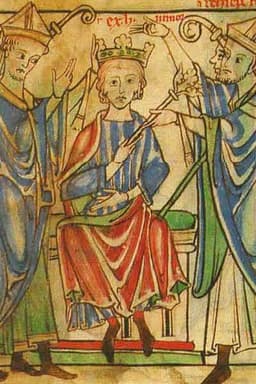
Henry the Young King
Emperor · Medieval
40.8Total

King U of Goryeo
Emperor · Medieval
39.6Total
Basic Information
Born
1155
1365
Died
1183
1389
Era
Medieval
Medieval
Nationality
England
Korea
Occupation
Emperor
Emperor
Civilization
Western
Eastern
Score Comparison
Military (10%)
14.9
20.0
Political (20%)
40.8
35.0
Influence (20%)
47.1
45.5
Legacy (20%)
35.8
35.8
Leadership (15%)
49.9
49.9
Strategy (15%)
50.0
45.0
TOTAL
40.8
39.6
Henry the Young King — Complete Timeline
1170 AD
Coronation as Junior KingPolitical Action◆ Major
Henry the Young King was crowned as junior king of England by his father Henry II, a practice to secure succession. This coronation gave him nominal authority but no real power, leading to future conflict.
CoronationSuccession
Impact: national
1172 AD
Second CoronationPolitical Action
To assert his status, Henry the Young King was crowned again at Winchester by the Archbishop of York, after his first coronation was performed by the Archbishop of Canterbury, causing a dispute.
CoronationChurch Dispute
Impact: national
1173 AD
Rebellion of 1173-1174War◆ Major
Henry the Young King led a major rebellion against his father Henry II, joined by his brothers Richard and Geoffrey, and supported by King Louis VII of France. The revolt failed after 18 months, and Henry was forced to submit.
RebellionCivil WarFamily Conflict
Impact: regionaldestructive
1183 AD
Death from DysenteryOther◆ Major
Henry the Young King died of dysentery at Martel in Quercy, France, at age 28. His death ended his rivalry with his father and brothers, and he was buried in Rouen Cathedral.
DeathDisease
Impact: regionaltragic
King U of Goryeo — Complete Timeline
1374 AD
Ascended Throne with Yuan SupportPolitical Action◆ Major
King U became king at age 9 after the death of King Gongmin, with support from the Yuan court. His youth and alleged illegitimate birth (rumored to be the son of a Buddhist monk) made his rule controversial from the start.
Child KingSuccessionControversy
Impact: national
1388 AD
Deposed by Yi Seong-gyePolitical Action
King U was deposed by General Yi Seong-gye (later King Taejo of Joseon) after Yi's coup. Yi accused U of being unfit to rule and of plotting against the state, and placed U's son King Chang on the throne as a puppet.
CoupDepositionYi Seong-gye
Impact: nationaldestructive
1389 AD
Killed by Yi Seong-gye's ForcesOther◆ Major
King U was executed along with his son King Chang by Yi Seong-gye's forces, after Yi decided to eliminate all potential rivals. This brutal act cleared the way for Yi to establish the Joseon dynasty in 1392.
ExecutionPolitical PurgeEnd of Dynasty
Impact: nationaltragic
Expert Analysis
Origins
Henry the Young King (1155-1183) was the second son of King Henry II of England and Eleanor of Aquitaine. Born in London, he was groomed for kingship from an early age. His father crowned him junior king in 1170, a practice to secure succession. Henry's early life was marked by privilege and expectation, but he held no real power.
King U of Goryeo (1365-1389) ascended the throne at age 9 after the death of King Gongmin. His mother was a slave, leading to rumors that he was not of royal blood. With support from the Yuan court, he became king during a period of declining Goryeo dynasty and rising internal strife.
Rise to Power
Henry the Young King's rise was orchestrated by his father. He was crowned junior king in 1170 at Westminster Abbey, and again in 1172 at Winchester to assert his status. However, his father retained all authority, leading to resentment. In 1173, Henry led a rebellion against Henry II, joined by his brothers Richard and Geoffrey, and supported by King Louis VII of France. The rebellion lasted until 1174, ending in defeat.
King U became king in 1374 after King Gongmin was assassinated. The Yuan court, which had influence over Goryeo, supported his accession. His youth made him a puppet for powerful nobles, including General Yi Seong-gye. U's reign was marked by factional struggles between pro-Yuan and anti-Yuan groups.
Leadership & Governance
Henry the Young King never actually governed. He was a figurehead without administrative responsibility. His leadership style was impulsive and focused on personal glory rather than statecraft. He spent his time participating in tournaments and building alliances against his father. His governance score of 40.8 reflects his minimal impact.
King U, despite his youth, attempted to assert authority but was manipulated by court factions. He pursued a policy of strengthening royal power against the aristocracy, but his alleged illegitimate birth undermined his legitimacy. His political score of 35.0 indicates weak governance. He relied on Yuan support, which alienated reform-minded officials.
Triumph & Tragedy
Henry's greatest success was his coronation as junior king, which temporarily secured his position. However, his rebellion of 1173-1174 was a failure; he was forced to submit to his father. His death from dysentery at age 28 ended his ambitions. He never achieved independent rule.
King U's triumph was his accession despite his low birth, but his reign was plagued by crisis. His deposition by Yi Seong-gye in 1388 was a turning point. He was executed along with his son King Chang in 1389, clearing the way for the Joseon dynasty. His legacy is one of illegitimacy and failed kingship.
Character & Destiny
Henry was described as charming but irresponsible. He prioritized tournaments and rebellion over governance. His character led him to challenge his father, a more capable ruler. His death was untimely but perhaps merciful, as he lacked the skills to rule.
King U was likely a pawn in larger political games. His alleged non-royal blood made him vulnerable. He was indecisive and unable to control the factions. His destiny was sealed by the rising power of Yi Seong-gye, who saw him as an obstacle.
Legacy
Henry the Young King is remembered primarily as a rebel prince. His total score of 40.8 reflects his limited impact. He is a footnote in the Angevin dynasty, overshadowed by his father and brother Richard the Lionheart.
King U's legacy is more consequential: his deposition led to the end of the Goryeo dynasty and the founding of the Joseon dynasty. His total score of 39.6 is slightly lower, but his influence on Korean history is significant. He is often portrayed as a tragic figure.
Conclusion
While Henry the Young King scored slightly higher (40.8 vs 39.6), King U of Goryeo had a greater historical impact. Henry's rebellion was a personal failure with no lasting consequences. In contrast, U's deposition directly led to the fall of the Goryeo dynasty and the rise of Joseon, which ruled Korea for over 500 years. Therefore, King U had greater impact, despite his lower total score.
Rankings
🥇
Henry the Young KingLeader
Mil: 14.9Pol: 40.8Inf: 47.1
40.8
🥈
King U of Goryeo
Mil: 20.0Pol: 35.0Inf: 45.5
39.6
+1.2 behind
How This Comparison Works
Algorithm
Each figure is scored on 6 dimensions (0—100 scale) based on structured historical data: Military (10%), Political (20%), Influence (20%), Legacy (20%), Leadership (15%), Strategy (15%). The weighted total produces the final ranking.
Data Sources
Scores are computed from structured sub-indicators in the database. Scale factors adjust for era (Ancient ×0.85, Modern ×1.0) and civilization size (Eastern ×1.05, Other ×0.80) to account for differences in population and military scale.
Maximum 3 Figures
Comparisons are limited to 2—3 figures to ensure readability and statistical meaningfulness.
Error Margins
±5 points per dimension — Sub-scores are derived from historical records with inherent uncertainty. Two figures within 5 points on a dimension should be considered roughly equivalent in that area.
Total Score Accuracy
±3 points overall — The weighted combination of 6 dimensions produces a total score with approximately ±3 points of uncertainty. Differences of less than 3 points are not statistically significant— the figures are effectively tied.
Known Limitations
- Historical records are incomplete and uneven across civilizations
- Figures from oral-tradition societies may be underrepresented
- Occupation labels can misclassify multi-role figures
- Scores measure capability and impact, not moral character
- Quantitative scoring is a comparison tool, not absolute truth
Capability Radar
Military (10%) — Battles & Warfare
Battles
10
5
Win Rate
5
5
Expansion
5
5
Political (20%) — Governance & Reform
Reform
0
5
Diplomacy
10
5
Economy
0
5
Influence (20%) — Cultural & Global Reach
Cultural
5
5
Global
5
5
Legacy (20%) — Historical Impact
Historical
10
10
Longevity
5
5
Leadership (15%) — Power & Stability
Tenure
10
10
Stability
5
5
Strategy (15%) — Tactics & Innovation
Strategy
10
5
Tactics
10
5
Reform
0
5
Similar Comparisons
Comments & Discussion
No comments yet. Be the first to share your thoughts!