Loading...
Harold Godwinson vs Henry the Young King
Harold Godwinson leads by 5.0 pts · 2 figures compared
…
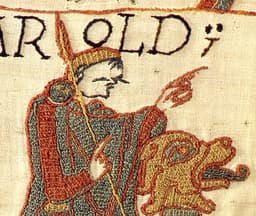
Harold Godwinson
Emperor · Medieval
45.8Total
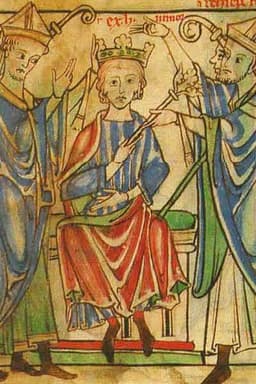
Henry the Young King
Emperor · Medieval
40.8Total
Basic Information
Born
1022
1155
Died
1066
1183
Era
Medieval
Medieval
Nationality
England
England
Occupation
Emperor
Emperor
Civilization
Western
Western
Score Comparison
Military (10%)
47.5
14.9
Political (20%)
35.1
40.8
Influence (20%)
54.1
47.1
Legacy (20%)
49.2
35.8
Leadership (15%)
31.2
49.9
Strategy (15%)
52.5
50.0
TOTAL
45.8
40.8
Harold Godwinson — Complete Timeline
1066 AD
Battle of Stamford BridgeWar◆ Major
Harold defeated an invading Norwegian army under King Harald Hardrada at Stamford Bridge in Yorkshire. The victory was decisive, but Harold's army was weakened and exhausted.
BattleVictoryViking Invasion
Impact: national
Battle of HastingsWar
Harold's army was defeated by William of Normandy at Hastings on October 14. Harold was killed in the battle, traditionally by an arrow in the eye, ending Anglo-Saxon rule in England.
BattleDefeatNorman Conquest
Impact: globaltragic
Coronation of Harold GodwinsonPolitical Action◆ Major
Harold was crowned king of England on January 6, 1066, the day after Edward the Confessor's death. His claim was contested by William of Normandy and Harald Hardrada of Norway.
CoronationSuccessionContested Claim
Impact: national
Henry the Young King — Complete Timeline
1170 AD
Coronation as Junior KingPolitical Action◆ Major
Henry the Young King was crowned as junior king of England by his father Henry II, a practice to secure succession. This coronation gave him nominal authority but no real power, leading to future conflict.
CoronationSuccession
Impact: national
1172 AD
Second CoronationPolitical Action
To assert his status, Henry the Young King was crowned again at Winchester by the Archbishop of York, after his first coronation was performed by the Archbishop of Canterbury, causing a dispute.
CoronationChurch Dispute
Impact: national
1173 AD
Rebellion of 1173-1174War◆ Major
Henry the Young King led a major rebellion against his father Henry II, joined by his brothers Richard and Geoffrey, and supported by King Louis VII of France. The revolt failed after 18 months, and Henry was forced to submit.
RebellionCivil WarFamily Conflict
Impact: regionaldestructive
1183 AD
Death from DysenteryOther◆ Major
Henry the Young King died of dysentery at Martel in Quercy, France, at age 28. His death ended his rivalry with his father and brothers, and he was buried in Rouen Cathedral.
DeathDisease
Impact: regionaltragic
Expert Analysis
Origins
Harold Godwinson was born around 1022 into the powerful Godwin family, the most influential noble house in England under King Edward the Confessor. His father, Godwin, Earl of Wessex, was the king's chief minister. Harold grew up amidst court politics and military campaigns, gaining experience as an earl and military commander. He was well-educated for the time, fluent in French and Latin, and deeply connected to the Anglo-Saxon aristocracy.
Henry the Young King was born on February 28, 1155, the second son of King Henry II of England and Eleanor of Aquitaine. Unlike Harold, Henry was born into royalty, not nobility. He was groomed for kingship from childhood, crowned junior king in 1170 at age 15 to secure the succession. His upbringing was marked by privilege but also by the shadow of his powerful father, which shaped his rebellious nature.
Rise to Power
Harold Godwinson rose to power through military and political acumen. By 1045, he was Earl of East Anglia, and after his father's exile and return, he became Earl of Wessex in 1053, effectively ruling England alongside Edward the Confessor. His greatest turning point came in 1064 when he was shipwrecked in Normandy and allegedly swore an oath to support William's claim to the English throne. Upon Edward's death in January 1066, Harold was elected king by the Witan, taking the crown on January 6.
Henry the Young King's rise was artificial, orchestrated by his father. He was crowned junior king in 1170, but real power remained with Henry II. This nominal kingship led to resentment. In 1173, at age 18, Henry led a rebellion against his father, joined by his brothers Richard and Geoffrey, and supported by King Louis VII of France. The rebellion lasted until 1174 and ended in failure, with Henry forced to submit.
Leadership & Governance
Harold Godwinson's leadership was tested in 1066. He demonstrated decisive military command, marching his army 185 miles from London to York in four days to confront Harald Hardrada at Stamford Bridge on September 25. He achieved a decisive victory, killing Hardrada and his ally Tostig. However, his governance was short-lived; he failed to consolidate his rule or secure lasting alliances, relying on a depleted army after Stamford Bridge.
Henry the Young King never governed. As a junior king, he had no real authority; his father controlled administration. Henry's leadership was defined by rebellion, not governance. He lacked the patience or skill for statecraft, preferring tournaments and display. His political score of 40.8 reflects his inability to wield power effectively. In contrast, Harold's political score of 35.1 indicates limited political maneuvering, but he at least held the throne for nine months.
Triumph & Tragedy
Harold's greatest triumph was the Battle of Stamford Bridge, where his tactical acumen defeated a formidable Viking army. His tragedy was the Battle of Hastings on October 14, 1066. Forced to march south rapidly, he engaged William of Normandy with a tired army. His death, traditionally by an arrow in the eye, ended Anglo-Saxon rule. Harold scored 47.5 in military, reflecting his competence but ultimate failure.
Henry the Young King's triumph was symbolic: his coronation as junior king, a rare honor. His tragedy was his rebellion's failure and early death at 28 from dysentery in 1183. He died in debt, having squandered his inheritance. His military score of 14.9 is the lowest among all scores, indicating his ineptitude in war.
Character & Destiny
Harold Godwinson was pragmatic and courageous, but his oath to William bound him to a fateful conflict. His decision to fight at Hastings, despite exhaustion, showed valor but poor strategy. Historians note his loyalty to his family and kingdom, but his inability to secure peace sealed his doom.
Henry the Young King was charismatic but petulant. He craved power without responsibility, leading to constant conflict. His character—ambitious but undisciplined—led to his downfall. Contemporary chroniclers described him as a 'troubled youth' who wasted his potential.
Legacy
Harold Godwinson's legacy is as the last Anglo-Saxon king, a symbol of English resistance. His defeat at Hastings transformed England, ushering in Norman rule and feudalism. His influence score of 54.1 reflects this pivotal role. Henry the Young King's legacy is minor; he is remembered as a failed rebel. His legacy score of 35.8 indicates his limited historical footprint. He is notable primarily for his role in the Angevin family drama.
Conclusion
Harold Godwinson had greater impact, scoring 45.8 total versus Henry's 40.8. Harold's reign, though brief, changed English history irrevocably. His defeat led to the Norman Conquest, which reshaped language, law, and culture. Henry the Young King's rebellion, while dramatic, did not alter the course of history. Harold's military and strategic scores (47.5 and 52.5) outweigh Henry's (14.9 and 50.0). Thus, Harold's position as a turning point in English history gives him the edge.
Rankings
🥇
Harold GodwinsonLeader
Mil: 47.5Pol: 35.1Inf: 54.1
45.8
🥈
Henry the Young King
Mil: 14.9Pol: 40.8Inf: 47.1
40.8
+5.0 behind
How This Comparison Works
Algorithm
Each figure is scored on 6 dimensions (0—100 scale) based on structured historical data: Military (10%), Political (20%), Influence (20%), Legacy (20%), Leadership (15%), Strategy (15%). The weighted total produces the final ranking.
Data Sources
Scores are computed from structured sub-indicators in the database. Scale factors adjust for era (Ancient ×0.85, Modern ×1.0) and civilization size (Eastern ×1.05, Other ×0.80) to account for differences in population and military scale.
Maximum 3 Figures
Comparisons are limited to 2—3 figures to ensure readability and statistical meaningfulness.
Error Margins
±5 points per dimension — Sub-scores are derived from historical records with inherent uncertainty. Two figures within 5 points on a dimension should be considered roughly equivalent in that area.
Total Score Accuracy
±3 points overall — The weighted combination of 6 dimensions produces a total score with approximately ±3 points of uncertainty. Differences of less than 3 points are not statistically significant— the figures are effectively tied.
Known Limitations
- Historical records are incomplete and uneven across civilizations
- Figures from oral-tradition societies may be underrepresented
- Occupation labels can misclassify multi-role figures
- Scores measure capability and impact, not moral character
- Quantitative scoring is a comparison tool, not absolute truth
Capability Radar
Military (10%) — Battles & Warfare
Battles
60
10
Win Rate
55
5
Expansion
40
5
Political (20%) — Governance & Reform
Reform
20
0
Diplomacy
40
10
Economy
30
0
Influence (20%) — Cultural & Global Reach
Cultural
35
5
Global
30
5
Legacy (20%) — Historical Impact
Historical
55
10
Longevity
40
5
Leadership (15%) — Power & Stability
Tenure
15
10
Stability
20
5
Strategy (15%) — Tactics & Innovation
Strategy
60
10
Tactics
65
10
Reform
30
0
Similar Comparisons
Comments & Discussion
No comments yet. Be the first to share your thoughts!