Loading...
Herbert Hoover vs Julius Caesar
Julius Caesar leads by 29.0 pts · 2 figures compared
…
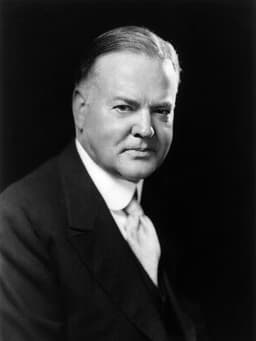
Herbert Hoover
Politician · Modern
53.8Total

Julius Caesar
General · Ancient
82.8Total
Basic Information
Born
1874
-100
Died
1964
-44
Era
Modern
Ancient
Nationality
United States
Roman Republic
Occupation
Politician
General
Civilization
Western
Western
Score Comparison
Military (10%)
49.1
88.0
Political (20%)
54.7
78.0
Influence (20%)
58.0
85.0
Legacy (20%)
49.2
82.0
Leadership (15%)
65.0
80.0
Strategy (15%)
41.8
85.0
TOTAL
53.8
82.8
Herbert Hoover — Complete Timeline
1928 AD
Election as President of the United StatesPolitical Action◆ Major
Hoover, a Republican, won the 1928 presidential election in a landslide against Democrat Al Smith. Hoover's reputation as a successful businessman and humanitarian, particularly for his relief work in Europe during and after World War I, contributed to his victory.
Presidential ElectionRepublican Party
Impact: national
1929 AD
Stock Market Crash of 1929Other
The Wall Street Crash of 1929 occurred in October, marking the beginning of the Great Depression. Hoover's response, including calls for voluntary cooperation and limited federal intervention, was widely criticized as inadequate, and the depression deepened.
Great DepressionEconomic Crisis
Impact: globaltragic
1930 AD
Signing of the Smoot-Hawley TariffPolitical Action◆ Major
Hoover signed the Smoot-Hawley Tariff, which raised tariffs on thousands of imported goods to record levels. The tariff sparked retaliatory measures from other countries, contributing to a collapse in international trade and worsening the Great Depression.
Tariff PolicyGreat Depression
Impact: globaldestructive
Julius Caesar — Complete Timeline
58 BC
Gallic WarsWar◆ Major
Caesar, as proconsul of Gaul, launched a series of campaigns that conquered all of Gaul (modern France, Belgium, and parts of Switzerland). He fought numerous battles, including against the Helvetii, the Belgae, and the Gallic chieftain Vercingetorix. The wars brought immense wealth and a loyal army to Caesar.
Gallic WarsConquestRoman Expansion
Impact: regional
49 BC
Crossing the RubiconPolitical Action◆ Major
Caesar led Legio XIII across the Rubicon River into Italy, defying the Roman Senate's order to disband his army. This act triggered a civil war against Pompey and the Optimates, ultimately leading to Caesar's dictatorship and the end of the Roman Republic.
Roman Civil WarEnd of RepublicPower Struggle
Impact: global
48 BC
Battle of PharsalusWar◆ Major
Caesar's outnumbered army defeated the larger forces of Pompey the Great at Pharsalus in Greece. Caesar's tactical use of a reserve line to counter Pompey's cavalry charge proved decisive. Pompey fled to Egypt, where he was assassinated, leaving Caesar as the undisputed master of the Roman world.
Roman Civil WarBattleDecisive Victory
Impact: regional
44 BC
Appointment as Dictator for LifePolitical Action◆ Major
The Roman Senate appointed Caesar dictator perpetuo (dictator for life), granting him unprecedented personal power. This move concentrated military, legislative, and judicial authority in one person, effectively ending the Roman Republic's traditional system of checks and balances and alarming many senators.
DictatorshipEnd of RepublicPower Consolidation
Impact: regionaldestructive
Assassination on the Ides of MarchPolitical Action◆ Major
A group of Roman senators, led by Marcus Junius Brutus and Gaius Cassius Longinus, stabbed Caesar to death at a meeting of the Senate in the Theatre of Pompey. The assassination was intended to restore the Republic, but instead triggered another civil war that led to the rise of the Roman Empire.
AssassinationRoman PoliticsEnd of Republic
Impact: globaldestructive
Expert Analysis
herbert-hoover-vs-julius-caesar
# The Dictator and the Engineer: Two Men Who Shaped Their Eras
On the Ides of March, 44 BCE, a Roman senator named Gaius Julius Caesar fell beneath twenty-three dagger blows, his blood pooling at the base of Pompey's Theatre. Nearly two thousand years later, on a gray October morning in 1929, Herbert Hoover sat in the White House as the American stock market began its catastrophic collapse. One man died at the violent peak of his power; the other lived long enough to watch his reputation crumble into dust. Both were brilliant organizers who believed they could impose order on chaos. Both failed in ways that reshaped the world.
Origins
Caesar was born into the patrician Julian clan, a family of ancient prestige but dwindling wealth. Rome in the first century BCE was a republic in name only—a crucible of civil wars, senatorial corruption, and slave revolts. Young Caesar learned early that in such a world, survival meant audacity. He was captured by pirates as a young man and laughed at their ransom demands, insisting they raise the price. When they did, he raised a fleet, captured them, and had them crucified.
Herbert Hoover was born in 1874 in West Branch, Iowa, a Quaker community that valued humility, hard work, and moral certainty. Orphaned at nine, he was raised by stern relatives who taught him that discipline and engineering could solve any problem. He graduated from Stanford in 1895, the first class of a university that embodied American optimism about progress. Where Caesar inherited a legacy of aristocratic arrogance, Hoover inherited a legacy of moral earnestness.
Rise to Power
Caesar’s path was a masterclass in strategic patience. He climbed the Roman political ladder—quaestor, aedile, praetor—borrowing enormous sums to fund games and bribes. In 60 BCE, he forged the First Triumvirate with Pompey and Crassus, an alliance of convenience that let him secure the governorship of Gaul. There, between 58 and 50 BCE, he conquered a territory larger than Italy itself, winning battles against hundreds of thousands of warriors and writing his own propaganda in crisp Latin prose.
Hoover’s rise was no less spectacular, though far less bloody. He became a mining engineer and businessman, traveling the world to extract gold, tin, and zinc from the earth. By forty, he was a multimillionaire. During World War I, he organized food relief for starving Belgians with such efficiency that he became known as the "Great Humanitarian." In 1921, President Harding appointed him Secretary of Commerce, where he modernized American industry and broadcasting. When he won the presidency in 1928, it was by a landslide—the engineer as savior.
Leadership & Governance
Caesar governed as a revolutionary conservative. As dictator, he reformed the calendar, extended citizenship to Gauls, launched public works projects, and centralized tax collection. His military genius was absolute: at Alesia in 52 BCE, he besieged a Gallic army while simultaneously building fortifications against a relieving force of 250,000 men, winning through sheer logistical brilliance. But he governed by personal authority, not law. He packed the Senate with his supporters, minted coins with his image, and accepted the title "dictator for life." He believed that only one man could save Rome—himself.
Hoover governed as a conservative revolutionary. He believed in "associationalism"—voluntary cooperation between business and government to stabilize the economy. When the Depression struck in 1929, he refused to provide direct federal relief, insisting that charity and local communities should handle poverty. Instead, he signed the Smoot-Hawley Tariff in 1930, raising import duties to record levels and triggering a global trade war. He created the Reconstruction Finance Corporation to bail out banks, but it was too little, too late. His engineering mind saw the economy as a machine that needed minor adjustments, not a human catastrophe that demanded radical intervention.
Triumph & Tragedy
Caesar’s greatest triumph was the conquest of Gaul, which brought him wealth, loyalty, and a veteran army. His most devastating failure was his inability to read the Roman elite’s hatred of monarchy. When he crossed the Rubicon in 49 BCE, he plunged the Republic into civil war. When he pardoned his enemies and showered them with offices, he assumed gratitude would follow. Instead, they stabbed him.
Hoover’s greatest triumph was his humanitarian work, which saved millions from starvation. His tragedy was that his very virtues became vices. He was a man of immense competence who could not inspire. He gave press conferences but never fireside chats. He believed in self-reliance so deeply that he could not see when self-reliance was impossible. By 1932, shantytowns were called "Hoovervilles," and newspapers were "Hoover blankets." He lost the election to Franklin Roosevelt in a landslide, and spent the rest of his life defending his record.
Character & Destiny
Caesar was charismatic, ruthless, and supremely confident. He gambled everything on his own genius, and for a time, the gamble paid off. But his arrogance blinded him to the limits of power. He famously said, "The die is cast," when crossing the Rubicon—a phrase that captures his belief that history was a game of chance he could win.
Hoover was competent, principled, and emotionally remote. He believed that facts and organization could overcome any crisis. But the Depression was not a technical problem—it was a crisis of human suffering. His Quaker upbringing taught him to help others, but his Quaker stoicism taught him not to show emotion. He could not say, "I feel your pain," because he believed that pain was a private matter. His character made him a great engineer, but a terrible president in a time of fear.
Legacy
Caesar’s legacy is the Roman Empire. His adopted heir, Octavian, learned from his mistakes—never pardoning enemies, never trusting the Senate. The imperial system Caesar built lasted five hundred years in the West. His name became a title: Kaiser, Tsar, Caesar. He is remembered as both a tyrant and a visionary, the man who killed the Republic and gave birth to something greater.
Hoover’s legacy is more ambiguous. His humanitarian work is now largely forgotten; his presidency is remembered as a failure. Yet the institutions he created—the RFC, the Hoover Dam, the Department of Commerce—outlasted him. His belief in limited government was discredited in 1932, but revived by later generations. He lived until 1964, long enough to see himself become a cautionary tale.
Conclusion
Caesar and Hoover stand at opposite ends of the Western tradition. One was a warrior-aristocrat who believed that history was made by great men. The other was a technocrat who believed that history was made by systems. Both were wrong, and both were right. Caesar proved that one man can change the world, but also that the world will resist. Hoover proved that competence without compassion is not enough, but also that compassion without competence is empty. Their lives remind us that leadership is not about having the right answers—it is about having the right questions, and the courage to ask them in the face of chaos.
Rankings
🥇
Julius CaesarLeader
Mil: 88.0Pol: 78.0Inf: 85.0
82.8
🥈
Herbert Hoover
Mil: 49.1Pol: 54.7Inf: 58.0
53.8
+29.0 behind
How This Comparison Works
Algorithm
Each figure is scored on 6 dimensions (0—100 scale) based on structured historical data: Military (10%), Political (20%), Influence (20%), Legacy (20%), Leadership (15%), Strategy (15%). The weighted total produces the final ranking.
Data Sources
Scores are computed from structured sub-indicators in the database. Scale factors adjust for era (Ancient ×0.85, Modern ×1.0) and civilization size (Eastern ×1.05, Other ×0.80) to account for differences in population and military scale.
Maximum 3 Figures
Comparisons are limited to 2—3 figures to ensure readability and statistical meaningfulness.
Error Margins
±5 points per dimension — Sub-scores are derived from historical records with inherent uncertainty. Two figures within 5 points on a dimension should be considered roughly equivalent in that area.
Total Score Accuracy
±3 points overall — The weighted combination of 6 dimensions produces a total score with approximately ±3 points of uncertainty. Differences of less than 3 points are not statistically significant— the figures are effectively tied.
Known Limitations
- Historical records are incomplete and uneven across civilizations
- Figures from oral-tradition societies may be underrepresented
- Occupation labels can misclassify multi-role figures
- Scores measure capability and impact, not moral character
- Quantitative scoring is a comparison tool, not absolute truth
Capability Radar
Military (10%) — Battles & Warfare
Battles
30
95
Win Rate
29
92
Expansion
38
97
Political (20%) — Governance & Reform
Reform
30
90
Diplomacy
55
85
Economy
40
82
Influence (20%) — Cultural & Global Reach
Cultural
30
88
Global
50
94
Legacy (20%) — Historical Impact
Historical
55
95
Longevity
40
96
Leadership (15%) — Power & Stability
Tenure
60
75
Stability
20
60
Strategy (15%) — Tactics & Innovation
Strategy
36
94
Tactics
40
96
Reform
44
88
Similar Comparisons
Comments & Discussion
No comments yet. Be the first to share your thoughts!