Loading...
Hu Jintao vs Shaukat Aziz
Hu Jintao leads by 1.3 pts · 2 figures compared
…

Hu Jintao
Politician · Modern
52.0Total
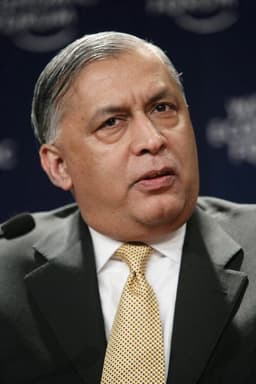
Shaukat Aziz
Politician · Modern
50.7Total
Basic Information
Born
1942
1949
Died
—
—
Era
Modern
Modern
Nationality
China
Pakistan
Occupation
Politician
Politician
Civilization
Eastern
Indian
Score Comparison
Military (10%)
17.2
35.8
Political (20%)
59.3
62.7
Influence (20%)
62.0
50.2
Legacy (20%)
48.3
38.3
Leadership (15%)
72.0
64.0
Strategy (15%)
30.0
60.0
TOTAL
52.0
50.7
Hu Jintao — Complete Timeline
2002 AD
Appointed General Secretary of the Communist PartyPolitical Action◆ Major
Hu Jintao succeeded Jiang Zemin as General Secretary. He promoted the 'Scientific Development Concept', emphasizing balanced growth, environmental protection, and social welfare.
Party LeadershipIdeology
Impact: nationalconstructive
2005 AD
Promulgated the 'Harmonious Society' PolicyPolitical Action◆ Major
Hu Jintao introduced the 'Harmonious Society' policy to address social inequalities and reduce unrest. It focused on rural development, healthcare reform, and poverty alleviation.
Social PolicyWelfare
Impact: nationalconstructive
2008 AD
Hosted the 2008 Beijing OlympicsCultural◆ Major
Under Hu Jintao's presidency, China hosted the Summer Olympics in Beijing. The event showcased China's economic rise and modernization to the world.
OlympicsSoft Power
Impact: globalconstructive
Responded to the 2008 Sichuan EarthquakePolitical Action◆ Major
Hu Jintao oversaw the government's response to the magnitude 8.0 Sichuan earthquake, which killed over 69,000 people. The relief effort was massive but criticized for slow initial response.
Natural DisasterEmergency Response
Impact: national
Shaukat Aziz — Complete Timeline
1999 AD
Economic Reforms as Finance MinisterReform◆ Major
As Finance Minister under President Pervez Musharraf from 1999 to 2004, Shaukat Aziz implemented economic reforms including privatization of state-owned enterprises, banking sector reforms, and tax restructuring. These policies contributed to GDP growth averaging 7% annually.
Economic ReformPrivatizationMusharraf
Impact: nationalconstructive
2004 AD
Appointed Prime Minister of PakistanPolitical Action◆ Major
Shaukat Aziz was appointed as the 17th Prime Minister of Pakistan on August 28, 2004, after serving as Finance Minister. He was a former Citibank executive and his appointment marked a technocratic shift in Pakistani politics.
Prime MinisterTechnocratPakistan
Impact: national
2007 AD
Completion of Five-Year TermPolitical Action◆ Major
Shaukat Aziz completed his five-year term as Prime Minister on November 15, 2007, becoming the first Pakistani Prime Minister to serve a full term since 1977. His tenure saw continued economic growth but also rising political instability.
Term CompletionPolitical StabilityPakistan
Impact: national
Expert Analysis
Origins
Hu Jintao was born in 1942 in Jiangsu, China, to a modest tea merchant family. He studied hydraulic engineering at Tsinghua University, graduating in 1965. His early career was in provincial water conservation projects, and he joined the Communist Party in 1964. Shaukat Aziz was born in 1949 in Karachi, Pakistan, into a business-oriented family. He attended St. Patrick's School in Karachi and later earned a degree from the University of Karachi. He began his career at Citibank in 1969, rising to become a top executive.
Rise to Power
Hu Jintao rose through the party ranks, serving as governor of Tibet (1988-1992) and later as party secretary of Guizhou. He became a member of the Politburo Standing Committee in 1992 and succeeded Jiang Zemin as General Secretary in 2002 and President in 2003. His rise was characterized by steady bureaucratic advancement. Shaukat Aziz entered politics after a successful banking career. He was appointed Finance Minister in 1999 under President Pervez Musharraf, implementing key economic reforms. In 2004, he became Prime Minister, winning a parliamentary vote with 189 out of 342 seats.
Leadership & Governance
Hu Jintao's governance focused on the 'Scientific Development Concept' and 'Harmonious Society', aiming for balanced growth and social equity. He pushed for environmental protection, rural development, and healthcare reforms. Under his leadership, China's GDP grew at an average of 11% annually. Shaukat Aziz, as Finance Minister and PM, pursued privatization, deregulation, and foreign investment. He reduced poverty from 34% to 17% and increased GDP growth to 7-8%. However, his economic policies were criticized for benefiting elites and widening inequality. In leadership scores, Hu scored 72.0, while Aziz scored 64.0.
Triumph & Tragedy
Hu Jintao's greatest success was hosting the 2008 Beijing Olympics, showcasing China's modernization. He also managed the response to the 2008 Sichuan earthquake, though the relief was criticized for delays. His 'Harmonious Society' policy improved social welfare but did not eliminate unrest. Shaukat Aziz's key achievement was completing a full five-year term as PM, a rare feat in Pakistan. He stabilized the economy, but his tenure saw rising inflation and the 2007 state of emergency under Musharraf. Aziz's political influence score is 50.2, lower than Hu's 62.0.
Character & Destiny
Hu Jintao was known for his consensus-building and cautious style, avoiding bold reforms. His character led to steady but incremental progress. He scored 30.0 in strategy, reflecting a lack of dramatic initiatives. Shaukat Aziz was a technocrat, pragmatic and business-oriented. He focused on economic stability but was seen as aloof from public sentiment. His military score (35.8) reflects his reliance on Musharraf's support. Both leaders were shaped by their environments: Hu by China's one-party system, Aziz by Pakistan's unstable democracy.
Legacy
Hu Jintao's legacy lies in institutionalizing 'Scientific Development' and 'Harmonious Society', influencing Xi Jinping's policies. China's rise continued, but his era is less iconic than his predecessors. He scores 48.3 in legacy. Shaukat Aziz's legacy is mixed: he is credited with economic reforms but criticized for corruption and inequality. He is remembered as a competent manager but not a transformative leader. His legacy score is 38.3. Overall, Hu's influence score (62.0) exceeds Aziz's (50.2).
Conclusion
Hu Jintao had greater impact due to his leadership of a global superpower during a critical growth phase. His total score of 52.0 surpasses Aziz's 50.7, and he governed a larger economy and population. While Aziz reformed Pakistan's economy, his achievements were constrained by political instability. Hu's policies shaped China's trajectory for decades, whereas Aziz's reforms were partially reversed. Thus, Hu Jintao emerges as the more significant figure.
Rankings
🥇
Hu JintaoLeader
Mil: 17.2Pol: 59.3Inf: 62.0
52.0
🥈
Shaukat Aziz
Mil: 35.8Pol: 62.7Inf: 50.2
50.7
+1.3 behind
How This Comparison Works
Algorithm
Each figure is scored on 6 dimensions (0—100 scale) based on structured historical data: Military (10%), Political (20%), Influence (20%), Legacy (20%), Leadership (15%), Strategy (15%). The weighted total produces the final ranking.
Data Sources
Scores are computed from structured sub-indicators in the database. Scale factors adjust for era (Ancient ×0.85, Modern ×1.0) and civilization size (Eastern ×1.05, Other ×0.80) to account for differences in population and military scale.
Maximum 3 Figures
Comparisons are limited to 2—3 figures to ensure readability and statistical meaningfulness.
Error Margins
±5 points per dimension — Sub-scores are derived from historical records with inherent uncertainty. Two figures within 5 points on a dimension should be considered roughly equivalent in that area.
Total Score Accuracy
±3 points overall — The weighted combination of 6 dimensions produces a total score with approximately ±3 points of uncertainty. Differences of less than 3 points are not statistically significant— the figures are effectively tied.
Known Limitations
- Historical records are incomplete and uneven across civilizations
- Figures from oral-tradition societies may be underrepresented
- Occupation labels can misclassify multi-role figures
- Scores measure capability and impact, not moral character
- Quantitative scoring is a comparison tool, not absolute truth
Capability Radar
Military (10%) — Battles & Warfare
Battles
13
45
Win Rate
16
45
Expansion
18
52
Political (20%) — Governance & Reform
Reform
65
55
Diplomacy
70
50
Economy
75
65
Influence (20%) — Cultural & Global Reach
Cultural
40
10
Global
60
30
Legacy (20%) — Historical Impact
Historical
50
20
Longevity
30
10
Leadership (15%) — Power & Stability
Tenure
70
40
Stability
80
35
Strategy (15%) — Tactics & Innovation
Strategy
21
54
Tactics
29
55
Reform
29
57
Similar Comparisons
Comments & Discussion
No comments yet. Be the first to share your thoughts!