Loading...
Huayna Capac vs Mindaugas
Huayna Capac leads by 12.9 pts · 2 figures compared
…
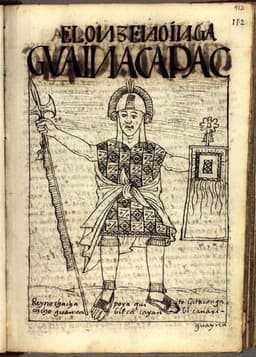
Huayna Capac
Emperor · Medieval
58.3Total
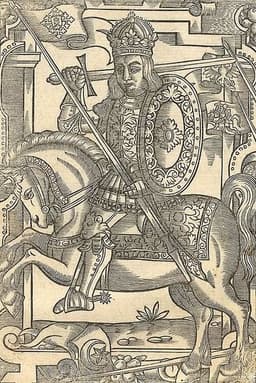
Mindaugas
Emperor · Medieval
45.4Total
Basic Information
Born
1468
1203
Died
1527
1263
Era
Medieval
Medieval
Nationality
Inca Empire
Lithuania
Occupation
Emperor
Emperor
Civilization
Other
Western
Score Comparison
Military (10%)
76.0
20.0
Political (20%)
45.0
43.7
Influence (20%)
55.0
54.1
Legacy (20%)
54.0
48.3
Leadership (15%)
68.0
51.9
Strategy (15%)
65.4
35.0
TOTAL
58.3
45.4
Huayna Capac — Complete Timeline
1493 AD
Conquest of the Kingdom of QuitoWar◆ Major
Huayna Capac led Inca armies northward, conquering the Kingdom of Quito (in modern Ecuador). This campaign extended the Inca Empire to its northernmost extent, incorporating new territories and peoples into the imperial administration.
Inca ExpansionConquestNorthern Campaign
Impact: regional
1500 AD
Construction of SacsayhuamanCultural◆ Major
Huayna Capac oversaw the expansion and fortification of Sacsayhuaman, a massive stone fortress overlooking Cusco. The complex, built with enormous fitted stones, served as both a military stronghold and a ceremonial center, demonstrating Inca engineering capabilities.
ArchitectureFortificationInca Engineering
Impact: regionalconstructive
1525 AD
Division of the Inca EmpirePolitical Action
Huayna Capac divided the Inca Empire between his sons Hu
Succession CrisisCivil WarInca Decline
Impact: regionaldestructive
1527 AD
Death from SmallpoxOther
Huayna Capac died from smallpox, a disease introduced by Europeans that spread through the Inca Empire ahead of Spanish conquistadors. His death triggered the Inca civil war and left the empire vulnerable to Francisco Pizarro's invasion.
EpidemicDiseaseInca Collapse
Impact: regionaltragic
Mindaugas — Complete Timeline
1240 AD
Unification of Lithuanian TribesPolitical Action◆ Major
Mindaugas unified the Lithuanian tribes under his rule, overcoming rival chieftains. This consolidation laid the foundation for the Grand Duchy of Lithuania.
UnificationLithuania
Impact: regionalconstructive
1251 AD
Conversion to ChristianityCultural◆ Major
Mindaugas converted to Roman Catholicism to gain papal support against the Teutonic Knights and internal rivals. This conversion was politically motivated and did not lead to widespread Christianization of Lithuania.
ConversionReligion
Impact: regional
1253 AD
Coronation as King of LithuaniaPolitical Action
Mindaugas was crowned King of Lithuania, the first and only king in Lithuanian history. The coronation was recognized by Pope Innocent IV, legitimizing Lithuania as a Christian kingdom.
CoronationLithuania
Impact: regionalconstructive
1263 AD
AssassinationPolitical Action◆ Major
Mindaugas was assassinated by his nephew Treniota and Duke Daumantas. His death ended the Kingdom of Lithuania and plunged the state into civil war, reversing the Christianization process.
AssassinationCivil War
Impact: regionaltragic
Expert Analysis
Origins
Huayna Capac was born around 1493 in Cusco, the capital of the Inca Empire, as the son of Emperor Tupac Inca Yupanqui and his wife Mama Ocllo. He was raised in the Inca nobility, trained in warfare, governance, and the religious duties of a Sapa Inca. His family background placed him directly in line for the throne, and he received education from the amautas (wise men) on Inca history, laws, and administration. The Inca Empire was at its zenith, and Huayna Capac was groomed to continue expansion.
Mindaugas was born around 1203, likely in the Aukštaitija region of Lithuania, into a pagan tribal aristocracy. Little is known about his early life, but he emerged as a powerful duke among the Lithuanian tribes. The region was fragmented, with constant threats from the Teutonic Knights and the Kingdom of Poland. Mindaugas's background was shaped by the need to consolidate power and defend against external aggression.
Rise to Power
Huayna Capac ascended to the throne around 1493 after his father's death. He consolidated power by suppressing rebellions in the southern provinces and then launched a major campaign northward. Between 1515 and 1525, he conquered the Kingdom of Quito, extending Inca control into modern Ecuador. This campaign involved massive armies, with estimates of up to 200,000 soldiers. He also secured alliances with local chieftains through marriage and gifts. By 1525, Huayna Capac ruled an empire spanning from modern Colombia to Chile, covering over 2 million square kilometers.
Mindaugas rose to power by unifying the Lithuanian tribes, a process that involved eliminating rival dukes. By the 1230s, he had established dominance, but faced threats from the Teutonic Knights, who were crusading against pagan Baltic tribes. To gain an advantage, Mindaugas converted to Roman Catholicism around 1251 and sought papal recognition. In 1253, he was crowned King of Lithuania by a papal legate, becoming the first and only king in Lithuanian history. This coronation gave him legitimacy and protection from the Teutonic Knights, but it also created internal resentment among pagan nobles.
Leadership & Governance
Huayna Capac ruled as an absolute monarch, embodying the divine status of the Sapa Inca. He centralized administration through a network of governors and used the mit'a labor system for public works. He constructed fortresses like Sacsayhuaman, which required moving stones weighing up to 100 tons. He also improved the road system, facilitating communication and troop movement. Huayna Capac's military leadership scored 76.0, reflecting his successful campaigns, but his political score of 45.0 indicates flaws in succession planning.
Mindaugas's leadership style was pragmatic and opportunistic. He converted to Christianity solely to secure political advantages, scoring 43.7 in political acumen. He attempted to balance pagan traditions with Christian requirements, but his rule faced constant opposition from pagan nobles and relatives. His military score of 20.0 suggests limited battlefield success; his strategy relied more on diplomacy and alliances. He granted lands to the Teutonic Knights in exchange for peace, which weakened his support among Lithuanian nobles.
Triumph & Tragedy
Huayna Capac's greatest triumph was expanding the Inca Empire to its maximum extent, incorporating Quito and securing northern borders. He oversaw the construction of Sacsayhuaman, a marvel of engineering. However, his greatest failure was dividing the empire between his sons Huáscar and Atahualpa before his death. This division led to a civil war that weakened the Incas just before the Spanish arrival. His death from smallpox around 1527 triggered a power struggle, and the empire fell within a decade.
Mindaugas's triumph was unifying Lithuania and becoming its first king, laying the foundation for the Grand Duchy of Lithuania. His conversion to Christianity temporarily defused threats from the Teutonic Knights. However, his assassination in 1263 by his nephew Treniota and Duke Daumantas ended the kingdom and led to a return to paganism. His failure was the inability to secure his legacy; his successors reverted to pre-unification fragmentation.
Character & Destiny
Huayna Capac was decisive and ambitious, but his decision to divide the empire proved catastrophic. He trusted his sons to manage the division, but they were rivals. Historical assessments note his administrative skills but criticize his succession plan. His total score of 58.3 reflects solid but not exceptional leadership.
Mindaugas was cunning and adaptable, but his pragmatic conversion alienated pagan supporters. His assassination highlights the instability of his rule. His total score of 45.4 shows lower overall impact, especially in military and strategy.
Legacy
Huayna Capac's legacy is tied to the Inca Empire's peak and its sudden collapse. The division he created facilitated the Spanish conquest. Sacsayhuaman remains a symbol of Inca engineering. His influence score of 55.0 reflects his role in shaping Andean history.
Mindaugas's legacy is as the only crowned king of Lithuania. His unification efforts paved the way for the Grand Duchy of Lithuania, which later became a major power. His legacy score of 48.3 indicates moderate long-term impact.
Conclusion
Huayna Capac had greater impact than Mindaugas. His military score of 76.0 versus 20.0 and total score of 58.3 versus 45.4 demonstrate his superior achievements. While Mindaugas founded a kingdom, Huayna Capac ruled an empire of millions and oversaw monumental construction. The Inca Empire's collapse after his death underscores his central role, whereas Mindaugas's kingdom disintegrated immediately. Huayna Capac's influence on Andean history is more profound than Mindaugas's on Baltic history.
Rankings
🥇
Huayna CapacLeader
Mil: 76.0Pol: 45.0Inf: 55.0
58.3
🥈
Mindaugas
Mil: 20.0Pol: 43.7Inf: 54.1
45.4
+12.9 behind
How This Comparison Works
Algorithm
Each figure is scored on 6 dimensions (0—100 scale) based on structured historical data: Military (10%), Political (20%), Influence (20%), Legacy (20%), Leadership (15%), Strategy (15%). The weighted total produces the final ranking.
Data Sources
Scores are computed from structured sub-indicators in the database. Scale factors adjust for era (Ancient ×0.85, Modern ×1.0) and civilization size (Eastern ×1.05, Other ×0.80) to account for differences in population and military scale.
Maximum 3 Figures
Comparisons are limited to 2—3 figures to ensure readability and statistical meaningfulness.
Error Margins
±5 points per dimension — Sub-scores are derived from historical records with inherent uncertainty. Two figures within 5 points on a dimension should be considered roughly equivalent in that area.
Total Score Accuracy
±3 points overall — The weighted combination of 6 dimensions produces a total score with approximately ±3 points of uncertainty. Differences of less than 3 points are not statistically significant— the figures are effectively tied.
Known Limitations
- Historical records are incomplete and uneven across civilizations
- Figures from oral-tradition societies may be underrepresented
- Occupation labels can misclassify multi-role figures
- Scores measure capability and impact, not moral character
- Quantitative scoring is a comparison tool, not absolute truth
Capability Radar
Military (10%) — Battles & Warfare
Battles
75
35
Win Rate
80
40
Expansion
85
50
Political (20%) — Governance & Reform
Reform
60
35
Diplomacy
65
55
Economy
70
30
Influence (20%) — Cultural & Global Reach
Cultural
60
45
Global
55
20
Legacy (20%) — Historical Impact
Historical
65
50
Longevity
50
40
Leadership (15%) — Power & Stability
Tenure
70
40
Stability
55
25
Strategy (15%) — Tactics & Innovation
Strategy
75
45
Tactics
70
30
Reform
65
25
Similar Comparisons
Comments & Discussion
No comments yet. Be the first to share your thoughts!