Loading...
Huayna Capac vs Julius Caesar
Julius Caesar leads by 24.5 pts · 2 figures compared
…
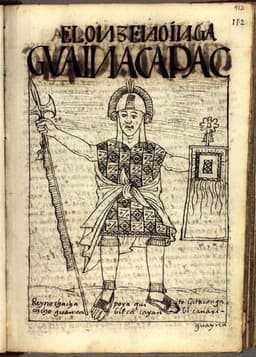
Huayna Capac
Emperor · Medieval
58.3Total

Julius Caesar
General · Ancient
82.8Total
Basic Information
Born
1468
-100
Died
1527
-44
Era
Medieval
Ancient
Nationality
Inca Empire
Roman Republic
Occupation
Emperor
General
Civilization
Other
Western
Score Comparison
Military (10%)
76.0
88.0
Political (20%)
45.0
78.0
Influence (20%)
55.0
85.0
Legacy (20%)
54.0
82.0
Leadership (15%)
68.0
80.0
Strategy (15%)
65.4
85.0
TOTAL
58.3
82.8
Huayna Capac — Complete Timeline
1493 AD
Conquest of the Kingdom of QuitoWar◆ Major
Huayna Capac led Inca armies northward, conquering the Kingdom of Quito (in modern Ecuador). This campaign extended the Inca Empire to its northernmost extent, incorporating new territories and peoples into the imperial administration.
Inca ExpansionConquestNorthern Campaign
Impact: regional
1500 AD
Construction of SacsayhuamanCultural◆ Major
Huayna Capac oversaw the expansion and fortification of Sacsayhuaman, a massive stone fortress overlooking Cusco. The complex, built with enormous fitted stones, served as both a military stronghold and a ceremonial center, demonstrating Inca engineering capabilities.
ArchitectureFortificationInca Engineering
Impact: regionalconstructive
1525 AD
Division of the Inca EmpirePolitical Action
Huayna Capac divided the Inca Empire between his sons Hu
Succession CrisisCivil WarInca Decline
Impact: regionaldestructive
1527 AD
Death from SmallpoxOther
Huayna Capac died from smallpox, a disease introduced by Europeans that spread through the Inca Empire ahead of Spanish conquistadors. His death triggered the Inca civil war and left the empire vulnerable to Francisco Pizarro's invasion.
EpidemicDiseaseInca Collapse
Impact: regionaltragic
Julius Caesar — Complete Timeline
58 BC
Gallic WarsWar◆ Major
Caesar, as proconsul of Gaul, launched a series of campaigns that conquered all of Gaul (modern France, Belgium, and parts of Switzerland). He fought numerous battles, including against the Helvetii, the Belgae, and the Gallic chieftain Vercingetorix. The wars brought immense wealth and a loyal army to Caesar.
Gallic WarsConquestRoman Expansion
Impact: regional
49 BC
Crossing the RubiconPolitical Action◆ Major
Caesar led Legio XIII across the Rubicon River into Italy, defying the Roman Senate's order to disband his army. This act triggered a civil war against Pompey and the Optimates, ultimately leading to Caesar's dictatorship and the end of the Roman Republic.
Roman Civil WarEnd of RepublicPower Struggle
Impact: global
48 BC
Battle of PharsalusWar◆ Major
Caesar's outnumbered army defeated the larger forces of Pompey the Great at Pharsalus in Greece. Caesar's tactical use of a reserve line to counter Pompey's cavalry charge proved decisive. Pompey fled to Egypt, where he was assassinated, leaving Caesar as the undisputed master of the Roman world.
Roman Civil WarBattleDecisive Victory
Impact: regional
44 BC
Appointment as Dictator for LifePolitical Action◆ Major
The Roman Senate appointed Caesar dictator perpetuo (dictator for life), granting him unprecedented personal power. This move concentrated military, legislative, and judicial authority in one person, effectively ending the Roman Republic's traditional system of checks and balances and alarming many senators.
DictatorshipEnd of RepublicPower Consolidation
Impact: regionaldestructive
Assassination on the Ides of MarchPolitical Action◆ Major
A group of Roman senators, led by Marcus Junius Brutus and Gaius Cassius Longinus, stabbed Caesar to death at a meeting of the Senate in the Theatre of Pompey. The assassination was intended to restore the Republic, but instead triggered another civil war that led to the rise of the Roman Empire.
AssassinationRoman PoliticsEnd of Republic
Impact: globaldestructive
Expert Analysis
huayna-capac-vs-julius-caesar
The Two Faces of Absolute Power
On a spring morning in 1527, deep in the Andes, the most powerful man in the Western Hemisphere lay dying from a disease he could not name. Thousands of miles away, across an ocean that might as well have been another world, a Roman senator had fallen to daggers in the Senate chamber over fifteen centuries earlier. Huayna Capac and Julius Caesar never knew of each other's existence. Yet their stories, separated by time and geography, ask the same haunting question: What happens when one man holds the fate of millions in his hands?
Origins
Julius Caesar was born into the twilight of the Roman Republic, a world of senatorial intrigue and crumbling traditions. His family, the Julii, claimed descent from Venus herself, but their political fortunes had faded. Young Caesar grew up in a Rome where the old aristocratic order was cracking under the weight of empire, where ambitious men like Marius and Sulla had already shown that a general with loyal legions could dictate terms to the Senate. This world taught Caesar that prestige was earned through conquest, that laws were negotiable, and that survival required cunning.
Huayna Capac entered a very different cosmos. Born in 1468, he was the eleventh emperor of the Inca, inheriting a divine kingship where the Sapa Inca was not merely a ruler but a living god, son of the sun. The Andean world had no concept of a republic or a senate; power flowed downward from Cusco, the navel of the universe, through an intricate web of kinship and ritual obligation. Where Caesar learned to navigate competing factions, Huayna Capac learned to embody an entire civilization.
Rise to Power
Caesar's ascent was a masterclass in calculated risk. He borrowed fortunes to fund public games, married strategically into power, and built his reputation in the provinces of Spain. The turning point came when he formed the First Triumvirate with Pompey and Crassus—an informal alliance that bypassed the Senate's authority. Then came Gaul. Between 58 and 50 BCE, Caesar conquered what is now France and Belgium, writing his own propaganda in elegant Latin commentaries that schoolchildren still read today. When the Senate demanded he disband his army, Caesar crossed the Rubicon River in 49 BCE, a line no Roman general was allowed to cross with his troops. The civil war that followed ended with Caesar as dictator for life.
Huayna Capac's rise was smoother, ordained by blood and tradition. He inherited an empire already vast, built by his father Topa Inca Yupanqui. But Huayna Capac was no mere caretaker. In 1493, he led Inca armies northward into the Kingdom of Quito, a campaign that lasted years and extended the empire into modern Ecuador and Colombia. He was a warrior-emperor who personally led his troops through mountain passes and jungle lowlands, consolidating territories through a mix of military force and diplomatic marriage. Unlike Caesar, he did not need to fight his way to the top; the throne was his by birthright. But he had to prove himself worthy of it.
Leadership & Governance
Caesar governed as a revolutionary reformer. He reorganized the calendar, granted citizenship to provincials, initiated public works projects, and packed the Senate with his supporters. His military genius was tactical—at the Battle of Alesia, he built siege works around a Gallic army while simultaneously defending against a relief force, a feat of engineering and discipline that still astounds military historians. But his political wisdom was flawed. He pardoned his enemies, thinking generosity would win loyalty, only to be stabbed by men he had spared. He centralized power but failed to build lasting institutions, ruling through personal authority rather than law.
Huayna Capac governed as an administrator and builder. Under his reign, the Inca Empire reached its greatest extent—a territory stretching 2,500 miles along the Andes, connected by 25,000 miles of roads. He oversaw the construction of Sacsayhuaman, a fortress of massive stone blocks fitted together without mortar, so precisely that a knife blade cannot slip between them. The Inca state was a command economy: every subject owed labor to the empire, and in return received food, shelter, and security. Huayna Capac managed this system with a bureaucracy of quipu-knot record-keepers, maintaining order through ritual and redistribution rather than force. His leadership score of 83.5 reflects a ruler who could inspire loyalty without the constant threat of assassination.
Triumph & Tragedy
Caesar's triumph was Gaul—the conquest that made him immortal. His tragedy was the Ides of March, 44 BCE, when sixty senators surrounded him in the Theater of Pompey and stabbed him twenty-three times. He died not as a tyrant but as a man who had tried to fix a broken system and been destroyed by its broken pieces.
Huayna Capac's triumph was the integration of Quito into the empire, doubling its territory and securing its northern frontier. His tragedy unfolded after his death. In 1525, he divided the empire between his sons Huáscar and Atahualpa, a decision that triggered a devastating civil war. Then came smallpox, carried by Spanish explorers who had not yet reached Inca lands. The disease killed Huayna Capac in 1527 and swept through the Andes, killing his heir and destabilizing the empire just as Francisco Pizarro arrived with 168 men. The Inca Empire fell not to Spanish steel but to a chain of events set in motion by its greatest emperor.
Character & Destiny
Caesar was audacious, charismatic, and ruthlessly strategic. He gambled everything repeatedly—his fortune, his reputation, his life—and won until he didn't. His personality shaped the Republic's fall because he refused to play by the old rules, preferring to break them and build anew. Huayna Capac was cautious, ritualistic, and deeply traditional. He expanded the empire but never questioned its foundations. His personality shaped the empire's vulnerability because he prepared for succession as a matter of blood, not of statecraft.
Legacy
Caesar's legacy is the Roman Empire itself. His adopted heir Octavian became Augustus, the first emperor, and the imperial system Caesar pioneered lasted another 1,500 years in the East. His name became a title: Kaiser, Tsar. He is remembered as a genius, a tyrant, and the man who changed history's course.
Huayna Capac's legacy is more fragile. The empire he built crumbled within a generation of his death. But the roads he built still run through the Andes. The terraces his engineers carved still grow crops. The stones of Sacsayhuaman still stand, unmoved by earthquakes. He is remembered by descendants who speak Quechua, who know that before the Spanish, there was a time when the sun's son ruled a world of order and abundance.
Conclusion
Caesar and Huayna Capac represent two poles of human ambition. One conquered through force and left an empire of law and language that reshaped the West. The other conquered through integration and left an empire of stone and kinship that reshaped the Andes. Both were undone by the very systems they mastered—Caesar by a Republic that could not contain him, Huayna Capac by a succession crisis he could not prevent. Their stories remind us that absolute power, whether seized or inherited, carries the same terrible burden: the knowledge that one man's decisions can lift millions to greatness or cast them into ruin, and that history will judge the outcome long after the dust settles.
Rankings
🥇
Julius CaesarLeader
Mil: 88.0Pol: 78.0Inf: 85.0
82.8
🥈
Huayna Capac
Mil: 76.0Pol: 45.0Inf: 55.0
58.3
+24.5 behind
How This Comparison Works
Algorithm
Each figure is scored on 6 dimensions (0—100 scale) based on structured historical data: Military (10%), Political (20%), Influence (20%), Legacy (20%), Leadership (15%), Strategy (15%). The weighted total produces the final ranking.
Data Sources
Scores are computed from structured sub-indicators in the database. Scale factors adjust for era (Ancient ×0.85, Modern ×1.0) and civilization size (Eastern ×1.05, Other ×0.80) to account for differences in population and military scale.
Maximum 3 Figures
Comparisons are limited to 2—3 figures to ensure readability and statistical meaningfulness.
Error Margins
±5 points per dimension — Sub-scores are derived from historical records with inherent uncertainty. Two figures within 5 points on a dimension should be considered roughly equivalent in that area.
Total Score Accuracy
±3 points overall — The weighted combination of 6 dimensions produces a total score with approximately ±3 points of uncertainty. Differences of less than 3 points are not statistically significant— the figures are effectively tied.
Known Limitations
- Historical records are incomplete and uneven across civilizations
- Figures from oral-tradition societies may be underrepresented
- Occupation labels can misclassify multi-role figures
- Scores measure capability and impact, not moral character
- Quantitative scoring is a comparison tool, not absolute truth
Capability Radar
Military (10%) — Battles & Warfare
Battles
75
95
Win Rate
80
92
Expansion
85
97
Political (20%) — Governance & Reform
Reform
60
90
Diplomacy
65
85
Economy
70
82
Influence (20%) — Cultural & Global Reach
Cultural
60
88
Global
55
94
Legacy (20%) — Historical Impact
Historical
65
95
Longevity
50
96
Leadership (15%) — Power & Stability
Tenure
70
75
Stability
55
60
Strategy (15%) — Tactics & Innovation
Strategy
75
94
Tactics
70
96
Reform
65
88
Similar Comparisons
Comments & Discussion
MARSYAS-THE-SKEPTIC6/17/2026
Caesar comparisons are tired. Every strongman gets called "the new Caesar." But putting him against an Inca emperor reveals the true gap — Caesar operated in a literate, historiographical tradition where his own writings shaped the narrative. Huayna Capac's legacy is entirely filtered through Spanish chroniclers and oral tradition. We literally don't have a single word he wrote. This comparison is apples and sacred oranges.
星象逆行者6/17/2026
拿凯撒对比瓦伊纳·卡帕克?前者是靠三万老兵搞政治赌博的共和破坏者,后者是接手成熟神权帝国的太阳之子。凯撒被刺杀时罗马还在为元老院席位打架,卡帕克临终前恰卡帝国正在修两万公里的皇家道路。你说哪个更像"孤家寡人"?凯撒连个像样的继承体系都没留下,卡帕克倒好,直接分裂成两兄弟内战。高下立判。
TRIUMPHATOR-TROLL6/17/2026
The analysis gets it backwards. Caesar WAS the charismatic military genius who built his own legend; Huayna Capac was literally born into a god-king system he did nothing to create. Caesar crossed the Rubicon with a single legion and gambled everything. Capac inherited an empire already spanning 2,500 miles and just... kept it running. That's not "two faces of absolute power" — that's one self-made emperor and one very lucky manager with better PR from the gods.
曹孟德再世6/17/2026
把修路和搞基建当成统治力标准?可笑。凯撒在高卢杀了百万人口,亲自上阵攻城拔寨,战史写得比小说还精彩。卡帕克呢?史料少得可怜,连他到底死于天花还是西班牙人带来的瘟疫都说不清。一个留下了《高卢战记》和跨海征英的实锤,一个连自己能活多久都算不准。比绝对权力?凯撒至少知道权力是刀尖舔血,卡帕克不过是坐在黄金上等死。