Loading...
Hugo Chavez vs Julius Caesar
Julius Caesar leads by 31.9 pts · 2 figures compared
…
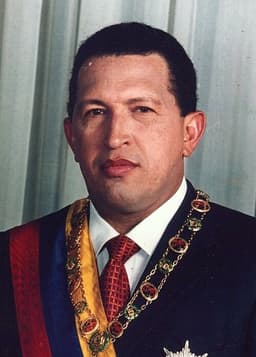
Hugo Chavez
Politician · Modern
50.9Total

Julius Caesar
General · Ancient
82.8Total
Basic Information
Born
1954
-100
Died
—
-44
Era
Modern
Ancient
Nationality
Venezuela
Roman Republic
Occupation
Politician
General
Civilization
Western
Western
Score Comparison
Military (10%)
10.0
88.0
Political (20%)
62.7
78.0
Influence (20%)
56.7
85.0
Legacy (20%)
49.2
82.0
Leadership (15%)
68.0
80.0
Strategy (15%)
38.3
85.0
TOTAL
50.9
82.8
Hugo Chavez — Complete Timeline
1992 AD
Failed 1992 coup attemptPolitical Action◆ Major
Chávez, then a lieutenant colonel, led a failed military coup against President Carlos Andrés Pérez. The coup was crushed, and Chávez was imprisoned. His televised speech accepting responsibility made him a national figure and martyr for the poor.
CoupImprisonmentPolitical Rise
Impact: national
1998 AD
Election as President of VenezuelaPolitical Action
Chávez won the presidential election with 56% of the vote, running on a platform of anti-corruption and social justice. His victory marked the beginning of the Bolivarian Revolution, a leftist movement aimed at transforming Venezuela's political and economic system.
ElectionBolivarian RevolutionPopulism
Impact: nationalconstructive
2001 AD
Nationalization of oil industryReform◆ Major
Chávez enacted a new Hydrocarbons Law that increased state control over the oil industry, raising royalties and taxes on foreign companies. He also reasserted control over PDVSA, the state oil company, using oil revenues to fund social programs.
NationalizationOilEconomic Policy
Impact: nationalconstructive
2002 AD
2002 coup attempt and return to powerPolitical Action◆ Major
Chávez was briefly overthrown in a coup led by business and military sectors, but was restored to power after 47 hours due to mass protests and loyalist military units. The coup attempt deepened political polarization in Venezuela.
CoupPolitical CrisisReturn
Impact: national
2004 AD
Creation of the Bolivarian Alliance for the Americas (ALBA)Political Action◆ Major
Chávez founded ALBA as an alternative to the Free Trade Area of the Americas, promoting regional integration based on solidarity, barter, and social welfare. The alliance included Cuba, Bolivia, and other leftist governments in Latin America.
Regional IntegrationSocialismAnti-imperialism
Impact: regionalconstructive
Julius Caesar — Complete Timeline
58 BC
Gallic WarsWar◆ Major
Caesar, as proconsul of Gaul, launched a series of campaigns that conquered all of Gaul (modern France, Belgium, and parts of Switzerland). He fought numerous battles, including against the Helvetii, the Belgae, and the Gallic chieftain Vercingetorix. The wars brought immense wealth and a loyal army to Caesar.
Gallic WarsConquestRoman Expansion
Impact: regional
49 BC
Crossing the RubiconPolitical Action◆ Major
Caesar led Legio XIII across the Rubicon River into Italy, defying the Roman Senate's order to disband his army. This act triggered a civil war against Pompey and the Optimates, ultimately leading to Caesar's dictatorship and the end of the Roman Republic.
Roman Civil WarEnd of RepublicPower Struggle
Impact: global
48 BC
Battle of PharsalusWar◆ Major
Caesar's outnumbered army defeated the larger forces of Pompey the Great at Pharsalus in Greece. Caesar's tactical use of a reserve line to counter Pompey's cavalry charge proved decisive. Pompey fled to Egypt, where he was assassinated, leaving Caesar as the undisputed master of the Roman world.
Roman Civil WarBattleDecisive Victory
Impact: regional
44 BC
Appointment as Dictator for LifePolitical Action◆ Major
The Roman Senate appointed Caesar dictator perpetuo (dictator for life), granting him unprecedented personal power. This move concentrated military, legislative, and judicial authority in one person, effectively ending the Roman Republic's traditional system of checks and balances and alarming many senators.
DictatorshipEnd of RepublicPower Consolidation
Impact: regionaldestructive
Assassination on the Ides of MarchPolitical Action◆ Major
A group of Roman senators, led by Marcus Junius Brutus and Gaius Cassius Longinus, stabbed Caesar to death at a meeting of the Senate in the Theatre of Pompey. The assassination was intended to restore the Republic, but instead triggered another civil war that led to the rise of the Roman Empire.
AssassinationRoman PoliticsEnd of Republic
Impact: globaldestructive
Expert Analysis
hugo-chavez-vs-julius-caesar
# The Dictator's Dilemma: Caesar and Chávez
On a winter morning in 44 BCE, Julius Caesar walked into the Senate chamber, ignoring the warnings of a soothsayer. Within minutes, he lay bleeding from twenty-three stab wounds, the Republic he had sought to master collapsing around his corpse. Two thousand years later, on an April morning in 2002, Hugo Chávez was marched out of Miraflores Palace in handcuffs, a coup having swept him from power. He was back in office within forty-seven hours. One man died for his ambition; the other survived to see his revolution falter. What separates a legend from a cautionary tale?
Origins
Caesar was born into the patrician Julian clan, a family of ancient prestige but dwindling influence. His uncle Marius had been a populist general, his father a minor praetor. The Roman Republic of the first century BCE was rotting from within—oligarchic, corrupt, and unable to manage an empire. Caesar absorbed this decay as a child, watching Sulla's proscriptions carve up political rivals. He learned early that in Rome, power flowed from armies, not laws.
Hugo Chávez grew up in a mud-walled house in rural Venezuela, the second of seven sons of schoolteachers. His grandmother told him stories of Simón Bolívar, the liberator who had dreamed of a united South America. The Venezuela of Chávez's youth was an oil-rich democracy that had long since abandoned its revolutionary ideals for crony capitalism. Chávez entered the military academy at seventeen, where he absorbed leftist ideas and the cult of Bolívar. Where Caesar saw a republic in need of a master, Chávez saw a democracy in need of a savior.
Rise to Power
Caesar's path was a masterclass in patience and audacity. He climbed the cursus honorum—quaestor, aedile, praetor—borrowing fortunes to buy popularity. In 60 BCE, he formed the First Triumvirate with Pompey and Crassus, an illegal alliance that gave him command of Gaul. For eight years, he conquered a territory larger than Italy, building an army that loved him and a reputation that terrified his enemies. When the Senate ordered him to disband, he crossed the Rubicon River in 49 BCE, a line that meant civil war.
Chávez's rise was faster and more desperate. On February 4, 1992, he led a coup against President Carlos Andrés Pérez, a man widely despised for corruption and austerity. The coup failed; Chávez was captured and allowed to speak on television for ninety seconds. "For now," he said, "the objectives have not been achieved." That phrase made him a folk hero. He served two years in prison, then emerged into a Venezuela devastated by economic collapse. In 1998, he won the presidency with 56% of the vote, promising to dismantle the old order.
Leadership & Governance
Caesar ruled as a military genius and political reformer. As dictator, he overhauled the calendar, granted citizenship to Gauls, launched public works projects, and reformed debt laws. He governed with a blend of clemency and ruthlessness—pardoning former enemies while centralizing power. His military strategy was revolutionary: he built bridges across the Rhine, invaded Britain, and at Alesia defeated a Gallic army three times his size through siegecraft and discipline.
Chávez governed through charisma and oil. He nationalized the petroleum industry in 2001, using windfall profits to fund social missions in health, education, and food subsidies. He created the Bolivarian Alliance for the Americas (ALBA) in 2004 as a counterweight to U.S. influence. But his rule was chaotic: he purged the military, packed the courts, and governed by decree. Inflation rose, crime exploded, and oil production stagnated. Where Caesar built institutions, Chávez dismantled them.
Triumph & Tragedy
Caesar's greatest triumph was his conquest of Gaul, which brought him wealth, glory, and an invincible army. His greatest tragedy was his failure to understand that the Republic would not tolerate a king. He refused the crown three times but accepted dictator for life, a title that sealed his fate. When he was assassinated, he fell not at the hands of enemies but of friends and allies who believed they were saving Rome.
Chávez's triumph was his survival. The 2002 coup lasted less than two days; his supporters flooded the streets, and loyal troops restored him. He returned more radical than before, deepening his revolution. His tragedy was that he never built anything that outlasted him. The oil boom of the 2000s masked structural rot. When oil prices fell, Venezuela collapsed. Chávez died of cancer in 2013, leaving behind a nation in ruins, his revolution a hollow shell.
Character & Destiny
Caesar was cold and calculating, yet capable of great generosity. He forgave his enemies, promoted talent regardless of class, and wrote clear, ruthless prose. His flaw was hubris—he believed his achievements made him indispensable. He dismissed the omens, ignored the warnings, and walked into the Senate unarmed.
Chávez was warm and theatrical, a performer who loved the camera. He wept on television, sang songs, and hugged supporters. His flaw was narcissism—he believed his vision was enough. He centralized everything around his personality, creating a system that could not function without him.
Legacy
Caesar's legacy is the Roman Empire. His adopted heir Octavian became Augustus, the first emperor. His reforms outlived him; the Julian calendar lasted 1,600 years. He is remembered as a founder, a tyrant, a genius, a warning. His name became a title: Kaiser, Tsar.
Chávez's legacy is a cautionary tale. The Bolivarian Revolution survives in name, but Venezuela is a failed state—hunger, hyperinflation, exodus. His supporters remember him as a champion of the poor; his critics as a caudillo who destroyed democracy. He is studied not as a model but as a warning about the limits of personality-driven politics.
Conclusion
Caesar and Chávez both seized history by the throat. Both promised to remake their worlds. One succeeded in building an empire that lasted centuries; the other left a country in rubble. The difference was not ambition—both had that in abundance. It was not intelligence—both were brilliant in their ways. The difference was that Caesar understood power as a structure, something to be built and inherited. Chávez understood power as a performance, something to be felt and consumed. In the end, the Republic that killed Caesar gave birth to an empire. The democracy that embraced Chávez gave way to collapse. Perhaps the lesson is that the most dangerous tyrants are not the ones who seize power, but the ones who fail to understand what they have seized.
Rankings
🥇
Julius CaesarLeader
Mil: 88.0Pol: 78.0Inf: 85.0
82.8
🥈
Hugo Chavez
Mil: 10.0Pol: 62.7Inf: 56.7
50.9
+31.9 behind
How This Comparison Works
Algorithm
Each figure is scored on 6 dimensions (0—100 scale) based on structured historical data: Military (10%), Political (20%), Influence (20%), Legacy (20%), Leadership (15%), Strategy (15%). The weighted total produces the final ranking.
Data Sources
Scores are computed from structured sub-indicators in the database. Scale factors adjust for era (Ancient ×0.85, Modern ×1.0) and civilization size (Eastern ×1.05, Other ×0.80) to account for differences in population and military scale.
Maximum 3 Figures
Comparisons are limited to 2—3 figures to ensure readability and statistical meaningfulness.
Error Margins
±5 points per dimension — Sub-scores are derived from historical records with inherent uncertainty. Two figures within 5 points on a dimension should be considered roughly equivalent in that area.
Total Score Accuracy
±3 points overall — The weighted combination of 6 dimensions produces a total score with approximately ±3 points of uncertainty. Differences of less than 3 points are not statistically significant— the figures are effectively tied.
Known Limitations
- Historical records are incomplete and uneven across civilizations
- Figures from oral-tradition societies may be underrepresented
- Occupation labels can misclassify multi-role figures
- Scores measure capability and impact, not moral character
- Quantitative scoring is a comparison tool, not absolute truth
Capability Radar
Military (10%) — Battles & Warfare
Battles
0
95
Win Rate
0
92
Expansion
0
97
Political (20%) — Governance & Reform
Reform
70
90
Diplomacy
60
85
Economy
40
82
Influence (20%) — Cultural & Global Reach
Cultural
60
88
Global
55
94
Legacy (20%) — Historical Impact
Historical
55
95
Longevity
40
96
Leadership (15%) — Power & Stability
Tenure
75
75
Stability
30
60
Strategy (15%) — Tactics & Innovation
Strategy
0
94
Tactics
0
96
Reform
10
88
Similar Comparisons
Comments & Discussion
VeniVidiVenezuela6/17/2026
The comparison is flawed from the start. Chávez was no Caesar—he didn't cross a Rubicon or conquer Gaul. He staged a failed coup in 1992, then rode an oil boom to power. Caesar's Gallic Wars killed a million people, yes, but he built a lasting administrative system. Chávez's legacy? A wrecked economy and 90% inflation. One was a military genius who shaped history; the other was a lucky demagogue who bankrupted his country.
历史重构者6/17/2026
把查韦斯比作凯撒,这是对罗马共和国的侮辱。凯撒在公元前49年渡过卢比孔河时,赌的是共和国的命运;查韦斯在1992年发动政变时,赌的只是自己的野心。更可笑的是,凯撒被刺杀后,屋大维建立了帝国体系;而查韦斯死后,马杜罗把委内瑞拉变成了监狱。说他们是同类,就像说足球和乒乓球是同一种运动。
DataSkepticMike6/17/2026
Let's talk numbers. Caesar ruled for about 5 years as dictator, while Chávez held power for 14 years. Caesar's assassins numbered 60+; Chávez faced a coup that lasted 47 hours. But here's the kicker: Caesar inherited a debt crisis and left behind civil war; Chávez inherited a $40 oil price and left behind $140 oil price plus hyperinflation. The economic scales don't lie—Caesar's reforms, like the Julian calendar, actually worked.
古典学人6/17/2026
真正的差别在于对制度的理解。凯撒知道元老院只是个表象,所以他用高卢军团稳固权力;查韦斯却妄想用石油支票买通人民,忘了玻利瓦尔革命也需要军事基础。凯撒在公元前46年改革历法,将一年改为365天——这是永久的贡献。查韦斯的“21世纪社会主义”?不过是一堆油烙的短暂幻想罢了。没有永恒的制度,只有永恒的算计。