Loading...
Ignacio Comonfort vs Julius Caesar
Julius Caesar leads by 34.4 pts · 2 figures compared
…
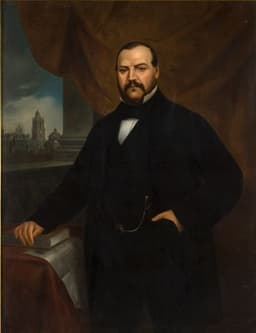
Ignacio Comonfort
Politician · Modern
48.4Total

Julius Caesar
General · Ancient
82.8Total
Basic Information
Born
1812
-100
Died
1863
-44
Era
Modern
Ancient
Nationality
Mexico
Roman Republic
Occupation
Politician
General
Civilization
Western
Western
Score Comparison
Military (10%)
14.9
88.0
Political (20%)
61.3
78.0
Influence (20%)
49.4
85.0
Legacy (20%)
42.5
82.0
Leadership (15%)
62.2
80.0
Strategy (15%)
54.3
85.0
TOTAL
48.4
82.8
Ignacio Comonfort — Complete Timeline
1855 AD
Served as Minister of War under AlvarezPolitical Action
Comonfort served as Minister of War in the interim government of Juan
ReformaMinister of WarÁlvarez
Impact: nationalconstructive
Became President of MexicoPolitical Action◆ Major
Comonfort succeeded
PresidencyReformaLey Lerdo
Impact: nationalconstructive
1857 AD
Issued the Plan of TacubayaPolitical Action
Comonfort issued the Plan of Tacubaya, which repudiated the liberal Constitution of 1857. This act triggered the War of the Reform, as conservatives and liberals clashed over the constitution's validity.
War of the ReformPlan of TacubayaConstitution of 1857
Impact: nationaldestructive
1858 AD
Overthrown and ExiledPolitical Action◆ Major
Comonfort was overthrown by conservative forces led by F
OverthrowExileConservative Coup
Impact: nationaltragic
Julius Caesar — Complete Timeline
58 BC
Gallic WarsWar◆ Major
Caesar, as proconsul of Gaul, launched a series of campaigns that conquered all of Gaul (modern France, Belgium, and parts of Switzerland). He fought numerous battles, including against the Helvetii, the Belgae, and the Gallic chieftain Vercingetorix. The wars brought immense wealth and a loyal army to Caesar.
Gallic WarsConquestRoman Expansion
Impact: regional
49 BC
Crossing the RubiconPolitical Action◆ Major
Caesar led Legio XIII across the Rubicon River into Italy, defying the Roman Senate's order to disband his army. This act triggered a civil war against Pompey and the Optimates, ultimately leading to Caesar's dictatorship and the end of the Roman Republic.
Roman Civil WarEnd of RepublicPower Struggle
Impact: global
48 BC
Battle of PharsalusWar◆ Major
Caesar's outnumbered army defeated the larger forces of Pompey the Great at Pharsalus in Greece. Caesar's tactical use of a reserve line to counter Pompey's cavalry charge proved decisive. Pompey fled to Egypt, where he was assassinated, leaving Caesar as the undisputed master of the Roman world.
Roman Civil WarBattleDecisive Victory
Impact: regional
44 BC
Appointment as Dictator for LifePolitical Action◆ Major
The Roman Senate appointed Caesar dictator perpetuo (dictator for life), granting him unprecedented personal power. This move concentrated military, legislative, and judicial authority in one person, effectively ending the Roman Republic's traditional system of checks and balances and alarming many senators.
DictatorshipEnd of RepublicPower Consolidation
Impact: regionaldestructive
Assassination on the Ides of MarchPolitical Action◆ Major
A group of Roman senators, led by Marcus Junius Brutus and Gaius Cassius Longinus, stabbed Caesar to death at a meeting of the Senate in the Theatre of Pompey. The assassination was intended to restore the Republic, but instead triggered another civil war that led to the rise of the Roman Empire.
AssassinationRoman PoliticsEnd of Republic
Impact: globaldestructive
Expert Analysis
ignacio-comonfort-vs-julius-caesar
# The Crossing and the Retreat
On a January night in 49 BCE, Julius Caesar stood at the banks of the Rubicon River, a thin stream that marked the boundary between his province and Italy proper. To cross with his legions was to declare war on the Roman Republic itself. He hesitated, then uttered a phrase that would echo through millennia: *“The die is cast.”* Less than two thousand years later, on a December night in 1857, another man faced his own Rubicon. Ignacio Comonfort, president of Mexico, stood before the Constitution of 1857—a document he had sworn to defend—and chose to repudiate it. Where Caesar’s crossing forged an empire, Comonfort’s retreat shattered a nation. Why did one man’s gamble lead to immortality, while the other’s led to exile?
Origins
Caesar was born into the patrician Julia clan, a family that claimed descent from the goddess Venus. Yet his Rome was a dying republic, choked by corruption and ruled by a senatorial oligarchy that hoarded power. His childhood witnessed the Social War and the civil wars of Marius and Sulla—brutal lessons in how quickly order could collapse. Caesar learned early that in Rome, survival meant ambition, and ambition meant audacity.
Comonfort was born in 1812 in the city of Puebla, during the final throes of Mexico’s war for independence. His Mexico was a newborn nation already bleeding from fifty years of chaos: military coups, foreign invasions, and the loss of half its territory to the United States. Where Caesar inherited a world of certainty—a republic with centuries of tradition—Comonfort inherited a world of uncertainty. He was a moderate in an age of extremes, a man who believed in reform but feared revolution.
Rise to Power
Caesar’s path was forged through debt and defiance. He borrowed fortunes to buy popularity, sponsored gladiatorial games that emptied his purse but filled his name. He served as governor of Further Spain, where he conquered tribes and amassed wealth. But his true masterstroke came in 58 BCE, when he secured command of Gaul. For eight years, he fought a war of annihilation, defeating over a million Gauls and extending Rome’s frontier to the Rhine. His *Commentaries* turned military reports into propaganda, making him a hero to the Roman mob and a threat to the Senate.
Comonfort rose through the ranks of Mexican liberalism, but his ascent was cautious. He served as Minister of War under Juan Álvarez after the Revolution of Ayutla in 1855, a moderate in a cabinet of radicals. When Álvarez resigned, Comonfort became president—not through conquest, but compromise. He was the man both liberals and conservatives could tolerate, a bridge between irreconcilable worlds. Where Caesar seized power, Comonfort was handed it, and that difference would prove fatal.
Leadership & Governance
Caesar governed as he fought: decisively, ruthlessly, and with an eye on eternity. As dictator, he reformed the calendar, granted citizenship to provincials, launched public works, and centralized power in his own hands. His military genius lay in speed and surprise—he defeated Pompey’s larger armies at Pharsalus by attacking before dawn, and crushed the last Republican holdouts at Munda through sheer personal courage. His political wisdom was colder: he pardoned enemies to win allies, but never forgot a threat.
Comonfort’s governance was a series of half-measures. He enacted the Ley Lerdo, which forced the Church to sell its lands, and the Ley Juárez, which abolished special courts for clergy and soldiers. These were bold reforms, but Comonfort lacked the nerve to enforce them fully. He tried to placate conservatives while satisfying liberals, and pleased no one. His military record was negligible—he was a politician, not a general, and his strategy consisted of hoping the crisis would pass.
Triumph & Tragedy
Caesar’s greatest triumph was Gaul—the conquest of a continent that made him the richest man in Rome and gave him an army loyal to him alone. His greatest tragedy was the Ides of March, 44 BCE, when sixty senators stabbed him to death in the Senate chamber. He died at the height of his power, bleeding at the feet of Pompey’s statue, having achieved everything except the one thing he could not control: his own survival.
Comonfort’s triumph was the Constitution of 1857, a liberal masterpiece that abolished slavery, established civil liberties, and separated church and state. His tragedy was the Plan of Tacubaya, issued in December of that same year, when he repudiated the very constitution he had championed. He hoped to prevent civil war by moderating the reforms; instead, he triggered the War of Reform, a three-year bloodbath that left Mexico in ruins. By 1858, he was overthrown and exiled to the United States, a man without a country.
Character & Destiny
Caesar’s character was forged in fire. He was arrogant, calculating, and utterly convinced of his own destiny. When pirates captured him as a young man, he laughed at their ransom demand and promised to crucify them—a promise he kept after his release. He forgave his enemies, but only because he believed they could never harm him again. His flaw was hubris: he thought the Senate would never dare to strike him down in public.
Comonfort’s character was forged in doubt. He was intelligent, honorable, and genuinely desired peace, but he lacked the ruthlessness that history demands of reformers. He tried to be Caesar and Cato at once—to cross the Rubicon and then retreat—and found that the die, once cast, cannot be recast. His flaw was indecision: he thought moderation could save Mexico, but moderation only destroyed him.
Legacy
Caesar’s name became a title: “Caesar” meant emperor for two thousand years, from Rome to Russia to Germany. His reforms outlasted the Republic he destroyed, and his *Commentaries* remain a masterpiece of Latin prose. He is remembered as the man who crossed the Rubicon, the father of the Roman Empire, the lover of Cleopatra, the victim of Brutus’s knife.
Comonfort is remembered, if at all, as a footnote. The War of Reform that he triggered was won by the liberals he abandoned, and his name is overshadowed by Benito Juárez, the indigenous president who defeated the French and restored the Republic. In Mexico, he is taught as a cautionary tale—the moderate who tried to stand between two fires and was burned to ash.
Conclusion
The difference between Caesar and Comonfort is not merely one of scale or skill, but of nerve. Caesar understood that history rewards those who commit fully to their ambitions. He crossed the Rubicon knowing that there was no turning back, and he accepted the consequences—even the daggers of the Senate. Comonfort understood that history punishes those who hesitate. He stood at his own Rubicon, looked at the Constitution of 1857, and blinked.
In the end, both men were destroyed by the forces they tried to control. But Caesar’s destruction was a climax, a tragedy in five acts that still captivates audiences. Comonfort’s destruction was an anticlimax, a quiet exile that ended in a stray bullet during the French intervention in 1863. One man’s gamble changed the world; the other’s hesitation changed nothing. The die is cast—but only if you have the courage to throw it.
Rankings
🥇
Julius CaesarLeader
Mil: 88.0Pol: 78.0Inf: 85.0
82.8
🥈
Ignacio Comonfort
Mil: 14.9Pol: 61.3Inf: 49.4
48.4
+34.4 behind
How This Comparison Works
Algorithm
Each figure is scored on 6 dimensions (0—100 scale) based on structured historical data: Military (10%), Political (20%), Influence (20%), Legacy (20%), Leadership (15%), Strategy (15%). The weighted total produces the final ranking.
Data Sources
Scores are computed from structured sub-indicators in the database. Scale factors adjust for era (Ancient ×0.85, Modern ×1.0) and civilization size (Eastern ×1.05, Other ×0.80) to account for differences in population and military scale.
Maximum 3 Figures
Comparisons are limited to 2—3 figures to ensure readability and statistical meaningfulness.
Error Margins
±5 points per dimension — Sub-scores are derived from historical records with inherent uncertainty. Two figures within 5 points on a dimension should be considered roughly equivalent in that area.
Total Score Accuracy
±3 points overall — The weighted combination of 6 dimensions produces a total score with approximately ±3 points of uncertainty. Differences of less than 3 points are not statistically significant— the figures are effectively tied.
Known Limitations
- Historical records are incomplete and uneven across civilizations
- Figures from oral-tradition societies may be underrepresented
- Occupation labels can misclassify multi-role figures
- Scores measure capability and impact, not moral character
- Quantitative scoring is a comparison tool, not absolute truth
Capability Radar
Military (10%) — Battles & Warfare
Battles
20
95
Win Rate
25
92
Expansion
5
97
Political (20%) — Governance & Reform
Reform
55
90
Diplomacy
45
85
Economy
30
82
Influence (20%) — Cultural & Global Reach
Cultural
20
88
Global
15
94
Legacy (20%) — Historical Impact
Historical
35
95
Longevity
20
96
Leadership (15%) — Power & Stability
Tenure
40
75
Stability
20
60
Strategy (15%) — Tactics & Innovation
Strategy
20
94
Tactics
15
96
Reform
10
88
Similar Comparisons
Comments & Discussion
No comments yet. Be the first to share your thoughts!