Loading...
This comparison has not been analyzed yet.
One-time AI generation (~1 minute). Scores and timeline are already available below.
Ilir Meta vs Purnomo Yusgiantoro
Ilir Meta leads by 4.2 pts · 2 figures compared
…
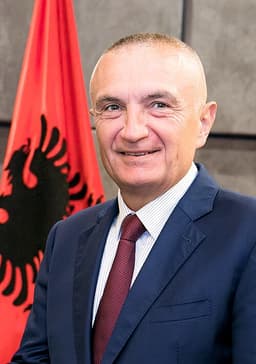
Ilir Meta
Politician · Modern
51.8Total

Purnomo Yusgiantoro
Politician · Modern
47.6Total
Basic Information
Born
1969
1951
Died
—
—
Era
Modern
Modern
Nationality
Albania
Indonesia
Occupation
Politician
Politician
Civilization
Western
Eastern
Score Comparison
Military (10%)
49.4
12.8
Political (20%)
68.0
68.0
Influence (20%)
52.5
51.0
Legacy (20%)
44.2
40.0
Leadership (15%)
53.2
72.0
Strategy (15%)
44.6
25.9
TOTAL
51.8
47.6
Ilir Meta — Complete Timeline
2017 AD
Elected President of AlbaniaPolitical Action◆ Major
Meta was elected President by parliament, serving until 2022. His presidency was marked by frequent clashes with Prime Minister Edi Rama, leading to political instability.
PresidencyPoliticsAlbania
Impact: nationaldestructive
2019 AD
Clashed with Prime Minister Edi Rama over judicial reformPolitical Action◆ Major
Meta opposed Rama's judicial reform, vetoing laws and calling for a referendum. This led to a constitutional crisis and protests, with the EU mediating the dispute.
Judicial ReformPolitical CrisisEU
Impact: nationaldestructive
2021 AD
Impeached by parliamentPolitical Action◆ Major
Meta was impeached by the Albanian parliament for allegedly violating the constitution by interfering in elections. The Constitutional Court later dismissed the impeachment, but the process deepened political divisions.
ImpeachmentConstitutional CrisisAlbania
Impact: nationaldestructive
2022 AD
Ended his presidencyPolitical Action
Meta's term ended in 2022, and he was succeeded by Bajram Begaj. His presidency was one of the most contentious in Albanian history, marked by constant conflict with the government.
PresidencyEnd of TermPolitics
Impact: national
Purnomo Yusgiantoro — Complete Timeline
2009 AD
Appointed as Minister of Energy and Mineral ResourcesPolitical Action◆ Major
Purnomo Yusgiantoro was appointed as Indonesia's Minister of Energy and Mineral Resources under President Susilo Bambang Yudhoyono. He oversaw the country's oil, gas, and mining sectors during a period of high commodity prices.
Energy PolicyNatural ResourcesYudhoyono
Impact: national
Served as OPEC PresidentPolitical Action◆ Major
Purnomo Yusgiantoro served as President of the Organization of the Petroleum Exporting Countries (OPEC) for one year. He represented Indonesia's interests in global oil market negotiations, though Indonesia later suspended its OPEC membership.
OPECOilInternational Relations
Impact: global
2013 AD
Oversaw Fuel Subsidy ReductionReform◆ Major
Purnomo Yusgiantoro implemented a reduction in fuel subsidies, raising gasoline and diesel prices by 44% and 22% respectively. The policy aimed to reduce the budget deficit but sparked public protests and inflation.
Fuel SubsidyEconomic ReformProtests
Impact: nationaldestructive
2014 AD
Appointed as Minister of DefensePolitical Action◆ Major
Purnomo Yusgiantoro was appointed as Indonesia's Minister of Defense in the final cabinet of President Susilo Bambang Yudhoyono. He oversaw military modernization and defense policy, including the purchase of new equipment.
DefenseMilitaryYudhoyono
Impact: national
This comparison has not been analyzed yet.
One-time AI generation (~1 minute). Scores and timeline are already available below.
Rankings
🥇
Ilir MetaLeader
Mil: 49.4Pol: 68.0Inf: 52.5
51.8
🥈
Purnomo Yusgiantoro
Mil: 12.8Pol: 68.0Inf: 51.0
47.6
+4.2 behind
How This Comparison Works
Algorithm
Each figure is scored on 6 dimensions (0—100 scale) based on structured historical data: Military (10%), Political (20%), Influence (20%), Legacy (20%), Leadership (15%), Strategy (15%). The weighted total produces the final ranking.
Data Sources
Scores are computed from structured sub-indicators in the database. Scale factors adjust for era (Ancient ×0.85, Modern ×1.0) and civilization size (Eastern ×1.05, Other ×0.80) to account for differences in population and military scale.
Maximum 3 Figures
Comparisons are limited to 2—3 figures to ensure readability and statistical meaningfulness.
Error Margins
±5 points per dimension — Sub-scores are derived from historical records with inherent uncertainty. Two figures within 5 points on a dimension should be considered roughly equivalent in that area.
Total Score Accuracy
±3 points overall — The weighted combination of 6 dimensions produces a total score with approximately ±3 points of uncertainty. Differences of less than 3 points are not statistically significant— the figures are effectively tied.
Known Limitations
- Historical records are incomplete and uneven across civilizations
- Figures from oral-tradition societies may be underrepresented
- Occupation labels can misclassify multi-role figures
- Scores measure capability and impact, not moral character
- Quantitative scoring is a comparison tool, not absolute truth
Capability Radar
Military (10%) — Battles & Warfare
Battles
30
13
Win Rate
33
18
Expansion
33
21
Political (20%) — Governance & Reform
Reform
45
40
Diplomacy
55
55
Economy
40
50
Influence (20%) — Cultural & Global Reach
Cultural
30
20
Global
25
25
Legacy (20%) — Historical Impact
Historical
35
20
Longevity
30
20
Leadership (15%) — Power & Stability
Tenure
65
60
Stability
35
50
Strategy (15%) — Tactics & Innovation
Strategy
39
26
Tactics
44
25
Reform
47
30
Similar Comparisons
Comments & Discussion
No comments yet. Be the first to share your thoughts!