Loading...
Ilir Meta vs Napoleon Bonaparte
Napoleon Bonaparte leads by 19.1 pts · 2 figures compared
…
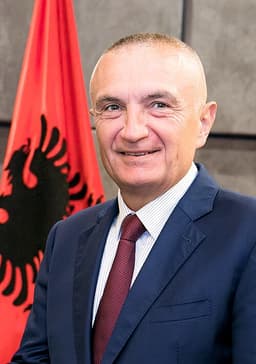
Ilir Meta
Politician · Modern
51.8Total

Napoleon Bonaparte
General · Modern
70.9Total
Basic Information
Born
1969
1769
Died
—
1821
Era
Modern
Modern
Nationality
Albania
France
Occupation
Politician
General
Civilization
Western
Western
Score Comparison
Military (10%)
49.4
94.0
Political (20%)
68.0
72.0
Influence (20%)
52.5
40.0
Legacy (20%)
44.2
80.0
Leadership (15%)
53.2
78.0
Strategy (15%)
44.6
90.0
TOTAL
51.8
70.9
Ilir Meta — Complete Timeline
2017 AD
Elected President of AlbaniaPolitical Action◆ Major
Meta was elected President by parliament, serving until 2022. His presidency was marked by frequent clashes with Prime Minister Edi Rama, leading to political instability.
PresidencyPoliticsAlbania
Impact: nationaldestructive
2019 AD
Clashed with Prime Minister Edi Rama over judicial reformPolitical Action◆ Major
Meta opposed Rama's judicial reform, vetoing laws and calling for a referendum. This led to a constitutional crisis and protests, with the EU mediating the dispute.
Judicial ReformPolitical CrisisEU
Impact: nationaldestructive
2021 AD
Impeached by parliamentPolitical Action◆ Major
Meta was impeached by the Albanian parliament for allegedly violating the constitution by interfering in elections. The Constitutional Court later dismissed the impeachment, but the process deepened political divisions.
ImpeachmentConstitutional CrisisAlbania
Impact: nationaldestructive
2022 AD
Ended his presidencyPolitical Action
Meta's term ended in 2022, and he was succeeded by Bajram Begaj. His presidency was one of the most contentious in Albanian history, marked by constant conflict with the government.
PresidencyEnd of TermPolitics
Impact: national
Napoleon Bonaparte — Complete Timeline
1799 AD
Coup of 18 BrumaireOther◆ Major
Napoleon Bonaparte, with support from his brother Lucien and key political figures, overthrew the Directory in a bloodless coup. He established the Consulate with himself as First Consul, effectively becoming the ruler of France. This event ended the French Revolution's most unstable period.
French RevolutionCoupRise to Power
Impact: regional
1804 AD
Promulgation of the Napoleonic CodeOther◆ Major
Napoleon enacted the Civil Code of the French, known as the Napoleonic Code, a comprehensive set of laws that replaced the fragmented feudal legal systems. The code established legal equality, protected property rights, and secularized law. It became the basis for legal systems in many European and world countries.
Legal ReformNapoleonic CodeCivil Law
Impact: globalconstructive
1805 AD
Battle of AusterlitzWar◆ Major
Napoleon's Grande Arm
Napoleonic WarsBattleDecisive Victory
Impact: global
1812 AD
Invasion of RussiaWar◆ Major
Napoleon led the Grande Arm
Napoleonic WarsInvasionDisaster
Impact: globaldestructive
1815 AD
Battle of WaterlooWar◆ Major
Napoleon's French army was defeated by the combined forces of the Duke of Wellington's Anglo-Allied army and Gebhard Leberecht von Bl
Napoleonic WarsBattleFinal Defeat
Impact: globaldestructive
Expert Analysis
ilir-meta-vs-napoleon-bonaparte
# The Corsican and the Albanian: Two Men Who Shaped Their Nations
On a June morning in 1815, Napoleon Bonaparte stood on a muddy field near Waterloo, watching his Imperial Guard march into the guns of the Duke of Wellington. Two hundred years later, in a cramped parliament chamber in Tirana, Ilir Meta raised his voice against a prime minister he accused of destroying Albania’s judiciary. One man had conquered half of Europe; the other had spent decades fighting for influence in a country smaller than Belgium. Yet both were driven by the same raw hunger for power, and both left their nations transformed—though in vastly different ways.
Origins
Napoleon was born in 1769 on the island of Corsica, a place that had just been sold to France by the Republic of Genoa. His family was minor nobility, but they were poor, and young Napoleon grew up speaking Italian, not French. He entered a military academy at nine, where classmates mocked his accent and his small stature. This outsider status forged a fierce ambition: he would prove himself not just equal to the French aristocracy, but superior to them. The French Revolution, which erupted when he was twenty, shattered the old order and opened doors for men of talent. Napoleon seized that opportunity with both hands.
Ilir Meta was born exactly two centuries later, in 1969, in the small Albanian village of Çorovodë. His family were farmers, and his childhood unfolded under the iron grip of Enver Hoxha’s Stalinist regime. Albania was the most isolated country in Europe—bristling with bunkers, cut off from the world, and ruled by a paranoid dictator. Meta grew up in a world where speaking the wrong word could land you in prison. When communism collapsed in 1991, he was twenty-two, a student activist hungry for change. Like Napoleon, he was a product of upheaval, a young man from nowhere who saw chaos as a ladder.
Rise to Power
Napoleon’s rise was meteoric. At twenty-four, he drove the British out of Toulon and was promoted to brigadier general. At twenty-six, he crushed a royalist uprising in Paris with a "whiff of grapeshot." By thirty, he had conquered Italy and Egypt, and by thirty-five he had crowned himself Emperor of the French. Each victory was a stepping stone, but the key was his ability to combine military brilliance with political cunning. He didn’t just win battles; he wrote newspapers, staged propaganda, and presented himself as the savior of the Revolution. His coup of 18 Brumaire in 1799 was a masterclass in seizing power while pretending to save the republic.
Meta’s path was slower and more bureaucratic. He entered politics in the early 1990s as a member of the Socialist Party, rising through the ranks as Albania struggled to build democracy. He became Prime Minister in 1999 at age thirty—young, but not unusually so for a post-communist leader. His rise was not marked by battlefield triumphs but by coalition-building, backroom deals, and careful positioning. He served as prime minister for three years, then as speaker of parliament, and finally, in 2017, was elected President. Where Napoleon stormed into history, Meta crept into it, step by cautious step.
Leadership & Governance
Napoleon ruled as a dictator, but a remarkably effective one. His Napoleonic Code standardized French law, abolished feudalism, and enshrined meritocracy. He built roads, schools, and a centralized bureaucracy. He was a military genius who reorganized armies into corps, used artillery with devastating precision, and exploited speed and surprise. But his governance was also deeply flawed: he censored the press, suppressed dissent, and placed family members on thrones across Europe. His ambition was limitless, and that ultimately proved his undoing.
Meta governed in a very different context. As president of a small, fragile democracy, his powers were largely ceremonial. Yet he used them aggressively, vetoing laws, calling for referendums, and clashing with Prime Minister Edi Rama over judicial reform. In 2019, he vetoed a law that would have overhauled Albania’s justice system, arguing it gave the government too much control. Rama called it obstruction; Meta called it defending the constitution. The conflict escalated into a constitutional crisis, with Meta accusing Rama of authoritarianism, and Rama accusing Meta of undermining reform. Where Napoleon commanded armies, Meta commanded only a microphone—but he used it relentlessly.
Triumph & Tragedy
Napoleon’s greatest triumph came in 1805 at Austerlitz, where he crushed the armies of Austria and Russia in a single day. It was his masterpiece: a perfect trap sprung with perfect timing. His greatest tragedy was the 1812 invasion of Russia, where he lost over 400,000 men to winter, disease, and guerrilla warfare. He never recovered. Exiled to Elba, he escaped and returned to power for a Hundred Days, but Waterloo ended it all. He died in 1821 on Saint Helena, a prisoner of the British, at age fifty-one.
Meta’s triumphs were smaller but real. He served as president for five years, the first Albanian president to complete a full term without resignation or assassination. His tragedy came in 2021, when parliament impeached him for allegedly interfering in elections—the first impeachment of an Albanian president. The Constitutional Court later overturned the impeachment, but the damage was done. Meta left office in 2022 with his reputation battered, his legacy contested. He had fought for influence, but in a country where power is personal and institutions are weak, influence often comes at the cost of credibility.
Character & Destiny
Napoleon was a man of immense will, intelligence, and ego. He believed he was destined to reshape the world, and he very nearly did. His character drove his success—the relentless energy, the strategic brilliance, the ability to inspire loyalty—but also his downfall. He could not stop. He could not compromise. He saw every treaty as a temporary truce, every ally as a future enemy. That hunger for more is what made him great, and what destroyed him.
Meta is a different type of politician: pragmatic, resilient, and deeply embedded in Albania’s clientelist networks. He has survived multiple political shifts, switching parties, forming coalitions, and outlasting rivals. His character is not that of a conqueror but of a survivor. He has been called many things—opportunist, spoiler, populist—but never a visionary. His destiny was shaped not by grand ambition but by the limits of his country. Albania is small, poor, and trapped between great powers. Meta could not conquer Europe; he could only fight for a piece of Tirana.
Legacy
Napoleon’s legacy is immense. The Napoleonic Code influenced legal systems across Europe, Latin America, and beyond. He redefined warfare, nationalism, and the role of the state. He is remembered as both a genius and a tyrant, a liberator and a conqueror. His name is synonymous with ambition, and his shadow falls across two centuries of European history.
Meta’s legacy is far narrower. He is remembered as a polarizing figure who helped stabilize Albania’s democracy in its early years but also contributed to its dysfunction. His presidency was one of the most contentious in Albanian history, marked by constant conflict with the prime minister. He will likely be seen as a transitional figure—a politician who played the game well but never changed the rules. In a hundred years, schoolchildren in Albania may remember his name; outside the Balkans, he will be forgotten.
Conclusion
Napoleon and Ilir Meta were both products of revolution, both outsiders who climbed to the top of their nations. But the scale of their stages was radically different. Napoleon inherited a continent in upheaval and reshaped it with fire and law. Meta inherited a country in ruins and fought to keep it from collapsing into chaos. One built an empire; the other built a career. Yet both understood the same truth: in times of crisis, the boldest and most ruthless survive. The difference is simply what the world allowed them to take.
Rankings
🥇
Napoleon BonaparteLeader
Mil: 94.0Pol: 72.0Inf: 40.0
70.9
🥈
Ilir Meta
Mil: 49.4Pol: 68.0Inf: 52.5
51.8
+19.1 behind
How This Comparison Works
Algorithm
Each figure is scored on 6 dimensions (0—100 scale) based on structured historical data: Military (10%), Political (20%), Influence (20%), Legacy (20%), Leadership (15%), Strategy (15%). The weighted total produces the final ranking.
Data Sources
Scores are computed from structured sub-indicators in the database. Scale factors adjust for era (Ancient ×0.85, Modern ×1.0) and civilization size (Eastern ×1.05, Other ×0.80) to account for differences in population and military scale.
Maximum 3 Figures
Comparisons are limited to 2—3 figures to ensure readability and statistical meaningfulness.
Error Margins
±5 points per dimension — Sub-scores are derived from historical records with inherent uncertainty. Two figures within 5 points on a dimension should be considered roughly equivalent in that area.
Total Score Accuracy
±3 points overall — The weighted combination of 6 dimensions produces a total score with approximately ±3 points of uncertainty. Differences of less than 3 points are not statistically significant— the figures are effectively tied.
Known Limitations
- Historical records are incomplete and uneven across civilizations
- Figures from oral-tradition societies may be underrepresented
- Occupation labels can misclassify multi-role figures
- Scores measure capability and impact, not moral character
- Quantitative scoring is a comparison tool, not absolute truth
Capability Radar
Military (10%) — Battles & Warfare
Battles
30
95
Win Rate
33
90
Expansion
33
95
Political (20%) — Governance & Reform
Reform
45
95
Diplomacy
55
80
Economy
40
85
Influence (20%) — Cultural & Global Reach
Cultural
30
85
Global
25
90
Legacy (20%) — Historical Impact
Historical
35
95
Longevity
30
90
Leadership (15%) — Power & Stability
Tenure
65
85
Stability
35
70
Strategy (15%) — Tactics & Innovation
Strategy
39
95
Tactics
44
98
Reform
47
92
Similar Comparisons
Comments & Discussion
Hussar of the Pen6/17/2026
Comparing Meta to Napoleon is like comparing a chess grandmaster to a toddler playing checkers. Napoleon rewrote Europe's political map and legal code, creating institutions that still function today. Meta's greatest "achievement" is presiding over a judiciary so corrupt the EU abandoned vetting. One man conquered entire kingdoms; the other couldn't even conquer Albania's court system. Stick to calling him "Ilir, the Eternal Backbencher."|zh|拿砲兵的馬|这位"巴尔干拿破仑"的军事战绩是什么?是在议会走廊游说吗?拿破仑的意大利战役把奥地利打得落花流水
数据举证者6/17/2026
我查过两人履历:拿破仑指挥过70多场战役,统治过7千万人口,编纂的民法典至今影响4亿人。梅塔最"辉煌"的数据是什么?历任7个部长职位但全部被同僚指控腐败,总统任期被议会弹劾4次。把这两个放在同一标题下比较,就像把珠穆朗玛峰和自家后院土堆并列比较海拔高度。
History's Balance Keeper6/17/2026
The comparison isn't entirely bankrupt. Both men exploited institutional breakdowns to rise from obscurity. Napoleon used the Revolution's chaos; Meta surfed Albania's post-communist vacuum. Both also overreached—Napoleon in Russia, Meta by cozying up to key DUI figures. But here the parallels collapse: Napoleon rebuilt France's bureaucracy; Meta's tenure saw Albania's EU accession talks stall. One man leaves a legacy of codes and roads; the other leaves a folder of parliamentary walkouts.