Loading...
Imelda Marcos vs Julius Caesar
Julius Caesar leads by 37.8 pts · 2 figures compared
…
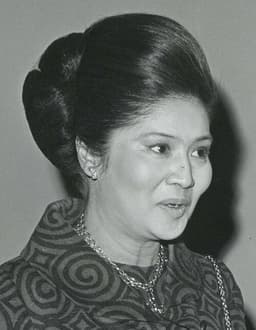
Imelda Marcos
Politician · Modern
45.0Total

Julius Caesar
General · Ancient
82.8Total
Basic Information
Born
1929
-100
Died
—
-44
Era
Modern
Ancient
Nationality
Philippines
Roman Republic
Occupation
Politician
General
Civilization
Eastern
Western
Score Comparison
Military (10%)
17.0
88.0
Political (20%)
29.3
78.0
Influence (20%)
56.4
85.0
Legacy (20%)
45.0
82.0
Leadership (15%)
67.0
80.0
Strategy (15%)
35.2
85.0
TOTAL
45.0
82.8
Imelda Marcos — Complete Timeline
1969 AD
Led the construction of the Cultural Center of the PhilippinesCultural
Imelda Marcos spearheaded the construction of the CCP complex, including the main theater and the Folk Arts Theater. The project was part of her 'edifice complex' and aimed to promote Filipino arts and culture. It was criticized for its cost during a period of poverty.
CultureArchitectureArts
Impact: nationalconstructive
1975 AD
Appointed Governor of Metro ManilaPolitical Action◆ Major
President Ferdinand Marcos appointed Imelda Marcos as Governor of Metro Manila. She oversaw the construction of cultural centers, hospitals, and infrastructure projects. However, her tenure was also marked by allegations of corruption and extravagance.
GovernorMetro ManilaMarcos
Impact: regional
1986 AD
Fled to Hawaii after the People Power RevolutionPolitical Action◆ Major
After the fall of the Marcos regime, Imelda fled with her husband to Hawaii on a US Air Force plane. She was later charged with corruption and human rights abuses. The Marcoses left behind an estimated $10 billion in stolen wealth.
ExilePeople PowerCorruption
Impact: nationaltragic
Acquired a collection of over 3,000 pairs of shoesOther
After the Marcoses fled, the public discovered Imelda's massive shoe collection in the Malaca
ScandalLuxuryCorruption
Impact: globaldestructive
Julius Caesar — Complete Timeline
58 BC
Gallic WarsWar◆ Major
Caesar, as proconsul of Gaul, launched a series of campaigns that conquered all of Gaul (modern France, Belgium, and parts of Switzerland). He fought numerous battles, including against the Helvetii, the Belgae, and the Gallic chieftain Vercingetorix. The wars brought immense wealth and a loyal army to Caesar.
Gallic WarsConquestRoman Expansion
Impact: regional
49 BC
Crossing the RubiconPolitical Action◆ Major
Caesar led Legio XIII across the Rubicon River into Italy, defying the Roman Senate's order to disband his army. This act triggered a civil war against Pompey and the Optimates, ultimately leading to Caesar's dictatorship and the end of the Roman Republic.
Roman Civil WarEnd of RepublicPower Struggle
Impact: global
48 BC
Battle of PharsalusWar◆ Major
Caesar's outnumbered army defeated the larger forces of Pompey the Great at Pharsalus in Greece. Caesar's tactical use of a reserve line to counter Pompey's cavalry charge proved decisive. Pompey fled to Egypt, where he was assassinated, leaving Caesar as the undisputed master of the Roman world.
Roman Civil WarBattleDecisive Victory
Impact: regional
44 BC
Appointment as Dictator for LifePolitical Action◆ Major
The Roman Senate appointed Caesar dictator perpetuo (dictator for life), granting him unprecedented personal power. This move concentrated military, legislative, and judicial authority in one person, effectively ending the Roman Republic's traditional system of checks and balances and alarming many senators.
DictatorshipEnd of RepublicPower Consolidation
Impact: regionaldestructive
Assassination on the Ides of MarchPolitical Action◆ Major
A group of Roman senators, led by Marcus Junius Brutus and Gaius Cassius Longinus, stabbed Caesar to death at a meeting of the Senate in the Theatre of Pompey. The assassination was intended to restore the Republic, but instead triggered another civil war that led to the rise of the Roman Empire.
AssassinationRoman PoliticsEnd of Republic
Impact: globaldestructive
Expert Analysis
imelda-marcos-vs-julius-caesar
# The Dictator and the First Lady: Two Paths to Power, Two Tragedies of Legacy
On a March morning in 44 BCE, Julius Caesar fell beneath twenty-three dagger strokes in the Senate chamber of Rome. The blood pooled on the marble floor, and with it, the hope of a republic that had already died. Nearly two thousand years later, in February 1986, Imelda Marcos fled Manila in the dead of night, leaving behind a palace filled with shoes—3,000 pairs—and a nation that had risen against her husband’s regime. One died in glory, the other lived in infamy. Both sought to shape history, but only one succeeded in being remembered as a founder. The other became a punchline.
Origins
Caesar was born into the patrician Julian clan, a family that traced its lineage to the goddess Venus. But the Rome of his youth was a violent, unstable republic, wracked by civil wars and the ambitions of generals like Marius and Sulla. Caesar’s father died when he was sixteen, leaving him to navigate a world where noble birth meant little without money or military command. He learned early that survival depended on alliances, audacity, and a willingness to risk everything.
Imelda Marcos, born Imelda Romualdez in 1929, grew up in a different kind of chaos. The Philippines was an American colony, and her family had once been wealthy landowners in Leyte. But her father died when she was nine, and the family fell into poverty. She later described sleeping on a cardboard box as a child. Where Caesar learned to wield a sword and a speech, Imelda learned to wield a smile and a song—she was a beauty queen, a singer, and a woman who understood that in a world of men, charm was a currency more powerful than gold.
Rise to Power
Caesar’s rise was a masterclass in calculated risk. He borrowed fortunes to fund political campaigns, allied with the wealthy Crassus and the popular Pompey, and then outmaneuvered them both. His conquest of Gaul (58–50 BCE) was not just a military campaign; it was a personal empire-building project. He wrote his own commentaries, crafted his own legend, and when the Senate ordered him to disband his army, he crossed the Rubicon River in 49 BCE, declaring war on the republic itself. The die was cast.
Imelda’s rise was different. She met Ferdinand Marcos in 1954, a rising politician who saw in her beauty a perfect campaign asset. Within eleven days, they were married. When Ferdinand became president in 1965, Imelda became his most powerful weapon—a diplomat, a fundraiser, a symbol of Filipino elegance. She was not elected; she was appointed. In 1975, Ferdinand made her Governor of Metro Manila, a position with real power over the capital’s development. She built cultural centers, hospitals, and hotels, using state funds as her personal budget.
Leadership & Governance
Caesar governed as a reformer and a dictator. He reorganized the calendar, granted citizenship to Gauls, reformed debt laws, and initiated massive public works. His military genius was undeniable—88 out of 100 in strategy—but his political wisdom was more fragile. He pardoned his enemies, believing that mercy would win loyalty. Instead, it bred contempt. He centralized power, but he never created a stable system to replace the republic he destroyed.
Imelda governed as a builder and a consumer. Her Cultural Center of the Philippines, completed in 1969, was a gleaming monument to her taste—and to the corruption that funded it. She oversaw the construction of the Folk Arts Theater, the Philippine Heart Center, and the Manila Film Center. But while she built, the nation’s economy collapsed under Ferdinand’s martial law. Her famous shoe collection, discovered after their flight, became a symbol of grotesque excess: 3,000 pairs of shoes for a woman who governed a nation where millions lived in poverty.
Triumph & Tragedy
Caesar’s greatest triumph was Gaul—a conquest that added a vast territory to the Roman world and made him the most powerful man in history. His greatest tragedy was his assassination, not because he died, but because he died without a clear successor. The civil wars that followed, the rise of Augustus, and the end of the republic were all consequences of his failure to institutionalize his power.
Imelda’s greatest triumph was survival. She returned to the Philippines in 1991, was elected to Congress in 1995 and again in 2010, and died a free woman in 2024 at the age of 95. Her greatest tragedy was not her fall, but her legacy. While Caesar is remembered as a founder of empires, Imelda is remembered as a punchline—a woman whose shoes overshadowed her politics, whose beauty masked her cruelty, whose ambition ended in exile. She was acquitted of corruption charges, but history convicted her in the court of public opinion.
Character & Destiny
Caesar was driven by *ambitio*—a Latin word that meant both ambition and the relentless pursuit of honor. He believed he was destined for greatness, and he shaped his own myth with every speech, every battle, every book. His personality was magnetic but ruthless: he could weep for a friend and then order the massacre of a tribe. He died because he could not imagine that anyone would dare to kill him.
Imelda was driven by a different force: the need to be seen. She collected shoes not because she needed them, but because they were visible proof of her status. She sang for world leaders, danced with dictators, and built monuments to her own taste. Her personality was charming but hollow: she could weep for the poor while hoarding wealth. She survived because she never stopped believing that she deserved to be remembered.
Legacy
Caesar’s legacy is the Roman Empire. His name became a title—*caesar*—used by emperors, kings, and even the German *Kaiser* and Russian *Tsar*. His writings, his reforms, his calendar, and his vision of a unified Mediterranean world shaped Western civilization for two millennia. He is studied in military academies, debated in political science classes, and remembered as both a hero and a tyrant.
Imelda’s legacy is a cautionary tale. She is remembered not for her buildings, but for her shoes. Her collection of 3,000 pairs became a symbol of the Marcos regime’s corruption, a shorthand for the gap between the powerful and the powerless. She is studied as a case study in authoritarian aesthetics, in the intersection of glamour and dictatorship, in the tragedy of a woman who had everything except a sense of proportion.
Conclusion
Two figures, two eras, two kinds of power. Caesar built an empire; Imelda built a wardrobe. One changed the course of history; the other became a footnote. But both reveal the same truth: that power, when divorced from responsibility, destroys even those who wield it. Caesar’s ambition ended in blood on the Senate floor. Imelda’s ambition ended in a palace of shoes, empty and silent. History remembers the builder and the collector, but only one of them built something that lasted. The other built a monument to herself, and it crumbled the moment she left.
Rankings
🥇
Julius CaesarLeader
Mil: 88.0Pol: 78.0Inf: 85.0
82.8
🥈
Imelda Marcos
Mil: 17.0Pol: 29.3Inf: 56.4
45.0
+37.8 behind
How This Comparison Works
Algorithm
Each figure is scored on 6 dimensions (0—100 scale) based on structured historical data: Military (10%), Political (20%), Influence (20%), Legacy (20%), Leadership (15%), Strategy (15%). The weighted total produces the final ranking.
Data Sources
Scores are computed from structured sub-indicators in the database. Scale factors adjust for era (Ancient ×0.85, Modern ×1.0) and civilization size (Eastern ×1.05, Other ×0.80) to account for differences in population and military scale.
Maximum 3 Figures
Comparisons are limited to 2—3 figures to ensure readability and statistical meaningfulness.
Error Margins
±5 points per dimension — Sub-scores are derived from historical records with inherent uncertainty. Two figures within 5 points on a dimension should be considered roughly equivalent in that area.
Total Score Accuracy
±3 points overall — The weighted combination of 6 dimensions produces a total score with approximately ±3 points of uncertainty. Differences of less than 3 points are not statistically significant— the figures are effectively tied.
Known Limitations
- Historical records are incomplete and uneven across civilizations
- Figures from oral-tradition societies may be underrepresented
- Occupation labels can misclassify multi-role figures
- Scores measure capability and impact, not moral character
- Quantitative scoring is a comparison tool, not absolute truth
Capability Radar
Military (10%) — Battles & Warfare
Battles
13
95
Win Rate
17
92
Expansion
18
97
Political (20%) — Governance & Reform
Reform
10
90
Diplomacy
30
85
Economy
15
82
Influence (20%) — Cultural & Global Reach
Cultural
45
88
Global
35
94
Legacy (20%) — Historical Impact
Historical
40
95
Longevity
30
96
Leadership (15%) — Power & Stability
Tenure
60
75
Stability
10
60
Strategy (15%) — Tactics & Innovation
Strategy
24
94
Tactics
27
96
Reform
28
88
Similar Comparisons
Comments & Discussion
Cross-Time Despot6/17/2026
Calling this a comparison is like comparing a typhoon to a hiccup. Caesar crossed the Rubicon and triggered a civil war that ended the Roman Republic forever—his ambition was systematic, lethal, and world-changing. Imelda just bought shoes while her husband stole billions. One redefined power; the other collected accessories. If Caesar had seen Imelda, he'd probably have exiled her to Gaul. She's not a tragedy of legacy—she's a footnote in kleptocracy.
数据解剖师6/17/2026
数据上,这两人的财富和权力根本不在一个量级。恺撒在位时通过征服高卢带来了约50万奴隶流入罗马,直接改变了劳动力结构和经济基础——这是系统性影响。而伊梅尔达的3000双鞋估值约500万美元,只占她丈夫马科斯政权掠夺的50-100亿美元中的0.05%。说“两个悲剧”是误导:一个是历史转折点,另一个只是腐败的豪华橱窗。别把配角和主角混为一谈。
Silva Textor6/17/2026
As a classics scholar, I find this pairing absurdly unbalanced. Caesar was a reformer who centralized power to break a corrupt senatorial oligarchy—the "dictator" label was a legal office he accepted, not a synonym for modern tyranny. He codified law, reformed the calendar, and granted citizenship to provincials. Imelda Marcos? Her only lasting "reform" was a fashion legacy. Comparing Caesar's dictatorial tenure to her husband's martial law is an insult to historical methodology.
历史潜水员6/17/2026
从大众记忆角度看,这对比倒有点意思:恺撒变成了“三月十五日”的符号,是悲剧英雄,莎士比亚和西方教育把他塑造成权力与背叛的教科书。伊梅尔达则成了“鞋后”,通俗文化里的小丑。两个人都规避了历史审判——恺撒的死让他免于面对自己建立的帝国是否会堕落,而伊梅尔达晚年洗白得相当成功,甚至和伊梅尔达·马科斯基金会搞慈善。说到底,历史选择谁被记住、如何被记住,更大过他们做了什么。
Revisionist Edge6/17/2026
This comparison soft-pedals both figures. Caesar wasn't a fallen hero—he was a genocidal warlord who slaughtered a million Gauls and enslaved another million for personal glory. His "reforms" were damage control after trashing the Republic. And Imelda's shoe collection is a deliberate distraction: she and Ferdinand looted $10 billion from one of Asia's poorest nations, funding Imelda's vanity projects and a culture of impunity. Both were parasites—Caesar on a continental scale, Imelda on a natio