Loading...
This comparison has not been analyzed yet.
One-time AI generation (~1 minute). Scores and timeline are already available below.
Irene of Athens vs Mari Djata II
Mari Djata II leads by 0.3 pts · 2 figures compared
…
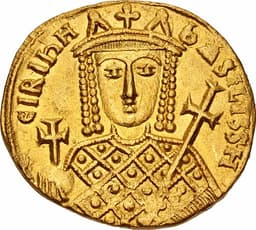
Irene of Athens
Emperor · Medieval
47.9Total

Mari Djata II
Emperor · Medieval
48.2Total
Basic Information
Born
752
1350
Died
803
1374
Era
Medieval
Medieval
Nationality
Byzantine Empire
Mali Empire
Occupation
Emperor
Emperor
Civilization
Western
Other
Score Comparison
Military (10%)
14.9
34.2
Political (20%)
43.7
39.4
Influence (20%)
54.9
60.0
Legacy (20%)
49.2
42.5
Leadership (15%)
62.2
48.4
Strategy (15%)
45.0
60.0
TOTAL
47.9
48.2
Irene of Athens — Complete Timeline
780 AD
Regency for Constantine VI (780-790)Political Action◆ Major
After the death of Leo IV, Irene became regent for her 10-year-old son Constantine VI. She ruled the Byzantine Empire effectively, reversing iconoclast policies and restoring icon veneration at the Second Council of Nicaea in 787.
RegencyIconoclasmChurch Council
Impact: regionalconstructive
787 AD
Second Council of Nicaea (787)Political Action
Irene convened the Second Council of Nicaea, which condemned iconoclasm and restored the veneration of icons in the Byzantine Church. This council is considered the Seventh Ecumenical Council by the Eastern Orthodox Church.
Ecumenical CouncilIconoclasmReligious Policy
Impact: globalconstructive
797 AD
Blinding and Imprisonment of Constantine VI (797)Political Action◆ Major
Irene ordered the blinding of her son Constantine VI, who had attempted to assert his own rule. He was imprisoned and died shortly after. This act allowed Irene to become sole ruler, but it was widely condemned as tyrannical and unnatural.
UsurpationViolenceFamily
Impact: regionaltragic
Sole Rule as Empress (797-802)Political Action◆ Major
After blinding her son, Irene ruled as sole empress, the first woman to do so in Byzantine history. She used the title 'basileus' (emperor) rather than 'basilissa' (empress), asserting her authority as a male ruler.
Female RuleImperial Title
Impact: regional
802 AD
Overthrow and Exile (802)Political Action◆ Major
Irene was overthrown by a conspiracy led by Nikephoros, the logothete (finance minister). She was exiled to the island of Lesbos and forced to support herself by spinning wool. She died the following year.
CoupExile
Impact: regionaltragic
Mari Djata II — Complete Timeline
1360 AD
Reign as Mansa of MaliPolitical Action◆ Major
Mari Djata II ruled the Mali Empire during a period of decline. He was known for extravagant gift-giving to nobles and foreign dignitaries, which further drained the state treasury. His reign accelerated the empire's financial and political weakening.
ReignMali EmpireEconomic Decline
Impact: nationaldestructive
This comparison has not been analyzed yet.
One-time AI generation (~1 minute). Scores and timeline are already available below.
Rankings
🥇
Mari Djata IILeader
Mil: 34.2Pol: 39.4Inf: 60.0
48.2
🥈
Irene of Athens
Mil: 14.9Pol: 43.7Inf: 54.9
47.9
+0.3 behind
How This Comparison Works
Algorithm
Each figure is scored on 6 dimensions (0—100 scale) based on structured historical data: Military (10%), Political (20%), Influence (20%), Legacy (20%), Leadership (15%), Strategy (15%). The weighted total produces the final ranking.
Data Sources
Scores are computed from structured sub-indicators in the database. Scale factors adjust for era (Ancient ×0.85, Modern ×1.0) and civilization size (Eastern ×1.05, Other ×0.80) to account for differences in population and military scale.
Maximum 3 Figures
Comparisons are limited to 2—3 figures to ensure readability and statistical meaningfulness.
Error Margins
±5 points per dimension — Sub-scores are derived from historical records with inherent uncertainty. Two figures within 5 points on a dimension should be considered roughly equivalent in that area.
Total Score Accuracy
±3 points overall — The weighted combination of 6 dimensions produces a total score with approximately ±3 points of uncertainty. Differences of less than 3 points are not statistically significant— the figures are effectively tied.
Known Limitations
- Historical records are incomplete and uneven across civilizations
- Figures from oral-tradition societies may be underrepresented
- Occupation labels can misclassify multi-role figures
- Scores measure capability and impact, not moral character
- Quantitative scoring is a comparison tool, not absolute truth
Capability Radar
Military (10%) — Battles & Warfare
Battles
10
34
Win Rate
5
33
Expansion
5
35
Political (20%) — Governance & Reform
Reform
40
0
Diplomacy
50
5
Economy
30
0
Influence (20%) — Cultural & Global Reach
Cultural
40
0
Global
30
0
Legacy (20%) — Historical Impact
Historical
55
5
Longevity
40
0
Leadership (15%) — Power & Stability
Tenure
60
10
Stability
20
0
Strategy (15%) — Tactics & Innovation
Strategy
5
38
Tactics
5
46
Reform
5
46
Similar Comparisons
Comments & Discussion
No comments yet. Be the first to share your thoughts!