Loading...
Irene of Athens vs Napoleon Bonaparte
Napoleon Bonaparte leads by 23.0 pts · 2 figures compared
…
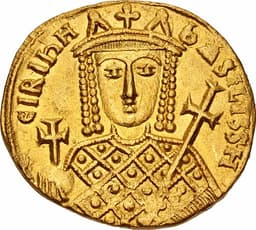
Irene of Athens
Emperor · Medieval
47.9Total

Napoleon Bonaparte
General · Modern
70.9Total
Basic Information
Born
752
1769
Died
803
1821
Era
Medieval
Modern
Nationality
Byzantine Empire
France
Occupation
Emperor
General
Civilization
Western
Western
Score Comparison
Military (10%)
14.9
94.0
Political (20%)
43.7
72.0
Influence (20%)
54.9
40.0
Legacy (20%)
49.2
80.0
Leadership (15%)
62.2
78.0
Strategy (15%)
45.0
90.0
TOTAL
47.9
70.9
Irene of Athens — Complete Timeline
780 AD
Regency for Constantine VI (780-790)Political Action◆ Major
After the death of Leo IV, Irene became regent for her 10-year-old son Constantine VI. She ruled the Byzantine Empire effectively, reversing iconoclast policies and restoring icon veneration at the Second Council of Nicaea in 787.
RegencyIconoclasmChurch Council
Impact: regionalconstructive
787 AD
Second Council of Nicaea (787)Political Action
Irene convened the Second Council of Nicaea, which condemned iconoclasm and restored the veneration of icons in the Byzantine Church. This council is considered the Seventh Ecumenical Council by the Eastern Orthodox Church.
Ecumenical CouncilIconoclasmReligious Policy
Impact: globalconstructive
797 AD
Blinding and Imprisonment of Constantine VI (797)Political Action◆ Major
Irene ordered the blinding of her son Constantine VI, who had attempted to assert his own rule. He was imprisoned and died shortly after. This act allowed Irene to become sole ruler, but it was widely condemned as tyrannical and unnatural.
UsurpationViolenceFamily
Impact: regionaltragic
Sole Rule as Empress (797-802)Political Action◆ Major
After blinding her son, Irene ruled as sole empress, the first woman to do so in Byzantine history. She used the title 'basileus' (emperor) rather than 'basilissa' (empress), asserting her authority as a male ruler.
Female RuleImperial Title
Impact: regional
802 AD
Overthrow and Exile (802)Political Action◆ Major
Irene was overthrown by a conspiracy led by Nikephoros, the logothete (finance minister). She was exiled to the island of Lesbos and forced to support herself by spinning wool. She died the following year.
CoupExile
Impact: regionaltragic
Napoleon Bonaparte — Complete Timeline
1799 AD
Coup of 18 BrumaireOther◆ Major
Napoleon Bonaparte, with support from his brother Lucien and key political figures, overthrew the Directory in a bloodless coup. He established the Consulate with himself as First Consul, effectively becoming the ruler of France. This event ended the French Revolution's most unstable period.
French RevolutionCoupRise to Power
Impact: regional
1804 AD
Promulgation of the Napoleonic CodeOther◆ Major
Napoleon enacted the Civil Code of the French, known as the Napoleonic Code, a comprehensive set of laws that replaced the fragmented feudal legal systems. The code established legal equality, protected property rights, and secularized law. It became the basis for legal systems in many European and world countries.
Legal ReformNapoleonic CodeCivil Law
Impact: globalconstructive
1805 AD
Battle of AusterlitzWar◆ Major
Napoleon's Grande Arm
Napoleonic WarsBattleDecisive Victory
Impact: global
1812 AD
Invasion of RussiaWar◆ Major
Napoleon led the Grande Arm
Napoleonic WarsInvasionDisaster
Impact: globaldestructive
1815 AD
Battle of WaterlooWar◆ Major
Napoleon's French army was defeated by the combined forces of the Duke of Wellington's Anglo-Allied army and Gebhard Leberecht von Bl
Napoleonic WarsBattleFinal Defeat
Impact: globaldestructive
Expert Analysis
irene-of-athens-vs-napoleon-bonaparte
# The Emperor and the Empress
On a December morning in 1805, Napoleon Bonaparte stood on a hill overlooking the frozen battlefield of Austerlitz, watching his Grand Army crush the combined forces of Russia and Austria. The sun broke through the mist at precisely the moment his troops struck—a stroke of luck he would later call "the sun of Austerlitz." Twenty-three years earlier and a thousand miles away, another ruler faced a different kind of dawn: Irene of Athens, in the dim light of Constantinople's Great Palace, signed the decrees that would restore the holy icons to Byzantine churches, ending decades of religious civil war. Both moments defined their reigns. Yet the paths that led Napoleon to glory and Irene to ruin reveal how character, circumstance, and the brutal logic of power shape history's most ambitious souls.
Origins
Napoleon was born in 1769 on Corsica, an island that had passed from Italian to French control just months before his birth. His family were minor nobility, but in the rigid hierarchy of pre-revolutionary France, they were outsiders. This bred in him a ferocious hunger for recognition. He devoured history and military strategy, wrote political pamphlets, and dreamed of liberating Corsica from French rule—before deciding that France itself offered a grander stage. The French Revolution, which demolished the old aristocracy, opened doors that would have remained locked to a Corsican upstart.
Irene, by contrast, was born in 752 into Athens' aristocratic elite, a world where power flowed through bloodlines and the Byzantine court operated by intricate rituals. The eighth century was an age of crisis: Arab armies pressed against the empire's borders, and the Iconoclast Controversy—a violent dispute over whether religious images were idolatrous—had split Byzantine society for decades. Irene was chosen as a bride for Emperor Leo IV not for her military skill but for her beauty and noble lineage. She entered the palace as a pawn, yet she possessed an iron will that would soon become evident.
Rise to Power
Napoleon's ascent was meteoric. At twenty-four, he drove the British out of Toulon with a brilliant artillery barrage. At twenty-six, he crushed a royalist uprising in Paris with a "whiff of grapeshot." By thirty, he had conquered Italy and Egypt, turning military victories into political capital. The Directory, France's corrupt ruling council, gave him command because they feared his ambition—and because they needed his victories. He repaid them by staging the coup of 18 Brumaire in 1799, seizing power as First Consul. The path was clear because the old structures had collapsed.
Irene's rise was slower, more treacherous. When Leo IV died in 780, she became regent for her ten-year-old son Constantine VI. The Byzantine court was a nest of intrigue, where eunuchs, generals, and church officials all schemed for influence. Irene maneuvered carefully: she crushed a rebellion by her husband's half-brothers, negotiated with the powerful iconoclast faction, and convened the Second Council of Nicaea in 787, which restored the veneration of icons. This was her Austerlitz—a triumph of political and religious diplomacy that unified the empire. But unlike Napoleon, who could always win another battle, Irene's power depended on controlling her son.
Leadership & Governance
Napoleon governed as he fought: with speed, audacity, and total control. He centralized the French state, created the Bank of France, and codified the Napoleonic Code—a legal system that enshrined equality before the law, protected property rights, and secularized government. He appointed officials based on merit, not birth. On the battlefield, he revolutionized warfare with rapid marches, massed artillery, and the corps system that allowed his armies to move faster than any enemy. His military genius was matched by his political instinct: he crowned himself emperor in 1804, not to restore monarchy but to legitimize his rule in the eyes of Europe's old dynasties.
Irene's governance was more constrained. As a woman in a patriarchal empire, she could not lead armies or command troops. Instead, she ruled through alliances, patronage, and religious authority. Her triumph at Nicaea showed her political skill, but her power remained fragile. She minted coins with her image, styled herself "Empress" (basilissa) rather than "Regent," and even attempted to marry Charlemagne to unite East and West. Yet the Byzantine system demanded a male emperor. Her son Constantine VI, now a young man, resented her control. When he tried to assert his own rule, Irene acted with a ruthlessness that Napoleon would have recognized.
Triumph & Tragedy
Napoleon's greatest moment came in 1805 at Austerlitz, where he destroyed a larger Austro-Russian army and forced Austria out of the war. He was thirty-six, at the height of his powers, and Europe lay at his feet. His greatest tragedy followed a decade later: the invasion of Russia in 1812, a catastrophic miscalculation that cost half a million men. He had overreached, believing his genius could conquer geography and winter. Exiled to Elba, he returned for the Hundred Days, only to meet final defeat at Waterloo in 1815. The tragedy was not that he lost, but that he could not stop.
Irene's triumph was the Council of Nicaea, which healed the empire's religious wounds. Her tragedy was her son. In 797, Constantine VI attempted to depose her. Irene responded by having him seized, dragged back to the palace, and blinded in the very room where she had given birth to him. He died of his wounds days later. She then ruled alone as the first Byzantine empress in her own right, using the title "Basileus" (Emperor). But the act horrified her subjects. A mother who blinded her own son—even a rebellious one—violated every sacred bond. Five years later, in 802, her finance minister Nikephoros led a coup. Irene was overthrown without a fight and exiled to the island of Lesbos, where she died the following year, impoverished and alone.
Character & Destiny
Napoleon's character was a paradox: a romantic who believed in destiny, yet a cold calculator who trusted no one. He once said, "Power is my mistress," and he meant it. He married for alliance, divorced for heirlessness, and surrounded himself with marshals he knew would betray him if he showed weakness. His ambition was limitless, but it was also his undoing. He could not stop conquering because he could not imagine a world where he was not the center.
Irene's character was shaped by survival. She had entered the palace as a foreign bride, surrounded by enemies. She learned to dissemble, to wait, to strike when the moment was right. Her blinding of Constantine VI was not madness but cold policy: she knew that a son who had tried to overthrow her would never forgive her. Yet the act destroyed her legitimacy. In a world that valued maternal piety, she had become a monster. Napoleon died in exile, but he died as a legend. Irene died forgotten, her name erased from Byzantine chronicles.
Legacy
Napoleon's legacy is immense. The Napoleonic Code influenced legal systems from Europe to Latin America. His military reforms shaped modern warfare. His conquests spread nationalism across Europe, planting seeds that would bloom into the unification of Germany and Italy. He is remembered as a genius, a tyrant, and a dreamer—a figure who both liberated and enslaved.
Irene's legacy is more ambiguous. The Orthodox Church remembers her as a saint for restoring icons. Historians see her as a pioneering female ruler who broke the glass ceiling of Byzantium. Yet her son's blinding haunts her memory. In the Eastern Orthodox tradition, the story of Irene is often told as a cautionary tale about the corrupting nature of power. She proved that a woman could rule the Roman Empire—but at a cost that made the achievement almost unbearable.
Conclusion
Napoleon and Irene both rose from precarious beginnings to dominate their worlds. Both used cunning, ruthlessness, and strategic brilliance. Both fell because they could not escape the logic of their own ambition. Yet the differences are instructive. Napoleon's world was one of movement, revolution, and opportunity; Irene's was one of ritual, tradition, and constraint. Napoleon could always fight another battle; Irene had only one son. Napoleon died a legend; Irene died a cautionary tale. Perhaps the deepest lesson is this: power, whether seized on a battlefield or held in a palace chamber, demands a price. For Napoleon, the price was exile. For Irene, it was her soul.
Rankings
🥇
Napoleon BonaparteLeader
Mil: 94.0Pol: 72.0Inf: 40.0
70.9
🥈
Irene of Athens
Mil: 14.9Pol: 43.7Inf: 54.9
47.9
+23.0 behind
How This Comparison Works
Algorithm
Each figure is scored on 6 dimensions (0—100 scale) based on structured historical data: Military (10%), Political (20%), Influence (20%), Legacy (20%), Leadership (15%), Strategy (15%). The weighted total produces the final ranking.
Data Sources
Scores are computed from structured sub-indicators in the database. Scale factors adjust for era (Ancient ×0.85, Modern ×1.0) and civilization size (Eastern ×1.05, Other ×0.80) to account for differences in population and military scale.
Maximum 3 Figures
Comparisons are limited to 2—3 figures to ensure readability and statistical meaningfulness.
Error Margins
±5 points per dimension — Sub-scores are derived from historical records with inherent uncertainty. Two figures within 5 points on a dimension should be considered roughly equivalent in that area.
Total Score Accuracy
±3 points overall — The weighted combination of 6 dimensions produces a total score with approximately ±3 points of uncertainty. Differences of less than 3 points are not statistically significant— the figures are effectively tied.
Known Limitations
- Historical records are incomplete and uneven across civilizations
- Figures from oral-tradition societies may be underrepresented
- Occupation labels can misclassify multi-role figures
- Scores measure capability and impact, not moral character
- Quantitative scoring is a comparison tool, not absolute truth
Capability Radar
Military (10%) — Battles & Warfare
Battles
10
95
Win Rate
5
90
Expansion
5
95
Political (20%) — Governance & Reform
Reform
40
95
Diplomacy
50
80
Economy
30
85
Influence (20%) — Cultural & Global Reach
Cultural
40
85
Global
30
90
Legacy (20%) — Historical Impact
Historical
55
95
Longevity
40
90
Leadership (15%) — Power & Stability
Tenure
60
85
Stability
20
70
Strategy (15%) — Tactics & Innovation
Strategy
5
95
Tactics
5
98
Reform
5
92
Similar Comparisons
Comments & Discussion
BattlefieldMystic6/17/2026
Napoleon’s "sun of Austerlitz" shows his genius for propaganda, not strategy. The real military lesson? He won because he split the Allied line with Davout’s corps holding the flank against impossible odds. Irene’s icon restoration ended a religious civil war without a single soldier lost—that’s true strategic wisdom. Give me the empress who unified through faith over the emperor who butchered for glory any day.
数字侦探6/17/2026
野史写手最爱把拿破仑和伊琳娜并列,数据会说话:拿破仑在位没重建单一主神庙,伊琳娜787年召集尼西亚第二次公会议,直接奠定东正教正统。比影响力,拿破仑的民法典只改了法国,伊琳娜的教义至今管着两亿信徒。这叫失败?你们才输了。