Loading...
Isabella II of Spain vs Julius Caesar
Julius Caesar leads by 36.3 pts · 2 figures compared
…
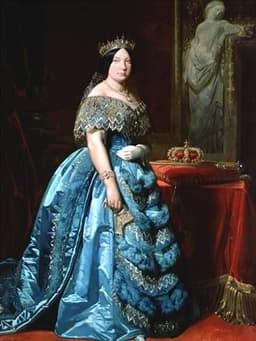
Isabella II of Spain
Emperor · Modern
46.5Total

Julius Caesar
General · Ancient
82.8Total
Basic Information
Born
1830
-100
Died
1904
-44
Era
Modern
Ancient
Nationality
Spain
Roman Republic
Occupation
Emperor
General
Civilization
Western
Western
Score Comparison
Military (10%)
24.4
88.0
Political (20%)
35.1
78.0
Influence (20%)
51.0
85.0
Legacy (20%)
41.7
82.0
Leadership (15%)
65.7
80.0
Strategy (15%)
57.8
85.0
TOTAL
46.5
82.8
Isabella II of Spain — Complete Timeline
1833 AD
First Carlist WarWar◆ Major
The First Carlist War broke out between the Isabelline forces (liberals) and the Carlists (absolutists). The war lasted until 1840 and ended with the defeat of the Carlists, but left Spain politically divided.
Civil WarCarlist WarsLiberal vs Absolutist
Impact: nationaldestructive
Accession to the thronePolitical Action◆ Major
Isabella II became Queen of Spain at age three after the death of her father Ferdinand VII. Her minority sparked the First Carlist War between supporters of Isabella and those of her uncle Carlos.
SuccessionCarlist WarsRegency
Impact: national
1843 AD
Declaration of majorityPolitical Action◆ Major
Isabella II was declared of age at 13, ending the regency of General Espartero. Her personal rule was marked by instability, with frequent changes of government and military interventions.
RegencyMonarchyPolitical Instability
Impact: national
1868 AD
Revolution of 1868 and exilePolitical Action
The Glorious Revolution (La Gloriosa) overthrew Isabella II, who fled to France. The revolution ended the Bourbon monarchy and led to the Sexenio Democr
RevolutionExileBourbon Restoration
Impact: nationaltragic
Julius Caesar — Complete Timeline
58 BC
Gallic WarsWar◆ Major
Caesar, as proconsul of Gaul, launched a series of campaigns that conquered all of Gaul (modern France, Belgium, and parts of Switzerland). He fought numerous battles, including against the Helvetii, the Belgae, and the Gallic chieftain Vercingetorix. The wars brought immense wealth and a loyal army to Caesar.
Gallic WarsConquestRoman Expansion
Impact: regional
49 BC
Crossing the RubiconPolitical Action◆ Major
Caesar led Legio XIII across the Rubicon River into Italy, defying the Roman Senate's order to disband his army. This act triggered a civil war against Pompey and the Optimates, ultimately leading to Caesar's dictatorship and the end of the Roman Republic.
Roman Civil WarEnd of RepublicPower Struggle
Impact: global
48 BC
Battle of PharsalusWar◆ Major
Caesar's outnumbered army defeated the larger forces of Pompey the Great at Pharsalus in Greece. Caesar's tactical use of a reserve line to counter Pompey's cavalry charge proved decisive. Pompey fled to Egypt, where he was assassinated, leaving Caesar as the undisputed master of the Roman world.
Roman Civil WarBattleDecisive Victory
Impact: regional
44 BC
Appointment as Dictator for LifePolitical Action◆ Major
The Roman Senate appointed Caesar dictator perpetuo (dictator for life), granting him unprecedented personal power. This move concentrated military, legislative, and judicial authority in one person, effectively ending the Roman Republic's traditional system of checks and balances and alarming many senators.
DictatorshipEnd of RepublicPower Consolidation
Impact: regionaldestructive
Assassination on the Ides of MarchPolitical Action◆ Major
A group of Roman senators, led by Marcus Junius Brutus and Gaius Cassius Longinus, stabbed Caesar to death at a meeting of the Senate in the Theatre of Pompey. The assassination was intended to restore the Republic, but instead triggered another civil war that led to the rise of the Roman Empire.
AssassinationRoman PoliticsEnd of Republic
Impact: globaldestructive
Expert Analysis
isabella-ii-of-spain-vs-julius-caesar
# The Emperor and the Queen: Two Paths to Power, Two Destinies
On the Ides of March in 44 BCE, a blood-soaked Julius Caesar fell at the feet of Pompey’s statue, stabbed sixty times by senators who feared his ambition. On a September morning in 1868, Queen Isabella II of Spain slipped out of a palace window in disguise, fleeing to France as revolutionaries stormed Madrid. Both inherited power. Both lost it violently. But one reshaped the Western world, while the other became a footnote. What separated the conqueror of Gaul from the queen who could not conquer her own kingdom?
Origins
Caesar was born into the chaos of the late Roman Republic, a world of civil wars and crumbling traditions. His family, the Julii, claimed descent from the goddess Venus, but they were politically marginal. His father died when Caesar was sixteen, leaving him to navigate a brutal system where survival meant alliances, bribes, and military glory. The Republic rewarded ruthlessness, and Caesar learned young that mercy was a tactic, not a virtue.
Isabella II entered a different kind of storm. Born in 1830, she was a child of the Bourbon dynasty, a family that had ruled Spain for centuries but had lost its grip. Her father Ferdinand VII abolished the Salic Law so she could inherit the throne—a decision that ignited the First Carlist War in 1833, the year she became queen at age three. While Caesar fought for his life in Roman street brawls, Isabella was dressed in lace and taught that her body was a political instrument. Her era demanded stability; her birthright guaranteed chaos.
Rise to Power
Caesar’s ascent was a masterpiece of calculated risk. He climbed the Roman political ladder—quaestor, aedile, praetor—borrowing fortunes to stage games and buy votes. In 60 BCE, he formed the First Triumvirate with Pompey and Crassus, a backroom deal that made him consul. Then he secured Gaul. Over eight years, from 58 to 50 BCE, he conquered a territory larger than Italy, slaughtering perhaps a million people and enslaving another million. The Gallic Wars made him a legend, a general whose soldiers would follow him anywhere—even across the Rubicon in 49 BCE, the river that meant civil war.
Isabella’s rise was passive. She was declared of age at thirteen in 1843, ending the regency of General Espartero. But she never truly ruled. Spanish politics was a revolving door of generals and factions—moderates, progressives, Carlists—who used her as a figurehead. Where Caesar seized power through blood and strategy, Isabella inherited a throne she could not hold. Her first major act was not a conquest but a marriage: at sixteen, she was wed to her cousin Francis of Assisi, a union so unhappy that rumors of his impotence and her infidelities became public scandals.
Leadership & Governance
Caesar governed like a storm. As dictator, he reformed the calendar, granted citizenship to provincials, and launched public works that employed the poor. He centralized authority, broke the power of the Senate, and filled it with his supporters. His military genius was absolute—at Alesia in 52 BCE, he besieged a Gallic army while simultaneously defeating a relief force, a feat of logistics and nerve. But his political wisdom was flawed: he pardoned his enemies, thinking generosity would win loyalty. It only bought him daggers.
Isabella governed like a weather vane. Her reign saw thirty-four governments in twenty-five years—an average of one every nine months. She favored the moderates, then the progressives, then the moderates again, depending on who flattered her. Her military record was nonexistent; she never led troops, never saw a battle. The First Carlist War ended in 1840, but only because her generals won it for her. Her strategy, if it can be called that, was survival: she clung to power by alternating between factions, alienating everyone. Her political score of 72 outpaces her military score of 45, but both reflect a ruler who reacted rather than acted.
Triumph & Tragedy
Caesar’s greatest moment was his triumph over Pompey at Pharsalus in 48 BCE, where he defeated a larger army with veteran discipline. His tragedy was believing that victory meant permanence. He became dictator for life in 44 BCE, but he never built a succession plan. When the assassins struck, he had no heir ready—only his grandnephew Octavian, a sickly teenager who would become Augustus. Caesar’s death threw Rome into another civil war, but it also cleared the path for the empire.
Isabella’s triumph was simply surviving for thirty-five years. She weathered coups, wars, and scandals. Her tragedy was the Revolution of 1868, La Gloriosa, which overthrew her not with a single blow but with a slow collapse. When she fled to France, she left behind a country that had exhausted its patience. Unlike Caesar, who died at the height of his power, Isabella lived another thirty-six years in exile, watching her son Alfonso XII reclaim the throne she had lost. She died in 1904, a ghost of a queen.
Character & Destiny
Caesar was audacity incarnate. He crossed the Rubicon with a single legion, gambling everything on the loyalty of his men. He was brilliant, vain, and cold—he wept only for his own ambition, not for the Gauls he slaughtered. His personality shaped his destiny: he could not stop reaching, and that reaching killed him. But his death was a catalyst. The Republic died with him, and something greater—the Roman Empire—was born.
Isabella was passive and stubborn. She resisted advice, clung to favorites, and refused to accept that her role was symbolic. Her personality mirrored her fate: she wanted to rule but could not govern. Her reign ended not with a dramatic assassination but with a quiet train ride to the French border. She was not murdered by her enemies; she was abandoned by her allies.
Legacy
Caesar’s legacy is carved into the foundations of Western civilization. His name became a title—Kaiser, Tsar. His conquests spread Latin, law, and culture across Europe. He is remembered as a genius, a tyrant, or both, but never forgotten. Every dictator since has measured himself against Caesar.
Isabella’s legacy is a cautionary tale. She is remembered as the queen who lost Spain, whose reign was a prelude to chaos. Her political score of 72 and influence of 70.4 suggest she mattered, but her legacy score of 57.1 tells the truth: she is a footnote in Spanish history, a lesson in how not to rule. The Carlist Wars she sparked continued into the twentieth century, but her name rarely appears outside textbooks.
Conclusion
Caesar and Isabella both held power they could not keep. But Caesar’s fall shattered a world and built a new one. Isabella’s fall merely closed a chapter. The difference was not in their titles—both were monarchs in all but name—but in their agency. Caesar shaped his fate; Isabella endured hers. One crossed the Rubicon; the other crossed a border. One died by the Senate’s knives; the other died in bed, forgotten. History rewards those who act, even when they fail. It forgets those who merely reign.
Rankings
🥇
Julius CaesarLeader
Mil: 88.0Pol: 78.0Inf: 85.0
82.8
🥈
Isabella II of Spain
Mil: 24.4Pol: 35.1Inf: 51.0
46.5
+36.3 behind
How This Comparison Works
Algorithm
Each figure is scored on 6 dimensions (0—100 scale) based on structured historical data: Military (10%), Political (20%), Influence (20%), Legacy (20%), Leadership (15%), Strategy (15%). The weighted total produces the final ranking.
Data Sources
Scores are computed from structured sub-indicators in the database. Scale factors adjust for era (Ancient ×0.85, Modern ×1.0) and civilization size (Eastern ×1.05, Other ×0.80) to account for differences in population and military scale.
Maximum 3 Figures
Comparisons are limited to 2—3 figures to ensure readability and statistical meaningfulness.
Error Margins
±5 points per dimension — Sub-scores are derived from historical records with inherent uncertainty. Two figures within 5 points on a dimension should be considered roughly equivalent in that area.
Total Score Accuracy
±3 points overall — The weighted combination of 6 dimensions produces a total score with approximately ±3 points of uncertainty. Differences of less than 3 points are not statistically significant— the figures are effectively tied.
Known Limitations
- Historical records are incomplete and uneven across civilizations
- Figures from oral-tradition societies may be underrepresented
- Occupation labels can misclassify multi-role figures
- Scores measure capability and impact, not moral character
- Quantitative scoring is a comparison tool, not absolute truth
Capability Radar
Military (10%) — Battles & Warfare
Battles
36
95
Win Rate
37
92
Expansion
42
97
Political (20%) — Governance & Reform
Reform
20
90
Diplomacy
25
85
Economy
15
82
Influence (20%) — Cultural & Global Reach
Cultural
20
88
Global
15
94
Legacy (20%) — Historical Impact
Historical
30
95
Longevity
20
96
Leadership (15%) — Power & Stability
Tenure
60
75
Stability
5
60
Strategy (15%) — Tactics & Innovation
Strategy
45
94
Tactics
51
96
Reform
49
88
Similar Comparisons
Comments & Discussion
LegionLad6/17/2026
Caesar didn't just conquer Gaul—he invented modern warfare. The guy built a bridge across the Rhine in ten days for a flex, then starved 8,000 Usipetes and Tencteri to death for looking at him wrong. Isabella? She couldn't even hold off a coup led by her own generals. One rewrote the map of Europe with blood and genius; the other fled through a window in a nightgown. This isn't a comparison; it's a massacre.
共和铁蹄6/17/2026
拿伊莎贝拉二世比恺撒,简直是对历史的侮辱。恺撒跨过卢比孔河时,展现的是真正的统治意志;而这位西班牙女王连自己的军队都管不住,只能靠情夫和政客维持摇摇欲坠的王座。一个征服了高卢,一个被自己的人民赶出窗外。别拿欧洲君主制末期的可怜虫来贬低古罗马的雄主。根本没有可比性。