Loading...
This comparison has not been analyzed yet.
One-time AI generation (~1 minute). Scores and timeline are already available below.
Ishbi-Erra vs King Yi of Zhou
Ishbi-Erra leads by 10.5 pts · 2 figures compared
…
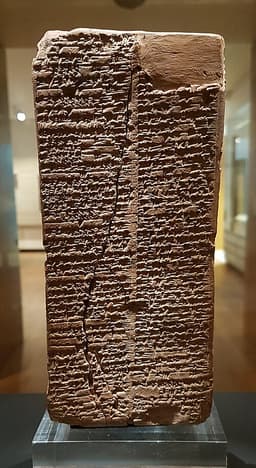
Ishbi-Erra
Emperor · Ancient
46.9Total

King Yi of Zhou
Emperor · Ancient
36.4Total
Basic Information
Born
-2017
-910
Died
-1985
-885
Era
Ancient
Ancient
Nationality
Isin
Zhou China
Occupation
Emperor
Emperor
Civilization
Middle Eastern
Eastern
Score Comparison
Military (10%)
25.0
25.9
Political (20%)
43.7
35.0
Influence (20%)
49.4
42.4
Legacy (20%)
40.8
32.5
Leadership (15%)
74.0
39.0
Strategy (15%)
41.7
39.6
TOTAL
46.9
36.4
Ishbi-Erra — Complete Timeline
2017 BC
Founded the First Dynasty of IsinPolitical Action◆ Major
Ishbi-Erra established the First Dynasty of Isin after the collapse of the Ur III empire. He seized control of Isin and gradually expanded his territory, becoming the dominant power in southern Mesopotamia and claiming the title 'King of Sumer and Akkad'.
DynastyIsinSumer
Impact: regional
2015 BC
Defeated the Elamites and expelled them from UrWar◆ Major
Ishbi-Erra led a military campaign against the Elamites who had occupied Ur after the fall of the Ur III dynasty. He defeated them and drove them out, restoring Sumerian control over the city and its important religious sites.
WarElamUr
Impact: regional
2010 BC
Consolidated control over Nippur and other Sumerian citiesPolitical Action
Ishbi-Erra extended his rule over key Sumerian cities including Nippur, the religious center of Mesopotamia. This consolidation allowed him to claim legitimacy as the successor to the Ur III kings and control trade routes.
ConsolidationNippurSumer
Impact: regional
Issued royal inscriptions and building projectsCultural
Ishbi-Erra commissioned royal inscriptions and building projects, including temples and fortifications in Isin and Ur. These works served to legitimize his rule and demonstrate his piety to the gods, following Sumerian traditions.
InscriptionsBuildingReligion
constructive
King Yi of Zhou — Complete Timeline
890 BC
Execution of the Duke of QiPolitical Action◆ Major
King Yi ordered the Duke of Qi to be boiled alive in a cauldron. This brutal punishment was recorded as an example of the king's cruelty and arbitrary use of power, which alienated the feudal lords.
ExecutionCrueltyQi
Impact: nationaldestructive
Deterioration of Royal AuthorityPolitical Action◆ Major
King Yi's harsh and erratic rule led to a decline in respect for the Zhou king. The incident with the Duke of Qi was a key factor in the erosion of the king's moral authority over the feudal states.
DeclineRoyal AuthorityZhou Dynasty
Impact: nationaldestructive
This comparison has not been analyzed yet.
One-time AI generation (~1 minute). Scores and timeline are already available below.
Rankings
🥇
Ishbi-ErraLeader
Mil: 25.0Pol: 43.7Inf: 49.4
46.9
🥈
King Yi of Zhou
Mil: 25.9Pol: 35.0Inf: 42.4
36.4
+10.5 behind
How This Comparison Works
Algorithm
Each figure is scored on 6 dimensions (0—100 scale) based on structured historical data: Military (10%), Political (20%), Influence (20%), Legacy (20%), Leadership (15%), Strategy (15%). The weighted total produces the final ranking.
Data Sources
Scores are computed from structured sub-indicators in the database. Scale factors adjust for era (Ancient ×0.85, Modern ×1.0) and civilization size (Eastern ×1.05, Other ×0.80) to account for differences in population and military scale.
Maximum 3 Figures
Comparisons are limited to 2—3 figures to ensure readability and statistical meaningfulness.
Error Margins
±5 points per dimension — Sub-scores are derived from historical records with inherent uncertainty. Two figures within 5 points on a dimension should be considered roughly equivalent in that area.
Total Score Accuracy
±3 points overall — The weighted combination of 6 dimensions produces a total score with approximately ±3 points of uncertainty. Differences of less than 3 points are not statistically significant— the figures are effectively tied.
Known Limitations
- Historical records are incomplete and uneven across civilizations
- Figures from oral-tradition societies may be underrepresented
- Occupation labels can misclassify multi-role figures
- Scores measure capability and impact, not moral character
- Quantitative scoring is a comparison tool, not absolute truth
Capability Radar
Military (10%) — Battles & Warfare
Battles
30
10
Win Rate
35
10
Expansion
40
10
Political (20%) — Governance & Reform
Reform
40
5
Diplomacy
45
5
Economy
35
5
Influence (20%) — Cultural & Global Reach
Cultural
20
5
Global
15
5
Legacy (20%) — Historical Impact
Historical
30
10
Longevity
25
5
Leadership (15%) — Power & Stability
Tenure
55
20
Stability
50
5
Strategy (15%) — Tactics & Innovation
Strategy
30
10
Tactics
25
10
Reform
20
5
Similar Comparisons
Comments & Discussion
No comments yet. Be the first to share your thoughts!