Loading...
Ivan VI vs Sunjong of Korea
Ivan VI leads by 9.1 pts · 2 figures compared
…
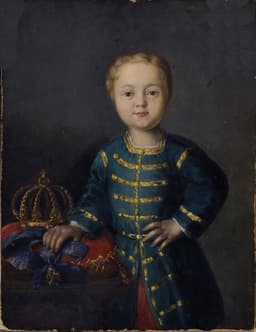
Ivan VI
Emperor · Modern
57.9Total

Sunjong of Korea
Emperor · Modern
48.8Total
Basic Information
Born
1740
1874
Died
1764
1926
Era
Modern
Modern
Nationality
Russia
Korea
Occupation
Emperor
Emperor
Civilization
Western
Eastern
Score Comparison
Military (10%)
20.5
53.5
Political (20%)
57.3
48.0
Influence (20%)
68.0
47.1
Legacy (20%)
52.0
35.8
Leadership (15%)
76.8
58.8
Strategy (15%)
57.2
66.8
TOTAL
57.9
48.8
Ivan VI — Complete Timeline
1740 AD
Accession as Emperor of RussiaPolitical Action◆ Major
Ivan VI was proclaimed emperor at the age of two months after the death of Anna of Russia, with Ernst Johann von Biron as regent. His accession was part of Anna's plan to secure the succession for her family line, but it immediately triggered a power struggle.
SuccessionInfant TsarRegency
Impact: national
1741 AD
Overthrow and ImprisonmentPolitical Action◆ Major
Ivan VI was deposed in a coup led by Elizabeth of Russia, who seized the throne. He was imprisoned in the Shlisselburg Fortress, where he spent the rest of his life in solitary confinement. His name was erased from official records, and he was referred to as the 'nameless prisoner'.
CoupImprisonmentElizabeth
Impact: nationaltragic
1764 AD
Murder in Shlisselburg FortressOther◆ Major
Ivan VI was killed by his guards during an attempted rescue by Lieutenant Vasily Mirovich. The rescue attempt aimed to restore him to the throne, but the guards followed orders to kill him if any escape was attempted. His death ended any possibility of a restoration.
AssassinationRescue AttemptShlisselburg
Impact: nationaltragic
Sunjong of Korea — Complete Timeline
1907 AD
Accession as Emperor of KoreaPolitical Action◆ Major
Sunjong became the last emperor of Korea after his father Gojong was forced to abdicate by Japan. His reign was largely ceremonial, with real power held by the Japanese Resident-General. He was a symbolic figurehead during the final years of Korean sovereignty.
AccessionKorean EmpireJapanese Control
Impact: national
1910 AD
Signing of the Japan-Korea Annexation TreatyPolitical Action
Sunjong was forced to sign the treaty that formally annexed Korea into the Japanese Empire. The treaty ended the Korean Empire and Joseon dynasty, beginning 35 years of Japanese colonial rule. Sunjong was stripped of all political power and reduced to a figurehead.
AnnexationJapanese Colonial RuleEnd of Dynasty
Impact: nationaltragic
1926 AD
Death of SunjongOther◆ Major
Sunjong died at Changdeokgung Palace, marking the end of the Joseon royal line. His funeral was a major event that sparked renewed Korean nationalist sentiment, though it was heavily monitored by Japanese authorities. He was the last Korean monarch.
DeathEnd of MonarchyKorean Nationalism
Impact: nationaltragic
Expert Analysis
Origins
Ivan VI was born on August 23, 1740, in Saint Petersburg, Russia, to Prince Anton Ulrich of Brunswick and Grand Duchess Anna Leopoldovna. He was the great-nephew of Empress Anna of Russia. His early life was marked by court intrigue, as he was proclaimed emperor at just two months old. Sunjong of Korea was born on March 25, 1874, in Seoul, Korea, as the second son of Emperor Gojong and Empress Myeongseong. He was educated in Confucian classics and received a traditional upbringing, but his youth was overshadowed by growing Japanese influence in Korea.
Rise to Power
Ivan VI's accession occurred on October 28, 1740, immediately after the death of Empress Anna. Ernst Johann von Biron served as regent, but was soon overthrown by Ivan's mother, Anna Leopoldovna, who became regent. However, on December 6, 1741, a coup led by Elizabeth of Russia deposed Ivan, who was then imprisoned. Sunjong became crown prince in 1895 after the assassination of his mother. He ascended the throne on July 20, 1907, when his father Gojong was forced to abdicate by Japan. His reign was largely ceremonial, as real power lay with Japanese officials.
Leadership & Governance
Ivan VI never actually ruled; his entire life was spent in captivity. The regency during his nominal reign was marked by instability and factionalism. His political score of 57.3 reflects his symbolic importance rather than actual governance. Sunjong, in contrast, was a figurehead emperor during the final years of the Korean Empire. He signed the Japan-Korea Annexation Treaty on August 22, 1910, effectively ending Korean sovereignty. His leadership score of 58.8 indicates his limited agency; he was a puppet ruler under Japanese control.
Triumph & Tragedy
Ivan VI's greatest 'triumph' was his mere existence as a symbol of the Romanov dynasty's continuity, but his tragedy was absolute: he was imprisoned from age one until his murder at 23. On July 16, 1764, during an attempted rescue by Lieutenant Vasily Mirovich, guards killed him. His military score of 20.5 reflects his total lack of command. Sunjong's reign saw no triumphs; his tragedy was presiding over the annexation of Korea. He died on April 24, 1926, at Changdeokgung Palace, marking the end of the Joseon dynasty. His influence score of 47.1 indicates his limited impact on events.
Character & Destiny
Ivan VI's character was shaped by isolation; he reportedly became mentally unstable after decades in solitary confinement. His destiny was sealed by his birthright, making him a threat to successive rulers. Sunjong was described as weak-willed and passive, a product of his subservient role. He scored 66.8 in strategy, but this likely reflects his survival under Japanese rule rather than active decision-making. Both were victims of larger political forces beyond their control.
Legacy
Ivan VI's legacy is that of a tragic footnote in Russian history. His imprisonment and murder highlighted the brutality of 18th-century Russian court politics. He scores 52.0 in legacy, largely symbolic. Sunjong's legacy is more complex: he is remembered as the last emperor of Korea, and his death sparked nationalist sentiment. However, his legacy score of 35.8 is lower due to his passive role. The Japanese annexation ended centuries of Korean independence, and Sunjong's compliance tarnished his memory for some.
Conclusion
Comparing Ivan VI and Sunjong reveals two rulers who were pawns in larger geopolitical games. Ivan VI's total score of 57.9 exceeds Sunjong's 48.8 by 9.1 points. This gap is primarily due to Ivan's higher influence (68.0 vs 47.1) and legacy (52.0 vs 35.8) scores, reflecting his greater symbolic weight as a Romanov heir. However, neither exerted meaningful leadership. In terms of historical impact, Sunjong's reign directly led to the end of Korean sovereignty, a more consequential event than Ivan VI's obscure imprisonment. Yet, Ivan VI's story has captured more historical imagination due to its tragic nature. Ultimately, Ivan VI had greater impact as a symbol of dynastic strife, while Sunjong's impact was more direct but passive. The data suggests Ivan VI's higher scores reflect his enduring narrative power.
Rankings
🥇
Ivan VILeader
Mil: 20.5Pol: 57.3Inf: 68.0
57.9
🥈
Sunjong of Korea
Mil: 53.5Pol: 48.0Inf: 47.1
48.8
+9.1 behind
How This Comparison Works
Algorithm
Each figure is scored on 6 dimensions (0—100 scale) based on structured historical data: Military (10%), Political (20%), Influence (20%), Legacy (20%), Leadership (15%), Strategy (15%). The weighted total produces the final ranking.
Data Sources
Scores are computed from structured sub-indicators in the database. Scale factors adjust for era (Ancient ×0.85, Modern ×1.0) and civilization size (Eastern ×1.05, Other ×0.80) to account for differences in population and military scale.
Maximum 3 Figures
Comparisons are limited to 2—3 figures to ensure readability and statistical meaningfulness.
Error Margins
±5 points per dimension — Sub-scores are derived from historical records with inherent uncertainty. Two figures within 5 points on a dimension should be considered roughly equivalent in that area.
Total Score Accuracy
±3 points overall — The weighted combination of 6 dimensions produces a total score with approximately ±3 points of uncertainty. Differences of less than 3 points are not statistically significant— the figures are effectively tied.
Known Limitations
- Historical records are incomplete and uneven across civilizations
- Figures from oral-tradition societies may be underrepresented
- Occupation labels can misclassify multi-role figures
- Scores measure capability and impact, not moral character
- Quantitative scoring is a comparison tool, not absolute truth
Capability Radar
Military (10%) — Battles & Warfare
Battles
35
51
Win Rate
37
58
Expansion
45
58
Political (20%) — Governance & Reform
Reform
58
0
Diplomacy
61
5
Economy
64
0
Influence (20%) — Cultural & Global Reach
Cultural
65
5
Global
78
5
Legacy (20%) — Historical Impact
Historical
69
10
Longevity
74
5
Leadership (15%) — Power & Stability
Tenure
58
5
Stability
71
0
Strategy (15%) — Tactics & Innovation
Strategy
44
61
Tactics
51
65
Reform
50
65
Similar Comparisons
Comments & Discussion
No comments yet. Be the first to share your thoughts!