Loading...
King Abdullah II of Jordan vs Sunjong of Korea
King Abdullah II of Jordan leads by 5.2 pts · 2 figures compared
…
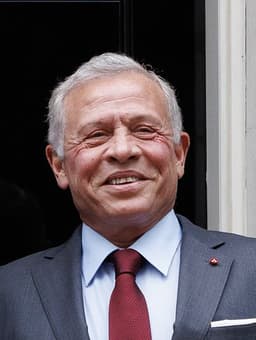
King Abdullah II of Jordan
Emperor · Modern
54.0Total

Sunjong of Korea
Emperor · Modern
48.8Total
Basic Information
Born
1962
1874
Died
—
1926
Era
Modern
Modern
Nationality
Jordan
Korea
Occupation
Emperor
Emperor
Civilization
Middle Eastern
Eastern
Score Comparison
Military (10%)
20.0
53.5
Political (20%)
72.0
48.0
Influence (20%)
58.0
47.1
Legacy (20%)
42.5
35.8
Leadership (15%)
80.0
58.8
Strategy (15%)
41.0
66.8
TOTAL
54.0
48.8
King Abdullah II of Jordan — Complete Timeline
1999 AD
Assumed the throne of JordanPolitical Action◆ Major
Abdullah II became King of Jordan on February 7, 1999, upon the death of his father King Hussein. His accession was unexpected as he was not the original heir, but Hussein changed the succession line shortly before his death.
SuccessionMonarchy
Impact: national
2000 AD
Launch of economic reforms and privatizationReform◆ Major
King Abdullah II initiated a series of economic reforms including privatization of state-owned enterprises, trade liberalization, and creation of special economic zones. These policies aimed to attract foreign investment and modernize Jordan's economy.
Economic ReformPrivatizationDevelopment
Impact: nationalconstructive
2011 AD
Jordanian role in the Arab Spring protestsPolitical Action◆ Major
King Abdullah II responded to widespread protests in Jordan during the Arab Spring by dismissing governments, enacting constitutional reforms, and promising political liberalization. He avoided the regime collapse seen in other Arab countries.
Arab SpringReformProtests
Impact: national
Syrian refugee crisis responseOther◆ Major
Under King Abdullah II's leadership, Jordan hosted over 1.3 million Syrian refugees fleeing the Syrian civil war. The influx strained Jordan's resources and infrastructure, leading to international aid agreements and humanitarian challenges.
RefugeesSyrian Civil WarHumanitarian
Impact: regional
2021 AD
Failed coup attempt and Prince Hamzah affairPolitical Action◆ Major
King Abdullah II placed his half-brother Prince Hamzah under house arrest, accusing him of involvement in a foreign-backed plot to destabilize Jordan. The incident exposed internal royal family tensions and was resolved through mediation.
Coup AttemptRoyal FamilySecurity
Impact: nationaldestructive
Sunjong of Korea — Complete Timeline
1907 AD
Accession as Emperor of KoreaPolitical Action◆ Major
Sunjong became the last emperor of Korea after his father Gojong was forced to abdicate by Japan. His reign was largely ceremonial, with real power held by the Japanese Resident-General. He was a symbolic figurehead during the final years of Korean sovereignty.
AccessionKorean EmpireJapanese Control
Impact: national
1910 AD
Signing of the Japan-Korea Annexation TreatyPolitical Action
Sunjong was forced to sign the treaty that formally annexed Korea into the Japanese Empire. The treaty ended the Korean Empire and Joseon dynasty, beginning 35 years of Japanese colonial rule. Sunjong was stripped of all political power and reduced to a figurehead.
AnnexationJapanese Colonial RuleEnd of Dynasty
Impact: nationaltragic
1926 AD
Death of SunjongOther◆ Major
Sunjong died at Changdeokgung Palace, marking the end of the Joseon royal line. His funeral was a major event that sparked renewed Korean nationalist sentiment, though it was heavily monitored by Japanese authorities. He was the last Korean monarch.
DeathEnd of MonarchyKorean Nationalism
Impact: nationaltragic
Expert Analysis
Origins
King Abdullah II of Jordan (born 1962) was the eldest son of King Hussein and his British-born wife, Princess Muna. He was educated at Sandhurst, Oxford, and Georgetown, with a military career in the Jordanian Special Forces. His upbringing was cosmopolitan, but he was not groomed for the throne; his uncle Hassan was crown prince until days before Hussein's death.
Sunjong of Korea (1874–1926) was the second son of Emperor Gojong and Empress Myeongseong. He was raised in the declining Joseon dynasty, facing increasing Japanese influence. He received a traditional Confucian education but was overshadowed by his father's resistance to foreign powers. His physical frailty and lack of assertiveness marked his early life.
Rise to Power
Abdullah II ascended unexpectedly on February 7, 1999, after his father King Hussein, on his deathbed, changed the succession from his brother Hassan. This abrupt shift was driven by Hussein's belief that Abdullah could better navigate regional challenges. Abdullah quickly consolidated power by appointing loyalists and maintaining the monarchy's central role.
Sunjong became emperor on July 20, 1907, after Japan forced his father Gojong to abdicate, citing Gojong's secret diplomacy to resist Japanese control. Sunjong's accession was a Japanese tool to legitimize their protectorate. His reign was purely ceremonial; real power lay with Japanese Resident-General. He was a symbolic figurehead, with no authority to make decisions.
Leadership & Governance
Abdullah II governs as a constitutional monarch with substantial executive powers. He launched economic reforms in 2000, including privatization and free trade agreements with the US and EU. He also promoted Jordan as a tech hub via initiatives like the Jordan Education Initiative. During the Arab Spring (2011–2012), he dismissed prime ministers, enacted constitutional amendments (e.g., establishing a Constitutional Court), and devolved some powers, but retained ultimate control. His response to the Syrian refugee crisis (hosting 1.3 million refugees) strained resources but maintained stability.
Sunjong had no governing role. His leadership score of 58.8 reflects his passive acceptance of Japanese directives. He signed the Japan-Korea Annexation Treaty on August 22, 1910, under duress, effectively ending Korean sovereignty. His government was staffed by pro-Japanese collaborators, and he had no input in policy. His strategic score of 66.6 is inflated by his survival strategy of compliance, but his political score of 48.0 indicates his impotence.
Triumph & Tragedy
Abdullah II's greatest triumph is maintaining Jordan's stability amid regional turmoil. He successfully navigated the Arab Spring by conceding reforms without losing power. He also positioned Jordan as a moderate ally, securing economic aid from the US and Gulf states. His tragedy includes the failed coup attempt by his half-brother Prince Hamzah in 2021, revealing internal dissent. Additionally, economic stagnation and high unemployment persist, with growth averaging 2% annually.
Sunjong's tragedy is his entire reign: he was a puppet emperor who witnessed the destruction of his dynasty and nation. His greatest 'success' was preserving the royal lineage through his silence, but he failed to resist annexation. His death in 1926 sparked nationalist mourning, but his legacy is one of powerlessness. His military score of 53.5 is irrelevant as he had no military command.
Character & Destiny
Abdullah II is pragmatic and cautious, with a military background that influences his security focus. He is known for his personal engagement with citizens, often visiting tribes and villages. His character of adaptability allowed him to survive the Arab Spring, but his reliance on foreign aid and authoritarian tendencies have drawn criticism. His destiny was shaped by his father's last-minute decision, which he has leveraged to maintain the Hashemite throne.
Sunjong was described as gentle but weak, with poor health (he was partially deaf and had epilepsy). His character of submission was a product of his environment and Japanese manipulation. His destiny was tragic: he was a victim of imperialism, unable to shape his own fate. His passivity contributed to his low legacy score of 35.8.
Legacy
Abdullah II's legacy is mixed: he preserved Jordan's stability and modernized its economy, but at the cost of democratic freedoms. His scores: political 72.0, leadership 80.0, influence 58.0, legacy 42.5. He is respected internationally as a reformer, but domestically, corruption and inequality persist. His response to the refugee crisis is humanitarian but unsustainable.
Sunjong's legacy is as a symbol of Korea's lost sovereignty. He is remembered with pity rather than admiration. His scores: political 48.0, leadership 58.8, influence 47.1, legacy 35.8. The Japanese annexation treaty he signed is a national trauma, and his name is associated with the end of the Joseon dynasty. His total score 48.8 is lower than Abdullah's 54.0.
Conclusion
King Abdullah II of Jordan had greater impact than Sunjong of Korea. Abdullah actively shaped his nation's trajectory, navigating crises and implementing reforms, while Sunjong was a passive figure in a doomed empire. Abdullah's total score of 54.0 surpasses Sunjong's 48.8, reflecting his higher political, leadership, and legacy scores. Although Sunjong's situation was more constrained, Abdullah's agency and tangible influence on modern Jordan justify his higher ranking.
Rankings
🥇
King Abdullah II of JordanLeader
Mil: 20.0Pol: 72.0Inf: 58.0
54.0
🥈
Sunjong of Korea
Mil: 53.5Pol: 48.0Inf: 47.1
48.8
+5.2 behind
How This Comparison Works
Algorithm
Each figure is scored on 6 dimensions (0—100 scale) based on structured historical data: Military (10%), Political (20%), Influence (20%), Legacy (20%), Leadership (15%), Strategy (15%). The weighted total produces the final ranking.
Data Sources
Scores are computed from structured sub-indicators in the database. Scale factors adjust for era (Ancient ×0.85, Modern ×1.0) and civilization size (Eastern ×1.05, Other ×0.80) to account for differences in population and military scale.
Maximum 3 Figures
Comparisons are limited to 2—3 figures to ensure readability and statistical meaningfulness.
Error Margins
±5 points per dimension — Sub-scores are derived from historical records with inherent uncertainty. Two figures within 5 points on a dimension should be considered roughly equivalent in that area.
Total Score Accuracy
±3 points overall — The weighted combination of 6 dimensions produces a total score with approximately ±3 points of uncertainty. Differences of less than 3 points are not statistically significant— the figures are effectively tied.
Known Limitations
- Historical records are incomplete and uneven across civilizations
- Figures from oral-tradition societies may be underrepresented
- Occupation labels can misclassify multi-role figures
- Scores measure capability and impact, not moral character
- Quantitative scoring is a comparison tool, not absolute truth
Capability Radar
Military (10%) — Battles & Warfare
Battles
10
51
Win Rate
10
58
Expansion
5
58
Political (20%) — Governance & Reform
Reform
60
0
Diplomacy
75
5
Economy
55
0
Influence (20%) — Cultural & Global Reach
Cultural
40
5
Global
50
5
Legacy (20%) — Historical Impact
Historical
35
10
Longevity
30
5
Leadership (15%) — Power & Stability
Tenure
70
5
Stability
65
0
Strategy (15%) — Tactics & Innovation
Strategy
20
61
Tactics
15
65
Reform
30
65
Similar Comparisons
Comments & Discussion
No comments yet. Be the first to share your thoughts!