Loading...
Jaber al-Ahmad al-Sabah vs Tupac Amaru
Jaber al-Ahmad al-Sabah leads by 3.7 pts · 2 figures compared
…
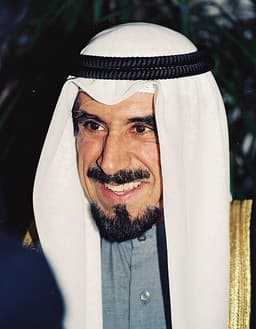
Jaber al-Ahmad al-Sabah
Emperor · Modern
45.4Total

Tupac Amaru
Emperor · Modern
41.7Total
Basic Information
Born
1926
1545
Died
—
1572
Era
Modern
Modern
Nationality
Kuwait
Inca Empire
Occupation
Emperor
Emperor
Civilization
Middle Eastern
Other
Score Comparison
Military (10%)
12.2
50.0
Political (20%)
68.0
27.9
Influence (20%)
56.4
52.5
Legacy (20%)
44.2
42.5
Leadership (15%)
40.0
38.1
Strategy (15%)
28.2
30.3
TOTAL
45.4
41.7
Jaber al-Ahmad al-Sabah — Complete Timeline
1990 AD
Iraqi Invasion of KuwaitWar◆ Major
Iraqi forces invaded and occupied Kuwait under Saddam Hussein. Jaber al-Ahmad al-Sabah fled to Saudi Arabia and established a government-in-exile. The invasion led to the Gulf War and a seven-month occupation of Kuwait.
Gulf WarIraqi InvasionKuwaiti Occupation
Impact: globaltragic
1991 AD
Liberation of KuwaitWar◆ Major
A US-led coalition launched Operation Desert Storm, liberating Kuwait from Iraqi occupation. Jaber al-Ahmad al-Sabah returned to Kuwait as emir. The liberation restored Kuwaiti sovereignty but left the country with extensive damage and environmental destruction.
Gulf WarKuwaiti LiberationCoalition
Impact: globalconstructive
Reconstruction of Kuwait After Gulf WarReform◆ Major
Jaber al-Ahmad al-Sabah oversaw the massive reconstruction of Kuwait's infrastructure, oil fields, and economy after the Gulf War. The rebuilding cost billions of dollars and restored Kuwait's status as a major oil exporter. He also restored the National Assembly.
ReconstructionPost-War RecoveryKuwaiti Economy
Impact: nationalconstructive
Tupac Amaru — Complete Timeline
1571 AD
Coronation as Sapa IncaPolitical Action◆ Major
Tupac Amaru was crowned Sapa Inca of the Neo-Inca State at Vilcabamba after the death of his half-brother Titu Cusi. He inherited a shrinking kingdom under constant Spanish pressure, with limited resources and a dwindling population.
CoronationNeo-Inca StateVilcabamba
Impact: regional
1572 AD
Spanish Invasion of VilcabambaWar
Viceroy Francisco de Toledo launched a military expedition against Vilcabamba, capturing the Neo-Inca capital. Spanish forces overwhelmed the Inca defenders, ending the last independent Inca state and capturing Tupac Amaru.
Spanish ConquestVilcabambaEnd of Inca State
Impact: regionaldestructive
Execution in CuscoPolitical Action
Tupac Amaru was publicly executed by beheading in Cusco's main square after a trial for rebellion. His death marked the final end of the Inca imperial line and the complete subjugation of the Andes under Spanish colonial rule.
ExecutionEnd of Inca EmpireSpanish Colonialism
Impact: regionaltragic
Expert Analysis
Origins
**Jaber al-Ahmad al-Sabah** was born in 1926 in Kuwait City into the ruling al-Sabah family. He was educated in Kuwait and later in private studies, focusing on governance and statecraft. His formative years were shaped by Kuwait's transformation from a pearl-diving economy to an oil-rich state, and he served as head of the Department of Public Security before becoming crown prince in 1965.
**Tupac Amaru** was born around 1545 in the Inca Empire, likely in Vilcabamba, the last Inca stronghold. As a son of Emperor Manco Inca, he was raised in the Neo-Inca State, a remnant of the once vast empire. He received traditional Inca education, learning Quechua, Inca history, and military tactics, but also witnessed the relentless Spanish encroachment.
Rise to Power
**Jaber al-Ahmad al-Sabah** became the Emir of Kuwait on December 31, 1977, succeeding his cousin Sabah al-Salim al-Sabah. He had previously served as prime minister since 1965, overseeing Kuwait's rapid modernization and oil wealth management. His rise was smooth within the dynasty, but he faced challenges including the 1983 bombings and the 1986 dissolution of the National Assembly.
**Tupac Amaru** was crowned Sapa Inca in 1571 after the death of his half-brother Titu Cusi. He inherited a shrinking kingdom under constant Spanish pressure. Unlike his predecessors, he was more resistant to Spanish overtures, refusing to negotiate or convert to Christianity, which set the stage for conflict.
Leadership & Governance
**Jaber al-Ahmad al-Sabah** ruled as an autocrat within a constitutional framework, often suspending parliament to maintain stability. He focused on economic development, investing oil revenues into infrastructure, education, and healthcare. During the Iraqi invasion, he led the government-in-exile from Saudi Arabia, coordinating with the US-led coalition. His governance was pragmatic, prioritizing survival and rebuilding.
**Tupac Amaru** led a traditional Inca monarchy, maintaining the religious and administrative systems of his ancestors. He enforced strict adherence to Inca customs and resisted Spanish cultural influence. However, his domain was limited to Vilcabamba and surrounding areas, with a population of perhaps a few thousand. His leadership was symbolic of resistance but lacked the resources to challenge Spanish rule effectively.
Triumph & Tragedy
**Jaber al-Ahmad al-Sabah's** greatest triumph was the liberation of Kuwait in 1991 following Operation Desert Storm. He returned to Kuwait and oversaw a massive reconstruction effort, costing over $50 billion, restoring oil production and infrastructure. His tragedy was the invasion itself, which exposed Kuwait's vulnerability despite its wealth, and he faced criticism for failing to anticipate Saddam Hussein's aggression. Additionally, his suspension of parliament damaged democratic institutions.
**Tupac Amaru's** triumph was his coronation as Sapa Inca, representing the continuity of Inca sovereignty. His tragedy was the Spanish invasion of Vilcabamba in 1572, where his forces were overwhelmed despite their mountain defenses. Captured, he was tried for rebellion and executed in Cusco's main square, marking the end of the Inca imperial line. His death symbolized the final Spanish conquest.
Character & Destiny
**Jaber al-Ahmad al-Sabah** was cautious and diplomatic, preferring negotiation over confrontation. He maintained strong ties with the West and Saudi Arabia, which proved crucial during the invasion. However, his reliance on foreign powers for defense exposed his regime's military weakness. His character was shaped by a desire for stability, leading to authoritarian tendencies.
**Tupac Amaru** was defiant and proud, refusing to submit to Spanish demands. His decision to reject peace terms and execute Spanish envoys provoked the final attack. His steadfastness ensured his place as a martyr but doomed his state. Historians view him as a tragic figure, noble but inflexible.
Legacy
**Jaber al-Ahmad al-Sabah** is remembered as the emir who saw Kuwait through its darkest hour and rebuilt it. His legacy is mixed: he restored the country but at the cost of democratic progress. Kuwait's political system remains constrained by the emir's powers. His scores reflect a political strength of 68.0 but a military score of only 12.2, highlighting his dependence on allies.
**Tupac Amaru's** legacy is that of the last Inca, a symbol of indigenous resistance. His name inspired later rebellions, including the Tupac Amaru II revolt in the 18th century. He scored 52.5 in influence, reflecting his enduring symbolic power, but only 27.9 in politics, as his rule was brief and ineffective. His military score of 50.0 indicates some tactical ability, but his overall total of 41.7 shows limited impact.
Conclusion
**Jaber al-Ahmad al-Sabah** had a greater impact, with a total score of 45.4 compared to Tupac Amaru's 41.7. While Tupac Amaru's symbolic legacy is significant, Jaber's governance affected millions and shaped a modern nation-state. His leadership during the Gulf War and reconstruction ensured Kuwait's survival, whereas Tupac Amaru's resistance ended in extinction. The score gap of 3.7 points reflects Jaber's higher political and legacy scores, as his decisions had tangible, long-lasting effects on a sovereign country. Tupac Amaru's story is poignant but ultimately a footnote in the Spanish conquest, while Jaber's actions influenced global geopolitics.
Rankings
🥇
Jaber al-Ahmad al-SabahLeader
Mil: 12.2Pol: 68.0Inf: 56.4
45.4
🥈
Tupac Amaru
Mil: 50.0Pol: 27.9Inf: 52.5
41.7
+3.7 behind
How This Comparison Works
Algorithm
Each figure is scored on 6 dimensions (0—100 scale) based on structured historical data: Military (10%), Political (20%), Influence (20%), Legacy (20%), Leadership (15%), Strategy (15%). The weighted total produces the final ranking.
Data Sources
Scores are computed from structured sub-indicators in the database. Scale factors adjust for era (Ancient ×0.85, Modern ×1.0) and civilization size (Eastern ×1.05, Other ×0.80) to account for differences in population and military scale.
Maximum 3 Figures
Comparisons are limited to 2—3 figures to ensure readability and statistical meaningfulness.
Error Margins
±5 points per dimension — Sub-scores are derived from historical records with inherent uncertainty. Two figures within 5 points on a dimension should be considered roughly equivalent in that area.
Total Score Accuracy
±3 points overall — The weighted combination of 6 dimensions produces a total score with approximately ±3 points of uncertainty. Differences of less than 3 points are not statistically significant— the figures are effectively tied.
Known Limitations
- Historical records are incomplete and uneven across civilizations
- Figures from oral-tradition societies may be underrepresented
- Occupation labels can misclassify multi-role figures
- Scores measure capability and impact, not moral character
- Quantitative scoring is a comparison tool, not absolute truth
Capability Radar
Military (10%) — Battles & Warfare
Battles
3
20
Win Rate
10
15
Expansion
13
10
Political (20%) — Governance & Reform
Reform
40
10
Diplomacy
55
15
Economy
50
10
Influence (20%) — Cultural & Global Reach
Cultural
30
30
Global
50
25
Legacy (20%) — Historical Impact
Historical
45
35
Longevity
30
30
Leadership (15%) — Power & Stability
Tenure
60
15
Stability
35
10
Strategy (15%) — Tactics & Innovation
Strategy
12
20
Tactics
18
25
Reform
23
10
Similar Comparisons
Comments & Discussion
No comments yet. Be the first to share your thoughts!