Loading...
Jacinda Ardern vs Mahendra Chaudhry
Jacinda Ardern leads by 11.6 pts · 2 figures compared
…
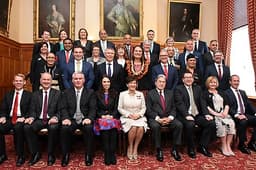
Jacinda Ardern
Politician · Modern
57.5Total
Mahendra Chaudhry
Politician · Modern
45.9Total
Basic Information
Born
1980
1942
Died
—
—
Era
Modern
Modern
Nationality
New Zealand
Fiji
Occupation
Politician
Politician
Civilization
Western
Other
Score Comparison
Military (10%)
50.0
42.8
Political (20%)
65.0
46.6
Influence (20%)
56.7
52.5
Legacy (20%)
49.2
40.0
Leadership (15%)
80.0
48.4
Strategy (15%)
42.9
42.9
TOTAL
57.5
45.9
Jacinda Ardern — Complete Timeline
2017 AD
Became Prime Minister of New ZealandPolitical Action◆ Major
Jacinda Ardern became Prime Minister after the Labour Party formed a coalition government with New Zealand First, supported by the Green Party. At 37, she was the youngest female head of government in the world at the time.
ElectionGender MilestoneGovernment Formation
Impact: nationalconstructive
2019 AD
Response to the Christchurch Mosque ShootingsPolitical Action
Following the terrorist attack on two mosques in Christchurch that killed 51 people, Ardern's government swiftly enacted gun law reforms, banning military-style semi-automatic weapons. Her empathetic leadership and wearing of a headscarf gained international praise.
TerrorismGun ControlCrisis Management
Impact: globalconstructive
2020 AD
COVID-19 Pandemic ResponsePolitical Action
Ardern's government implemented a strict nationwide lockdown and border closure in response to the COVID-19 pandemic. New Zealand successfully eliminated community transmission for several months, with low case numbers and deaths compared to many countries.
Public HealthPandemicLockdown
Impact: globalconstructive
2023 AD
Resigned as Prime MinisterPolitical Action◆ Major
Jacinda Ardern announced her resignation as Prime Minister, stating she no longer had 'enough in the tank' to lead. Her departure marked the end of a transformative but increasingly challenging tenure.
ResignationPolitical Career
Impact: national
Mahendra Chaudhry — Complete Timeline
1999 AD
Became first Indo-Fijian Prime MinisterPolitical Action
Chaudhry, leader of the Fiji Labour Party, won the 1999 general election and became Fiji's first Prime Minister of Indian descent. His election was a historic milestone for ethnic representation.
ElectionIndo-FijianEthnic Politics
Impact: nationalconstructive
2000 AD
Deposed in the 2000 Fijian coup d'étatPolitical Action◆ Major
Chaudhry and his government were taken hostage by armed gunmen led by George Speight, who sought to overturn the Indo-Fijian-led government. The coup resulted in Chaudhry's removal from office.
CoupHostage CrisisPolitical Instability
Impact: nationaltragic
2006 AD
Returned as Finance MinisterPolitical Action
After the 2006 election, Chaudhry served as Finance Minister in the government of Laisenia Qarase. His tenure was marked by tensions with the military, leading to another coup.
Finance MinisterCoalitionPolitical Tensions
Impact: national
Expert Analysis
Origins
Jacinda Ardern was born on July 26, 1980, in Hamilton, New Zealand, to a Mormon family. She grew up in Morrinsville and Murupara, attending the University of Waikato where she earned a Bachelor of Communication Studies in Politics and Public Relations. Her early career included stints as a researcher in the Prime Minister's office and as a policy advisor in the UK under Tony Blair's government. This background gave her a strong grasp of political communication and policy development.
Mahendra Chaudhry was born on October 9, 1942, in Ba, Fiji, into an Indo-Fijian farming family. He studied at the University of the South Pacific, earning a degree in economics and accounting, and later worked as a trade unionist. He became general secretary of the Fiji Public Service Association and president of the Fiji Trades Union Congress. His early activism focused on workers' rights and Indo-Fijian representation in a country where ethnic tensions between indigenous Fijians and Indo-Fijians were deep-seated.
Rise to Power
Ardern entered Parliament in 2008 as a list MP for the Labour Party. She quickly rose through the ranks, becoming the party's president in 2009 and later deputy leader. In 2017, after Labour's poor polling, she was chosen as party leader just seven weeks before the election. Her charisma and focus on child poverty and housing resonated with voters. Labour won 36.9% of the vote, and after negotiations with New Zealand First and the Green Party, Ardern became Prime Minister at age 37, the youngest female head of government in the world at that time.
Chaudhry's rise was slower but marked by persistent advocacy. He entered Parliament in 1992 as a member of the Fiji Labour Party (FLP). The 1999 general election saw the FLP win 37 of 71 seats, forming a coalition with other parties. Chaudhry became Prime Minister, the first Indo-Fijian to hold the office, on May 19, 1999. His election was historic, breaking the indigenous Fijian dominance of politics, but it also heightened ethnic tensions.
Leadership & Governance
Ardern's leadership is defined by empathetic and decisive crisis management. She scored 80.0 in Leadership, reflecting her ability to unite the nation. During the Christchurch mosque shootings (March 15, 2019), she swiftly banned military-style semi-automatic weapons, implemented a royal commission into intelligence failures, and wore a headscarf to honor victims. Her COVID-19 response—a strict lockdown from March 26, 2020, and border closure—eliminated community transmission for months, with New Zealand recording only 26 deaths by mid-2020. However, her government faced criticism for housing affordability and child poverty, which remained persistent despite efforts.
Chaudhry's governance focused on economic reforms and affirmative action for Indo-Fijians. He attempted to reduce the fiscal deficit and promote tourism, but his policies were seen as favoring the Indo-Fijian community, alienating indigenous Fijians. His leadership score of 48.4 reflects the instability of his tenure. He faced constant opposition from nationalist parties and the military, culminating in the 2000 coup led by George Speight, who took Chaudhry and his government hostage for 56 days. The coup was fueled by indigenous resentment of Indo-Fijian political power.
Triumph & Tragedy
Ardern's greatest triumph was her response to the Christchurch attack, which earned global praise for its compassion and swift action. She also achieved a landslide re-election in 2020, winning 50% of the vote and an outright majority—a rare feat under New Zealand's MMP system. Her tragedy was the resignation in January 2023, citing burnout, which underscored the toll of leadership. Critics note that while she excelled in crises, her long-term policy achievements on housing and inequality were limited.
Chaudhry's triumph was becoming Prime Minister, a milestone for Indo-Fijian representation. He also served as Finance Minister from 2006-2007 under Laisenia Qarase, pushing for economic reforms. His tragedy was the 2000 coup, which ended his premiership and led to years of political instability. He was also briefly imprisoned in 2000 and later faced allegations of corruption, though he was acquitted. His legacy is overshadowed by the ethnic divisions that his election exacerbated.
Character & Destiny
Ardern is known for her empathy, communication skills, and resilience. Her decision-making is consultative but decisive in crises. She scored 42.9 in Strategy, indicating a focus on short-term crisis management over long-term planning. Her character—often described as 'kind but firm'—shaped her destiny: she became a global icon for progressive leadership but ultimately stepped down due to the emotional weight of the job.
Chaudhry is characterized as a determined and principled politician, but also as polarizing. His tenacity in advocating for Indo-Fijian rights made him a target for nationalists. His strategic score of 42.9 reflects his failure to build cross-ethnic alliances. His destiny was shaped by the ethnic fault lines of Fiji: his election triggered a coup, and he never regained the premiership.
Legacy
Ardern's legacy is one of compassionate crisis leadership and progressive policies. She changed New Zealand's gun laws, advanced child poverty reduction, and elevated the country's international profile. Her influence score of 56.7 reflects her global impact, particularly on gender equality and empathetic governance. However, her long-term domestic impact remains debated, with some critics arguing her government failed to address structural issues.
Chaudhry's legacy is more ambiguous. He broke a racial barrier but also deepened ethnic divisions. The 2000 coup led to a period of political turmoil, including another coup in 2006. His legacy score of 40.0 reflects his limited lasting impact. He is remembered as a symbol of Indo-Fijian political aspirations and the fragility of democracy in multi-ethnic societies.
Conclusion
Jacinda Ardern had a greater impact than Mahendra Chaudhry, with a total score of 57.5 versus 45.9—a gap of 11.6 points. Ardern's leadership in times of crisis set a global standard, and her policies on gun control and pandemic response had tangible, immediate effects. Chaudhry's historical significance as the first Indo-Fijian PM is notable, but his tenure was cut short, and his legacy is tied to instability. Ardern's ability to lead effectively in emergencies and maintain democratic norms gives her a clear edge in overall impact.
Rankings
🥇
Jacinda ArdernLeader
Mil: 50.0Pol: 65.0Inf: 56.7
57.5
🥈
Mahendra Chaudhry
Mil: 42.8Pol: 46.6Inf: 52.5
45.9
+11.6 behind
How This Comparison Works
Algorithm
Each figure is scored on 6 dimensions (0—100 scale) based on structured historical data: Military (10%), Political (20%), Influence (20%), Legacy (20%), Leadership (15%), Strategy (15%). The weighted total produces the final ranking.
Data Sources
Scores are computed from structured sub-indicators in the database. Scale factors adjust for era (Ancient ×0.85, Modern ×1.0) and civilization size (Eastern ×1.05, Other ×0.80) to account for differences in population and military scale.
Maximum 3 Figures
Comparisons are limited to 2—3 figures to ensure readability and statistical meaningfulness.
Error Margins
±5 points per dimension — Sub-scores are derived from historical records with inherent uncertainty. Two figures within 5 points on a dimension should be considered roughly equivalent in that area.
Total Score Accuracy
±3 points overall — The weighted combination of 6 dimensions produces a total score with approximately ±3 points of uncertainty. Differences of less than 3 points are not statistically significant— the figures are effectively tied.
Known Limitations
- Historical records are incomplete and uneven across civilizations
- Figures from oral-tradition societies may be underrepresented
- Occupation labels can misclassify multi-role figures
- Scores measure capability and impact, not moral character
- Quantitative scoring is a comparison tool, not absolute truth
Capability Radar
Military (10%) — Battles & Warfare
Battles
27
21
Win Rate
30
24
Expansion
37
29
Political (20%) — Governance & Reform
Reform
70
40
Diplomacy
75
35
Economy
60
40
Influence (20%) — Cultural & Global Reach
Cultural
60
30
Global
65
25
Legacy (20%) — Historical Impact
Historical
55
30
Longevity
40
20
Leadership (15%) — Power & Stability
Tenure
65
30
Stability
70
10
Strategy (15%) — Tactics & Innovation
Strategy
41
28
Tactics
42
35
Reform
41
38
Similar Comparisons
Comments & Discussion
No comments yet. Be the first to share your thoughts!