Loading...
Jakaya Kikwete vs Julius Caesar
Julius Caesar leads by 32.2 pts · 2 figures compared
…
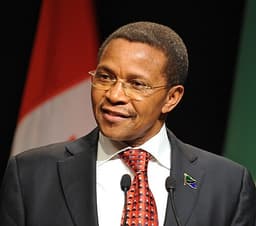
Jakaya Kikwete
Politician · Modern
50.6Total

Julius Caesar
General · Ancient
82.8Total
Basic Information
Born
1950
-100
Died
—
-44
Era
Modern
Ancient
Nationality
Tanzania
Roman Republic
Occupation
Politician
General
Civilization
Other
Western
Score Comparison
Military (10%)
40.0
88.0
Political (20%)
53.8
78.0
Influence (20%)
54.1
85.0
Legacy (20%)
41.7
82.0
Leadership (15%)
72.0
80.0
Strategy (15%)
38.3
85.0
TOTAL
50.6
82.8
Jakaya Kikwete — Complete Timeline
2005 AD
Became President of TanzaniaPolitical Action◆ Major
Jakaya Kikwete was elected President of Tanzania, succeeding Benjamin Mkapa. He won with over 80% of the vote, continuing the dominance of the Chama Cha Mapinduzi (CCM) party. His presidency focused on economic growth, infrastructure, and social services.
PresidencyElectionCCM
Impact: nationalconstructive
2009 AD
Launched Kilimo Kwanza (Agriculture First) InitiativeReform◆ Major
Kikwete launched the Kilimo Kwanza initiative to modernize agriculture, increase productivity, and ensure food security. The program aimed to transform Tanzania into a regional food exporter by providing subsidies, irrigation, and access to credit for farmers.
AgricultureKilimo KwanzaFood Security
Impact: nationalconstructive
2010 AD
Oversaw Economic Growth and Gas DiscoveriesOther◆ Major
Under Kikwete, Tanzania experienced sustained economic growth averaging 6-7% annually, driven by mining, tourism, and construction. Major natural gas discoveries off the coast of Mtwara raised hopes for energy exports, but development was slow due to regulatory and investment challenges.
Economic GrowthNatural GasEnergy
Impact: nationalconstructive
2015 AD
Faced Zanzibar Political CrisisPolitical Action
Kikwete's government faced a political crisis in Zanzibar after disputed elections in 2015, which were annulled by the Zanzibar Electoral Commission. The opposition Civic United Front (CUF) boycotted the rerun, leading to a one-party government in Zanzibar and increased tensions.
ZanzibarElection DisputePolitical Crisis
Impact: regionaldestructive
Stepped Down After Two TermsPolitical Action◆ Major
Kikwete stepped down after completing his two-term limit, handing power to his successor, John Magufuli. His peaceful transfer of power reinforced Tanzania's reputation for political stability in a region often marked by coups and extended presidencies.
Term LimitsSuccessionDemocracy
Impact: nationalconstructive
Julius Caesar — Complete Timeline
58 BC
Gallic WarsWar◆ Major
Caesar, as proconsul of Gaul, launched a series of campaigns that conquered all of Gaul (modern France, Belgium, and parts of Switzerland). He fought numerous battles, including against the Helvetii, the Belgae, and the Gallic chieftain Vercingetorix. The wars brought immense wealth and a loyal army to Caesar.
Gallic WarsConquestRoman Expansion
Impact: regional
49 BC
Crossing the RubiconPolitical Action◆ Major
Caesar led Legio XIII across the Rubicon River into Italy, defying the Roman Senate's order to disband his army. This act triggered a civil war against Pompey and the Optimates, ultimately leading to Caesar's dictatorship and the end of the Roman Republic.
Roman Civil WarEnd of RepublicPower Struggle
Impact: global
48 BC
Battle of PharsalusWar◆ Major
Caesar's outnumbered army defeated the larger forces of Pompey the Great at Pharsalus in Greece. Caesar's tactical use of a reserve line to counter Pompey's cavalry charge proved decisive. Pompey fled to Egypt, where he was assassinated, leaving Caesar as the undisputed master of the Roman world.
Roman Civil WarBattleDecisive Victory
Impact: regional
44 BC
Appointment as Dictator for LifePolitical Action◆ Major
The Roman Senate appointed Caesar dictator perpetuo (dictator for life), granting him unprecedented personal power. This move concentrated military, legislative, and judicial authority in one person, effectively ending the Roman Republic's traditional system of checks and balances and alarming many senators.
DictatorshipEnd of RepublicPower Consolidation
Impact: regionaldestructive
Assassination on the Ides of MarchPolitical Action◆ Major
A group of Roman senators, led by Marcus Junius Brutus and Gaius Cassius Longinus, stabbed Caesar to death at a meeting of the Senate in the Theatre of Pompey. The assassination was intended to restore the Republic, but instead triggered another civil war that led to the rise of the Roman Empire.
AssassinationRoman PoliticsEnd of Republic
Impact: globaldestructive
Expert Analysis
jakaya-kikwete-vs-julius-caesar
# The General and the Peacemaker
On a March morning in 44 BCE, Julius Caesar fell beneath twenty-three dagger blows in the Senate chamber of Rome, his blood pooling on the marble floor where he had once stood as the most powerful man in the Western world. Two thousand years later, in the dusty heat of an East African July, Jakaya Kikwete stood before a crowd in Dar es Salaam, handing over the presidency of Tanzania to his elected successor—a quiet ceremony that marked the end of a decade of rule. One man was murdered for his ambition; the other walked away voluntarily. What drove these two leaders, both men of power, to such different ends?
Origins
Caesar was born into the patrician Julian clan, a family claiming descent from the goddess Venus, but one that had fallen into political obscurity. The Roman Republic of his youth was a cauldron of civil wars, slave revolts, and class conflict—a system buckling under the weight of its own success. Caesar learned early that survival meant audacity. He was kidnapped by pirates as a young man and, after paying ransom, returned to crucify them. His world rewarded decisive, ruthless action.
Kikwete emerged from a very different soil. Born in 1950 in the village of Msoga, in what was then British Tanganyika, he grew up under the gentle but firm hand of Julius Nyerere, Tanzania’s founding father. Nyerere’s vision of *Ujamaa*—African socialism built on community and self-reliance—shaped Kikwete’s formative years. Where Caesar’s Rome taught that glory came from conquest, Kikwete’s Tanzania taught that leadership meant service. He joined the ruling party as a young economist, not a soldier.
Rise to Power
Caesar’s path was a masterclass in calculated risk. He climbed the Roman political ladder—the *cursus honorum*—with breathtaking speed, borrowing vast sums to fund games and bribes that bought popularity. In 60 BCE, he formed the First Triumvirate with Pompey and Crassus, an alliance that gave him command of Gaul. Over eight years, he conquered a territory larger than Italy itself, writing his own legend in dispatches that schoolchildren still read. When the Senate ordered him to disband his army, he chose war instead: crossing the Rubicon River in 49 BCE with the words “*Alea iacta est*”—the die is cast.
Kikwete’s rise was quieter but no less strategic. He served as a minister under Nyerere and later as finance minister under Benjamin Mkapa, earning a reputation for competence and calm. When Mkapa’s term ended in 2005, Kikwete won the presidency with over 80% of the vote—a landslide that reflected not personal charisma but the stability of Tanzania’s one-party dominant system. His path required patience, not rebellion.
Leadership & Governance
Caesar governed as a revolutionary. As dictator, he reformed the calendar, granted citizenship to provincials, initiated public works, and centralized power in ways that shattered the old republican order. His military genius was undeniable—the siege of Alesia in 52 BCE remains a textbook example of double-envelopment—but his political wisdom was more fragile. He pardoned his enemies, only to have them stab him. He trusted that his clemency would win loyalty; it won him a funeral.
Kikwete governed as a technocrat. He launched the Kilimo Kwanza (Agriculture First) initiative in 2009, aiming to modernize farming and boost food security. Under his watch, Tanzania’s economy grew at 6–7% annually, driven by natural gas discoveries and tourism. He navigated the ethnic and religious tensions of Zanzibar with diplomacy, though the disputed 2015 elections tested his skills. Where Caesar built bridges across the Rhine, Kikwete built roads across the Serengeti. Neither conquest nor charisma defined his rule—only steady, unspectacular progress.
Triumph & Tragedy
Caesar’s greatest moment was his triumph over Gaul, a conquest that added a province and a fortune to Rome. His most devastating failure was his own assassination—a death he had been warned of repeatedly. “Beware the Ides of March,” the soothsayer had said, and Caesar ignored him. He died because he had become what the Republic feared most: a king in all but name.
Kikwete’s triumph was more subtle: the peaceful transfer of power in 2015. In a continent where leaders clung to office until death or coup, he stepped down after two terms, setting a precedent for democratic maturity. His tragedy lay in what he could not achieve. The Kilimo Kwanza initiative sputtered; corruption persisted; the Zanzibar crisis left scars. He left office with respect, but not adulation—a quiet exit that would have seemed baffling to Caesar.
Character & Destiny
Caesar was driven by *ambitio*—the Roman hunger for glory that could never be satisfied. He wrote his own commentaries, minted coins with his image, and accepted the title *dictator perpetuo* (dictator for life). His personality was his destiny: he could not stop reaching, and so he was cut down. Kikwete was driven by *kujituma*—a Swahili word meaning dedication to duty. He served his two terms, then went home. His personality was his destiny too: he could not seize more than he was given, and so he survived.
Legacy
Caesar’s legacy is the Roman Empire itself. His name became a title—*Kaiser*, *Tsar*—and his reforms outlived the Republic he destroyed. He is remembered as both a tyrant and a visionary, a man who traded a system for an age.
Kikwete’s legacy is more modest but no less real. He proved that an African leader could leave office voluntarily, that economic growth could coexist with political stability, that a head of state need not be a Caesar. He is remembered as a competent manager in a world that often lacks them.
Conclusion
The dagger and the handshake—two endings to two stories of power. Caesar’s death shook the world because he had reshaped it so utterly. Kikwete’s departure barely made headlines because he had kept it running smoothly. Perhaps the difference is not in the men but in the eras they served. Caesar lived in a time when greatness meant conquest; Kikwete lived in one where greatness meant governance. One fell in the Senate, the other walked out the door. Both, in their own ways, did what history asked of them.
Rankings
🥇
Julius CaesarLeader
Mil: 88.0Pol: 78.0Inf: 85.0
82.8
🥈
Jakaya Kikwete
Mil: 40.0Pol: 53.8Inf: 54.1
50.6
+32.2 behind
How This Comparison Works
Algorithm
Each figure is scored on 6 dimensions (0—100 scale) based on structured historical data: Military (10%), Political (20%), Influence (20%), Legacy (20%), Leadership (15%), Strategy (15%). The weighted total produces the final ranking.
Data Sources
Scores are computed from structured sub-indicators in the database. Scale factors adjust for era (Ancient ×0.85, Modern ×1.0) and civilization size (Eastern ×1.05, Other ×0.80) to account for differences in population and military scale.
Maximum 3 Figures
Comparisons are limited to 2—3 figures to ensure readability and statistical meaningfulness.
Error Margins
±5 points per dimension — Sub-scores are derived from historical records with inherent uncertainty. Two figures within 5 points on a dimension should be considered roughly equivalent in that area.
Total Score Accuracy
±3 points overall — The weighted combination of 6 dimensions produces a total score with approximately ±3 points of uncertainty. Differences of less than 3 points are not statistically significant— the figures are effectively tied.
Known Limitations
- Historical records are incomplete and uneven across civilizations
- Figures from oral-tradition societies may be underrepresented
- Occupation labels can misclassify multi-role figures
- Scores measure capability and impact, not moral character
- Quantitative scoring is a comparison tool, not absolute truth
Capability Radar
Military (10%) — Battles & Warfare
Battles
0
95
Win Rate
0
92
Expansion
0
97
Political (20%) — Governance & Reform
Reform
55
90
Diplomacy
65
85
Economy
55
82
Influence (20%) — Cultural & Global Reach
Cultural
30
88
Global
35
94
Legacy (20%) — Historical Impact
Historical
30
95
Longevity
20
96
Leadership (15%) — Power & Stability
Tenure
60
75
Stability
60
60
Strategy (15%) — Tactics & Innovation
Strategy
0
94
Tactics
0
96
Reform
10
88
Similar Comparisons
Comments & Discussion
CaesarsGhost6/17/2026
Comparing Kikwete to Caesar is like comparing a housecat to a lion. Caesar conquered Gaul, crossed the Rubicon, and rewrote history. Kikwete’s biggest claim is voluntary retirement? That’s not a flex, that’s the bare minimum for a democratic leader. One reshaped the world, the other managed a peaceful transition in a small economy. Let’s not pretend they’re in the same league. History remembers conquerors, not caretakers.
历史毒舌6/17/2026
拿Kikwete比凯撒?简直是侮辱。凯撒在高卢杀了上百万敌人,元老院血流成河,而Kikwete呢?他只是在达累斯萨拉姆开了十年轻松的会。凯撒的遗产是罗马帝国,Kikwete的遗产是平稳交接——这就像拿核弹和鞭炮比。别把政治正确当历史业绩,和平主义者永远上不了历史课本的封面。
PewterSword6/17/2026
Data-wise, the comparison collapses. Caesar ruled for less than a year as dictator before being assassinated; Kikwete served two full five-year terms and left voluntarily. That’s not a "different end"—that’s a completely different political system. In a democracy, leaders leave. In a dictatorship (which late Republic Rome was), they die. Apples to oranges. Let’s talk numbers: Caesar’s assassins were senators. Kikwete’s opponents? They voted him out. Case closed.
数据刺客6/17/2026
数据告诉你:凯撒当权不到一年就被砍了,Kikwete干了十年安然退休。这叫“不同结局”?这根本是两种游戏规则。罗马是腐败的共和国晚期,政治谋杀家常便饭;坦桑尼亚是正常民主制度。别扯什么性格命运,制度才是根本。如果凯撒在现代坦桑尼亚,他也会退休领养老金,不会在罗马广场流血。
ClassicsMaven6/17/2026
You’re missing the irony: both were transitional figures between eras. Caesar ended the Roman Republic; Kikwete ended the era of strongman African leaders. The difference? Caesar knew he was breaking history and chose glory. Kikwete seems almost accidental—he didn't reform Ujamaa, just let it fade. One was a revolutionary architect, the other a reluctant caretaker. Caesar’s ambition was a bonfire; Kikwete’s was a candle flickering in a breeze.
古典破壁机6/17/2026
讽刺在于,两人都处在时代转折点上。凯撒终结了罗马共和国,Kikwete终结了非洲强人领袖时代。但凯撒有意识地打破规则,追求永恒荣耀;Kikwete只是被动接受了变化,几乎没有主动重塑制度。一个像火山爆发般改变世界,另一个像温水煮