Loading...
Jakaya Kikwete vs Mahmoud Ahmadinejad
Jakaya Kikwete leads by 6.0 pts · 2 figures compared
…
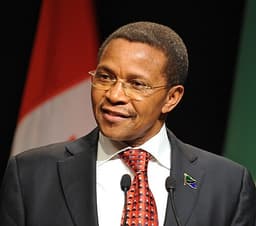
Jakaya Kikwete
Politician · Modern
50.6Total

Mahmoud Ahmadinejad
Politician · Modern
44.6Total
Basic Information
Born
1950
1956
Died
—
—
Era
Modern
Modern
Nationality
Tanzania
Iran
Occupation
Politician
Politician
Civilization
Other
Middle Eastern
Score Comparison
Military (10%)
40.0
24.5
Political (20%)
53.8
30.8
Influence (20%)
54.1
53.3
Legacy (20%)
41.7
40.8
Leadership (15%)
72.0
64.0
Strategy (15%)
38.3
44.0
TOTAL
50.6
44.6
Jakaya Kikwete — Complete Timeline
2005 AD
Became President of TanzaniaPolitical Action◆ Major
Jakaya Kikwete was elected President of Tanzania, succeeding Benjamin Mkapa. He won with over 80% of the vote, continuing the dominance of the Chama Cha Mapinduzi (CCM) party. His presidency focused on economic growth, infrastructure, and social services.
PresidencyElectionCCM
Impact: nationalconstructive
2009 AD
Launched Kilimo Kwanza (Agriculture First) InitiativeReform◆ Major
Kikwete launched the Kilimo Kwanza initiative to modernize agriculture, increase productivity, and ensure food security. The program aimed to transform Tanzania into a regional food exporter by providing subsidies, irrigation, and access to credit for farmers.
AgricultureKilimo KwanzaFood Security
Impact: nationalconstructive
2010 AD
Oversaw Economic Growth and Gas DiscoveriesOther◆ Major
Under Kikwete, Tanzania experienced sustained economic growth averaging 6-7% annually, driven by mining, tourism, and construction. Major natural gas discoveries off the coast of Mtwara raised hopes for energy exports, but development was slow due to regulatory and investment challenges.
Economic GrowthNatural GasEnergy
Impact: nationalconstructive
2015 AD
Faced Zanzibar Political CrisisPolitical Action
Kikwete's government faced a political crisis in Zanzibar after disputed elections in 2015, which were annulled by the Zanzibar Electoral Commission. The opposition Civic United Front (CUF) boycotted the rerun, leading to a one-party government in Zanzibar and increased tensions.
ZanzibarElection DisputePolitical Crisis
Impact: regionaldestructive
Stepped Down After Two TermsPolitical Action◆ Major
Kikwete stepped down after completing his two-term limit, handing power to his successor, John Magufuli. His peaceful transfer of power reinforced Tanzania's reputation for political stability in a region often marked by coups and extended presidencies.
Term LimitsSuccessionDemocracy
Impact: nationalconstructive
Mahmoud Ahmadinejad — Complete Timeline
2005 AD
Election as President of IranPolitical Action◆ Major
Mahmoud Ahmadinejad won the 2005 presidential election in a runoff, defeating Akbar Hashemi Rafsanjani. His populist campaign focused on fighting corruption, economic justice, and reviving revolutionary values.
ElectionPopulismIran
Impact: national
Controversial Holocaust Denial SpeechCultural◆ Major
Ahmadinejad called the Holocaust a 'myth' in a speech, sparking international outrage. This statement damaged Iran's relations with the West and Israel, and was condemned by many world leaders.
Holocaust DenialDiplomacyControversy
Impact: globaldestructive
2006 AD
Nuclear Program EscalationPolitical Action◆ Major
Ahmadinejad resumed uranium enrichment, defying UN Security Council resolutions. This led to multiple rounds of sanctions against Iran and heightened tensions with the US and Israel.
Nuclear ProgramSanctionsConflict
Impact: globaldestructive
2009 AD
2009 Presidential Election and ProtestsPolitical Action
Ahmadinejad won a disputed re-election, leading to massive protests known as the Green Movement. The government violently suppressed the demonstrations, resulting in deaths and arrests, and deepening political divisions.
ElectionProtestsGreen Movement
Impact: nationaldestructive
2013 AD
End of Presidency and Political IsolationPolitical Action◆ Major
Ahmadinejad left office after two terms, barred from running again. He later faced political isolation and was arrested in 2018 for inciting unrest, but was released. His legacy remains divisive.
End of TermArrestLegacy
Impact: national
Expert Analysis
Origins
Jakaya Mrisho Kikwete was born on October 7, 1950, in Msoga, Bagamoyo District, Tanganyika (now Tanzania). He came from a Muslim family; his father was a teacher and local leader. Kikwete studied at Kichangani Primary School and later at Tabora Boys Secondary School. He pursued economics at the University of Dar es Salaam, graduating in 1972 with a Bachelor of Arts in Economics. After university, he worked as a development officer and joined the ruling party Chama Cha Mapinduzi (CCM).
Mahmoud Ahmadinejad was born on October 28, 1956, in Aradan, Iran, to a poor religious family. His father was a barber. Ahmadinejad graduated from Iran University of Science and Technology with a PhD in civil engineering and traffic transportation. He became a member of the Islamic Revolutionary Guard Corps during the Iran-Iraq War, serving as an engineer.
Rise to Power
Kikwete's rise was steady within the CCM. He served as a Member of Parliament from 1988 to 2000, then as Minister of Finance (1995-1997) and Minister of Foreign Affairs (1997-2005). In 2005, he won the presidential election with 80.3% of the vote, succeeding Benjamin Mkapa.
Ahmadinejad's rise was more populist. He served as governor of Ardabil Province from 1993 to 1997, then as mayor of Tehran from 2003 to 2005. He won the 2005 presidential election in a runoff against Akbar Hashemi Rafsanjani, campaigning on anti-corruption and economic justice. His election marked a shift to hardline conservatism.
Leadership & Governance
Kikwete's leadership style was consensus-driven and reformist. He launched the Kilimo Kwanza (Agriculture First) initiative in 2009 to modernize agriculture, aiming to boost productivity and food security. Under his watch, Tanzania experienced sustained GDP growth of 6-7% annually, driven by mining, tourism, and construction. Major natural gas discoveries in 2010-2012 boosted prospects. He also improved relations with international donors and promoted peacekeeping in Africa, scoring a Leadership of 72.0 and Political of 53.8.
Ahmadinejad's governance was confrontational and populist. He implemented cash subsidy reforms, distributing oil revenues directly to citizens, but his economic policies led to high inflation and unemployment. His hardline stance on the nuclear program escalated tensions: Iran resumed uranium enrichment, leading to UN sanctions. His Leadership score is 64.0, but Political only 30.8, reflecting his divisive approach.
Triumph & Tragedy
Kikwete's triumphs include peaceful transfers of power (he stepped down after two terms in 2015) and economic growth. However, his legacy is marred by the Zanzibar political crisis in 2015, where disputed elections led to annulment and violence. He also faced criticism for corruption under his administration, though he himself was not implicated. His Strategy score is 38.3, indicating limited strategic vision.
Ahmadinejad's triumph was his initial popularity among the poor, but his tragedy includes the 2009 election protests (Green Movement) violently suppressed, his Holocaust denial speech that isolated Iran, and his later political isolation and arrest in 2018. His nuclear escalation brought severe sanctions, damaging Iran's economy. His Legacy score is 40.8 and Influence 53.3.
Character & Destiny
Kikwete was known as a moderate, affable leader who prioritized stability. His character led to peaceful transitions but also to a lack of bold reforms. He scored 72.0 in Leadership but 38.3 in Strategy, showing he was more a manager than a visionary.
Ahmadinejad was a populist firebrand, confrontational and ideological. His character drove him to challenge the West and defy norms, but it also led to isolation and economic hardship. His Leadership of 64.0 was undermined by low Political acumen (30.8).
Legacy
Kikwete's legacy is Tanzania's continued stability and democratic consolidation. His economic policies set the stage for later growth under Magufuli. He is remembered as a peaceful leader who upheld term limits. His Total score is 50.6.
Ahmadinejad's legacy is more polarizing: he intensified Iran's nuclear program and left a legacy of sanctions and domestic unrest. He is seen as a symbol of hardline populism. His Total score is 44.6.
Conclusion
Jakaya Kikwete had a greater positive impact on his nation than Mahmoud Ahmadinejad. Kikwete's peaceful governance, economic growth, and respect for democratic norms contrast with Ahmadinejad's divisive rule and economic mismanagement. The 6.0-point score gap reflects this: Kikwete's total of 50.6 vs. Ahmadinejad's 44.6. While Ahmadinejad's influence was global due to nuclear tensions, Kikwete's legacy of stability and development is more beneficial for his country.
Rankings
🥇
Jakaya KikweteLeader
Mil: 40.0Pol: 53.8Inf: 54.1
50.6
🥈
Mahmoud Ahmadinejad
Mil: 24.5Pol: 30.8Inf: 53.3
44.6
+6.0 behind
How This Comparison Works
Algorithm
Each figure is scored on 6 dimensions (0—100 scale) based on structured historical data: Military (10%), Political (20%), Influence (20%), Legacy (20%), Leadership (15%), Strategy (15%). The weighted total produces the final ranking.
Data Sources
Scores are computed from structured sub-indicators in the database. Scale factors adjust for era (Ancient ×0.85, Modern ×1.0) and civilization size (Eastern ×1.05, Other ×0.80) to account for differences in population and military scale.
Maximum 3 Figures
Comparisons are limited to 2—3 figures to ensure readability and statistical meaningfulness.
Error Margins
±5 points per dimension — Sub-scores are derived from historical records with inherent uncertainty. Two figures within 5 points on a dimension should be considered roughly equivalent in that area.
Total Score Accuracy
±3 points overall — The weighted combination of 6 dimensions produces a total score with approximately ±3 points of uncertainty. Differences of less than 3 points are not statistically significant— the figures are effectively tied.
Known Limitations
- Historical records are incomplete and uneven across civilizations
- Figures from oral-tradition societies may be underrepresented
- Occupation labels can misclassify multi-role figures
- Scores measure capability and impact, not moral character
- Quantitative scoring is a comparison tool, not absolute truth
Capability Radar
Military (10%) — Battles & Warfare
Battles
0
21
Win Rate
0
22
Expansion
0
26
Political (20%) — Governance & Reform
Reform
55
20
Diplomacy
65
25
Economy
55
15
Influence (20%) — Cultural & Global Reach
Cultural
30
20
Global
35
30
Legacy (20%) — Historical Impact
Historical
30
25
Longevity
20
10
Leadership (15%) — Power & Stability
Tenure
60
65
Stability
60
10
Strategy (15%) — Tactics & Innovation
Strategy
0
31
Tactics
0
31
Reform
10
36
Similar Comparisons
Comments & Discussion
No comments yet. Be the first to share your thoughts!