Loading...
This comparison has not been analyzed yet.
One-time AI generation (~1 minute). Scores and timeline are already available below.
Jaswant Singh of Jodhpur vs Umberto I of Italy
Umberto I of Italy leads by 0.8 pts · 2 figures compared
…

Jaswant Singh of Jodhpur
Emperor · Modern
49.4Total
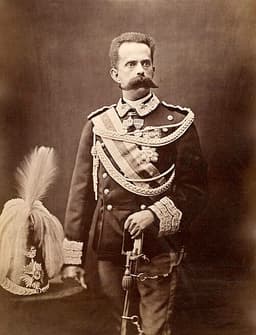
Umberto I of Italy
Emperor · Modern
50.2Total
Basic Information
Born
1629
1844
Died
1678
1900
Era
Modern
Modern
Nationality
India
Italy
Occupation
Emperor
Emperor
Civilization
Indian
Western
Score Comparison
Military (10%)
10.0
45.0
Political (20%)
61.3
43.7
Influence (20%)
52.5
49.4
Legacy (20%)
43.3
40.8
Leadership (15%)
67.0
74.0
Strategy (15%)
51.7
54.6
TOTAL
49.4
50.2
Jaswant Singh of Jodhpur — Complete Timeline
1658 AD
Battle of DharmatWar◆ Major
Jaswant Singh commanded the Rajput contingent for the Mughal prince Dara Shikoh against Aurangzeb at Dharmat. Aurangzeb's forces won, leading to Dara's downfall and Jaswant's temporary disgrace.
Mughal War of SuccessionBattle
Impact: regional
1659 AD
Battle of KhajwaWar◆ Major
Jaswant Singh fought for Aurangzeb against Dara Shikoh at Khajwa. His support helped Aurangzeb secure victory, and he was rewarded with the governorship of Gujarat.
Mughal War of SuccessionBattle
Impact: regional
1660 AD
Governor of GujaratPolitical Action
Jaswant Singh served as governor of Gujarat under Aurangzeb. He administered the province effectively but faced conflicts with Mughal officials, leading to his recall.
GovernorGujaratMughal Administration
Impact: regionalconstructive
1678 AD
Death in the Battle of JamrudWar◆ Major
Jaswant Singh died while leading a Mughal campaign against the Afghans at Jamrud. His death left Marwar without a strong ruler, leading to a succession crisis and Mughal intervention.
BattleDeathMarwar
Impact: regionaltragic
Umberto I of Italy — Complete Timeline
1878 AD
Accession to the ThronePolitical Action◆ Major
Umberto I became King of Italy upon the death of his father Victor Emmanuel II. His reign was marked by colonial expansion, social unrest, and the strengthening of the Triple Alliance with Germany and Austria-Hungary.
MonarchySuccession
Impact: national
1882 AD
Triple Alliance RenewalPolitical Action◆ Major
Umberto I supported Italy's entry into the Triple Alliance with Germany and Austria-Hungary. This defensive alliance shaped Italian foreign policy until World War I, isolating France and aligning Italy with Central Powers.
AllianceForeign Policy
Impact: regional
1895 AD
First Italo-Ethiopian WarWar◆ Major
Umberto I's government pursued colonial expansion in the Horn of Africa, leading to war with Ethiopia. The Italian defeat at the Battle of Adwa in 1896 was a major humiliation, causing his government to fall.
ColonialismWarDefeat
Impact: regionaldestructive
1898 AD
Bava-Beccaris MassacrePolitical Action◆ Major
Umberto I authorized General Bava-Beccaris to use artillery against protesters in Milan, killing dozens. He later decorated the general, earning widespread condemnation and making him a target for anarchists.
RepressionMassacreAnarchism
Impact: nationaldestructive
1900 AD
Assassination by Gaetano BresciPolitical Action
Anarchist Gaetano Bresci shot and killed Umberto I in Monza. The assassination was motivated by the Bava-Beccaris massacre. Umberto I was succeeded by his son Victor Emmanuel III.
AssassinationAnarchismMonarchy
Impact: nationaltragic
This comparison has not been analyzed yet.
One-time AI generation (~1 minute). Scores and timeline are already available below.
Rankings
🥇
Umberto I of ItalyLeader
Mil: 45.0Pol: 43.7Inf: 49.4
50.2
🥈
Jaswant Singh of Jodhpur
Mil: 10.0Pol: 61.3Inf: 52.5
49.4
+0.8 behind
How This Comparison Works
Algorithm
Each figure is scored on 6 dimensions (0—100 scale) based on structured historical data: Military (10%), Political (20%), Influence (20%), Legacy (20%), Leadership (15%), Strategy (15%). The weighted total produces the final ranking.
Data Sources
Scores are computed from structured sub-indicators in the database. Scale factors adjust for era (Ancient ×0.85, Modern ×1.0) and civilization size (Eastern ×1.05, Other ×0.80) to account for differences in population and military scale.
Maximum 3 Figures
Comparisons are limited to 2—3 figures to ensure readability and statistical meaningfulness.
Error Margins
±5 points per dimension — Sub-scores are derived from historical records with inherent uncertainty. Two figures within 5 points on a dimension should be considered roughly equivalent in that area.
Total Score Accuracy
±3 points overall — The weighted combination of 6 dimensions produces a total score with approximately ±3 points of uncertainty. Differences of less than 3 points are not statistically significant— the figures are effectively tied.
Known Limitations
- Historical records are incomplete and uneven across civilizations
- Figures from oral-tradition societies may be underrepresented
- Occupation labels can misclassify multi-role figures
- Scores measure capability and impact, not moral character
- Quantitative scoring is a comparison tool, not absolute truth
Capability Radar
Military (10%) — Battles & Warfare
Battles
45
5
Win Rate
40
5
Expansion
35
10
Political (20%) — Governance & Reform
Reform
30
30
Diplomacy
50
40
Economy
35
35
Influence (20%) — Cultural & Global Reach
Cultural
35
20
Global
20
15
Legacy (20%) — Historical Impact
Historical
40
25
Longevity
30
20
Leadership (15%) — Power & Stability
Tenure
40
55
Stability
30
30
Strategy (15%) — Tactics & Innovation
Strategy
45
5
Tactics
50
5
Reform
30
10
Similar Comparisons
Comments & Discussion
No comments yet. Be the first to share your thoughts!