Loading...
Jean-Baptiste Bernadotte vs Julius Caesar
Julius Caesar leads by 21.8 pts · 2 figures compared
…
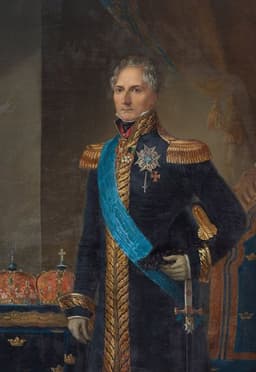
Jean-Baptiste Bernadotte
General · Modern
61.0Total

Julius Caesar
General · Ancient
82.8Total
Basic Information
Born
1763
-100
Died
1844
-44
Era
Modern
Ancient
Nationality
France
Roman Republic
Occupation
General
General
Civilization
Western
Western
Score Comparison
Military (10%)
67.5
88.0
Political (20%)
62.7
78.0
Influence (20%)
55.0
85.0
Legacy (20%)
52.0
82.0
Leadership (15%)
80.0
80.0
Strategy (15%)
61.2
85.0
TOTAL
61.0
82.8
Jean-Baptiste Bernadotte — Complete Timeline
1805 AD
Battle of AusterlitzWar◆ Major
Bernadotte commanded the I Corps at Austerlitz. His corps held the Allied left flank and participated in the encirclement of the Russian and Austrian forces, contributing to the French victory.
Napoleonic WarsBattleCorps Command
Impact: global
1809 AD
Battle of WagramWar◆ Major
Bernadotte commanded the Saxon IX Corps at Wagram. His corps was routed by Austrian forces, and he was criticized by Napoleon for his performance, leading to his dismissal from the Grande Arm
Napoleonic WarsBattleDefeatDismissal
Impact: regional
1810 AD
Elected Crown Prince of SwedenPolitical Action
The Swedish Riksdag elected Bernadotte as Crown Prince, due to his popularity and perceived ability to secure Norway. He converted to Lutheranism and was adopted by King Charles XIII, becoming heir to the throne.
SwedenSuccessionNapoleonic Era
Impact: nationalconstructive
1813 AD
Battle of LeipzigWar◆ Major
Bernadotte, now Crown Prince of Sweden, commanded the Swedish contingent and the Army of the North in the Allied coalition. His forces fought against Napoleon at Leipzig, contributing to the French defeat.
Napoleonic WarsBattleAllied Coalition
Impact: global
1814 AD
Treaty of KielPolitical Action◆ Major
Bernadotte negotiated the Treaty of Kiel with Denmark, which ceded Norway to Sweden. This fulfilled a key Swedish war aim and established the union between Sweden and Norway.
TreatySwedenNorwayDiplomacy
Impact: regionalconstructive
1818 AD
Reign as King of Sweden and NorwayReform◆ Major
As king, Bernadotte pursued a policy of neutrality and internal development. He improved infrastructure, reformed the legal system, and maintained peace, but faced opposition from liberal factions.
ReignReformsNeutrality
Impact: nationalconstructive
Accession as King Charles XIV JohnPolitical Action
Bernadotte ascended the Swedish throne as King Charles XIV John upon the death of Charles XIII. He founded the House of Bernadotte, which continues to reign in Sweden.
MonarchySwedenBernadotte Dynasty
Impact: nationalconstructive
Julius Caesar — Complete Timeline
58 BC
Gallic WarsWar◆ Major
Caesar, as proconsul of Gaul, launched a series of campaigns that conquered all of Gaul (modern France, Belgium, and parts of Switzerland). He fought numerous battles, including against the Helvetii, the Belgae, and the Gallic chieftain Vercingetorix. The wars brought immense wealth and a loyal army to Caesar.
Gallic WarsConquestRoman Expansion
Impact: regional
49 BC
Crossing the RubiconPolitical Action◆ Major
Caesar led Legio XIII across the Rubicon River into Italy, defying the Roman Senate's order to disband his army. This act triggered a civil war against Pompey and the Optimates, ultimately leading to Caesar's dictatorship and the end of the Roman Republic.
Roman Civil WarEnd of RepublicPower Struggle
Impact: global
48 BC
Battle of PharsalusWar◆ Major
Caesar's outnumbered army defeated the larger forces of Pompey the Great at Pharsalus in Greece. Caesar's tactical use of a reserve line to counter Pompey's cavalry charge proved decisive. Pompey fled to Egypt, where he was assassinated, leaving Caesar as the undisputed master of the Roman world.
Roman Civil WarBattleDecisive Victory
Impact: regional
44 BC
Appointment as Dictator for LifePolitical Action◆ Major
The Roman Senate appointed Caesar dictator perpetuo (dictator for life), granting him unprecedented personal power. This move concentrated military, legislative, and judicial authority in one person, effectively ending the Roman Republic's traditional system of checks and balances and alarming many senators.
DictatorshipEnd of RepublicPower Consolidation
Impact: regionaldestructive
Assassination on the Ides of MarchPolitical Action◆ Major
A group of Roman senators, led by Marcus Junius Brutus and Gaius Cassius Longinus, stabbed Caesar to death at a meeting of the Senate in the Theatre of Pompey. The assassination was intended to restore the Republic, but instead triggered another civil war that led to the rise of the Roman Empire.
AssassinationRoman PoliticsEnd of Republic
Impact: globaldestructive
Expert Analysis
jean-baptiste-bernadotte-vs-julius-caesar
# The Dictator and the King
On the Ides of March, 44 BCE, a Roman dictator lay bleeding at the foot of Pompey’s statue, his body pierced by twenty-three daggers wielded by senators he had once called friends. In a very different world, on a February day in 1818, Jean-Baptiste Bernadotte—a French marshal who had fought beside Napoleon—placed a crown upon his own head in Stockholm’s cathedral, becoming King Charles XIV John of Sweden. One man died by conspiracy, the other died of old age in his royal bed. Both were generals who rose from turbulent times, yet their fates could not have been more opposite. What drives a man to seize power by conquest, and what leads him to inherit it by invitation?
Origins
Julius Caesar was born into the patrician Julian clan in 100 BCE, a family whose lineage stretched back to the goddess Venus but whose political influence had faded. Rome itself was a republic in decay, torn by civil wars between populists and aristocrats. Caesar’s father died when he was sixteen, leaving him to navigate a world where ambition was the only currency that mattered. He learned early that survival meant taking risks—he defied the dictator Sulla by refusing to divorce his wife, then fled Rome to serve in the provinces.
Bernadotte came from far humbler stock. Born in 1763 in the small town of Pau in southwestern France, his father was a provincial lawyer. The France of his youth was still a monarchy, but the Enlightenment was reshaping minds, and the old order was creaking. Unlike Caesar, who was born into privilege and had to reclaim it, Bernadotte had no ancestral name to restore. He joined the army as a common soldier at seventeen, and the French Revolution would become his ladder. Where Caesar’s world was collapsing, Bernadotte’s was being built anew.
Rise to Power
Caesar’s path was a masterclass in calculated audacity. He climbed the political ladder of the Roman Republic—quaestor, aedile, praetor, consul—each step funded by borrowed money and secured by alliances. His conquest of Gaul between 58 and 50 BCE was not merely a war; it was a seven-year campaign that made him fabulously wealthy, gave him a loyal army, and turned him into a legend. When the Senate ordered him to disband his legions, he crossed the Rubicon River in 49 BCE, a line no general could legally cross with his army. It was civil war, and Caesar knew it. Within three years, he defeated Pompey and his enemies, and the Republic was effectively his.
Bernadotte’s rise followed a different logic. He became a general during the French Revolutionary Wars, not by birth but by merit. At the Battle of Austerlitz in 1805, he commanded Napoleon’s I Corps, holding the Allied left flank and helping to encircle the enemy army. Yet he was never Napoleon’s favorite—too independent, too popular with his own men. At the Battle of Wagram in 1809, his Saxon corps was routed, and Napoleon publicly blamed him. That failure might have ended a lesser man’s career, but Bernadotte had something Napoleon could not give: political instincts. When Sweden’s aging king needed a crown prince and looked to a French marshal who could secure Norway and keep peace with Russia, Bernadotte accepted in 1810. He was elected, not conquered.
Leadership & Governance
Caesar governed as he fought: decisively, ruthlessly, and with an eye on the future. As dictator, he reformed the calendar, granted citizenship to provincials, launched public works to employ the poor, and centralized the administration of Rome’s sprawling empire. His military genius was inseparable from his political will—he fought in person, shared his soldiers’ hardships, and wrote his own commentaries to shape his legend. But his leadership had a fatal flaw: he believed his own myth. He refused to restore the Republic, accepted the title “dictator for life,” and ignored the resentments he was breeding.
Bernadotte ruled Sweden for twenty-six years as King Charles XIV John, and his governance was defined by the very thing Caesar lacked: patience. He pursued a policy of neutrality that kept Sweden out of the Napoleonic Wars after 1813, a decision that saved countless lives and preserved his kingdom’s independence. He reformed the legal system, improved roads and canals, and promoted education. He was no battlefield genius—his military score of 60.2 reflects his mixed record—but he understood that a king’s power came from stability, not glory. Where Caesar centralized, Bernadotte negotiated. Where Caesar demanded loyalty, Bernadotte earned it.
Triumph & Tragedy
Caesar’s greatest triumph was his conquest of Gaul, which added a vast province to Rome and demonstrated his unmatched strategic brilliance—his military score of 88.0 speaks to this. His tragedy was his assassination on March 15, 44 BCE, a day he had been warned about. He died believing he was indispensable, and in a sense he was right: his death triggered another civil war, and the Republic he had dismantled never returned.
Bernadotte’s triumph was the Treaty of Kiel in 1814, which secured Norway for Sweden—a goal Swedish kings had pursued for centuries. His tragedy was more subtle: he was never fully accepted by the Swedish nobility, who saw him as a French upstart. He ruled effectively, but his legacy as a foreign-born king always carried a shadow. Still, he died in 1844 at the age of eighty-one, having founded a dynasty that reigns in Sweden to this day.
Character & Destiny
Caesar was restless, brilliant, and incapable of moderation. “I came, I saw, I conquered,” he wrote of one campaign, and the phrase captured his soul. He gambled constantly—on Gaul, on the Rubicon, on the idea that one man could replace a republic. His character drove him to reshape history, but it also made him blind to the limits of power. He could not imagine a world without him at its center.
Bernadotte was pragmatic, adaptable, and self-aware. He understood that power required legitimacy, not just force. When he switched sides in 1813 to fight against Napoleon at the Battle of Leipzig, he did so not out of betrayal but out of calculation: Sweden’s interests mattered more than old loyalties. He had the patience Caesar lacked, the humility to accept that a crown was a responsibility, not a prize.
Legacy
Caesar’s legacy is the Roman Empire itself. His name became synonymous with imperial rule—kaiser, tsar, Caesar. His reforms outlived him, his writings defined Latin prose, and his assassination became the most famous political murder in history. But he also left a warning: absolute power, unchecked, destroys the system that created it.
Bernadotte’s legacy is quieter but no less profound. He founded the House of Bernadotte, which still occupies the Swedish throne. He established Sweden’s policy of neutrality, a stance that kept the nation out of both world wars. And he proved that a foreign-born general could become a beloved king—if he understood that ruling meant serving, not conquering.
Conclusion
The dictator and the king both began as soldiers in a world of chaos. Caesar chose to break the old order and remake it in his image; Bernadotte chose to enter an existing order and adapt. One died violently at fifty-five, the other peacefully at eighty-one. Their stories suggest a deep truth about power: it is not enough to seize it. You must also know how to wear it. Caesar wore power like a weapon, and it killed him. Bernadotte wore it like a crown, and it outlasted him. In the end, history remembers both, but it is the king who founded a dynasty, and the general who built an empire—and lost everything.
Rankings
🥇
Julius CaesarLeader
Mil: 88.0Pol: 78.0Inf: 85.0
82.8
🥈
Jean-Baptiste Bernadotte
Mil: 67.5Pol: 62.7Inf: 55.0
61.0
+21.8 behind
How This Comparison Works
Algorithm
Each figure is scored on 6 dimensions (0—100 scale) based on structured historical data: Military (10%), Political (20%), Influence (20%), Legacy (20%), Leadership (15%), Strategy (15%). The weighted total produces the final ranking.
Data Sources
Scores are computed from structured sub-indicators in the database. Scale factors adjust for era (Ancient ×0.85, Modern ×1.0) and civilization size (Eastern ×1.05, Other ×0.80) to account for differences in population and military scale.
Maximum 3 Figures
Comparisons are limited to 2—3 figures to ensure readability and statistical meaningfulness.
Error Margins
±5 points per dimension — Sub-scores are derived from historical records with inherent uncertainty. Two figures within 5 points on a dimension should be considered roughly equivalent in that area.
Total Score Accuracy
±3 points overall — The weighted combination of 6 dimensions produces a total score with approximately ±3 points of uncertainty. Differences of less than 3 points are not statistically significant— the figures are effectively tied.
Known Limitations
- Historical records are incomplete and uneven across civilizations
- Figures from oral-tradition societies may be underrepresented
- Occupation labels can misclassify multi-role figures
- Scores measure capability and impact, not moral character
- Quantitative scoring is a comparison tool, not absolute truth
Capability Radar
Military (10%) — Battles & Warfare
Battles
65
95
Win Rate
60
92
Expansion
55
97
Political (20%) — Governance & Reform
Reform
70
90
Diplomacy
85
85
Economy
65
82
Influence (20%) — Cultural & Global Reach
Cultural
50
88
Global
55
94
Legacy (20%) — Historical Impact
Historical
65
95
Longevity
60
96
Leadership (15%) — Power & Stability
Tenure
80
75
Stability
75
60
Strategy (15%) — Tactics & Innovation
Strategy
75
94
Tactics
70
96
Reform
60
88
Similar Comparisons
Comments & Discussion
No comments yet. Be the first to share your thoughts!