Loading...
Jia Yi vs Julius Caesar
Julius Caesar leads by 32.0 pts · 2 figures compared
…
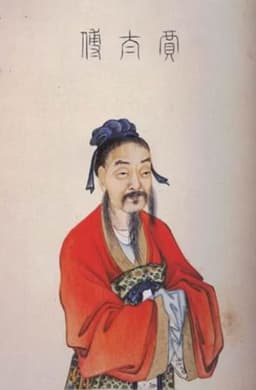
Jia Yi
Politician · Ancient
50.8Total

Julius Caesar
General · Ancient
82.8Total
Basic Information
Born
-200
-100
Died
-169
-44
Era
Ancient
Ancient
Nationality
China
Roman Republic
Occupation
Politician
General
Civilization
Eastern
Western
Score Comparison
Military (10%)
38.5
88.0
Political (20%)
39.4
78.0
Influence (20%)
57.2
85.0
Legacy (20%)
54.0
82.0
Leadership (15%)
48.4
80.0
Strategy (15%)
60.0
85.0
TOTAL
50.8
82.8
Jia Yi — Complete Timeline
176 BC
Exile to ChangshaPolitical Action
Jia Yi was exiled to serve as tutor to the Prince of Changsha after offending powerful officials at court. During his exile, he wrote the famous poem 'The Owl' (Funiao Fu), expressing his philosophical reflections on fate and mortality.
ExileChangshaPoetry
Impact: nationaltragic
174 BC
Memorial on Over-CentralizationPolitical Action◆ Major
Jia Yi submitted a memorial to Emperor Wen of Han warning against the dangers of over-centralization and the concentration of power in the hands of the emperor. He advocated for a balance between central authority and local autonomy, but his advice was not fully heeded.
Political MemorialHan DynastyCentralization
Impact: nationalconstructive
170 BC
Composition of the XinshuCultural◆ Major
Jia Yi wrote the Xinshu (New Writings), a collection of essays on political philosophy, statecraft, and history. The work criticized the Qin dynasty's harsh Legalism and advocated for a Confucian-inspired governance based on virtue and ritual.
Political PhilosophyConfucianismHan Dynasty
Impact: nationalconstructive
169 BC
Death from GriefOther
Jia Yi died at the age of 33, reportedly from grief and disappointment after his advice was ignored and his career stalled. His early death cut short a promising career, but his writings continued to influence Han political thought.
DeathGriefHan Dynasty
Impact: nationaltragic
Julius Caesar — Complete Timeline
58 BC
Gallic WarsWar◆ Major
Caesar, as proconsul of Gaul, launched a series of campaigns that conquered all of Gaul (modern France, Belgium, and parts of Switzerland). He fought numerous battles, including against the Helvetii, the Belgae, and the Gallic chieftain Vercingetorix. The wars brought immense wealth and a loyal army to Caesar.
Gallic WarsConquestRoman Expansion
Impact: regional
49 BC
Crossing the RubiconPolitical Action◆ Major
Caesar led Legio XIII across the Rubicon River into Italy, defying the Roman Senate's order to disband his army. This act triggered a civil war against Pompey and the Optimates, ultimately leading to Caesar's dictatorship and the end of the Roman Republic.
Roman Civil WarEnd of RepublicPower Struggle
Impact: global
48 BC
Battle of PharsalusWar◆ Major
Caesar's outnumbered army defeated the larger forces of Pompey the Great at Pharsalus in Greece. Caesar's tactical use of a reserve line to counter Pompey's cavalry charge proved decisive. Pompey fled to Egypt, where he was assassinated, leaving Caesar as the undisputed master of the Roman world.
Roman Civil WarBattleDecisive Victory
Impact: regional
44 BC
Appointment as Dictator for LifePolitical Action◆ Major
The Roman Senate appointed Caesar dictator perpetuo (dictator for life), granting him unprecedented personal power. This move concentrated military, legislative, and judicial authority in one person, effectively ending the Roman Republic's traditional system of checks and balances and alarming many senators.
DictatorshipEnd of RepublicPower Consolidation
Impact: regionaldestructive
Assassination on the Ides of MarchPolitical Action◆ Major
A group of Roman senators, led by Marcus Junius Brutus and Gaius Cassius Longinus, stabbed Caesar to death at a meeting of the Senate in the Theatre of Pompey. The assassination was intended to restore the Republic, but instead triggered another civil war that led to the rise of the Roman Empire.
AssassinationRoman PoliticsEnd of Republic
Impact: globaldestructive
Expert Analysis
jia-yi-vs-julius-caesar
# The General and the Scholar: Two Paths to Power in Ancient Worlds
The Ides of March, 44 BCE. A Roman dictator lies bleeding on the Senate floor, his body pierced by twenty-three dagger wounds. Across the world, in the Han Empire of China, a thirty-three-year-old scholar dies of a broken heart, his warnings unheeded, his career a ruin. One man changed the course of Western history; the other is now known only to specialists. Why did Julius Caesar achieve such towering influence, while Jia Yi, his near-contemporary, faded into obscurity? The answer lies not in talent, but in the very nature of power in their respective worlds.
Origins
Julius Caesar was born into the patrician Julian clan, one of Rome’s oldest families, but his branch was poor. His aunt married Gaius Marius, the great populist general, and his own wife was the daughter of Marius’s rival, Cinna. From childhood, Caesar navigated a world of civil war, proscription lists, and shifting alliances. He learned early that in Rome, survival meant ambition—and that ambition required gold, soldiers, and glory.
Jia Yi was born in Luoyang, the Han capital, around 200 BCE, just as the dynasty was consolidating its rule. He was a prodigy, known for his mastery of classical texts and his ability to compose essays on statecraft. Unlike Caesar, Jia Yi came from a modest background; his rise depended entirely on scholarly merit. In China, the path to influence ran through the imperial examination system and the favor of the emperor—not through battlefield command or senatorial intrigue.
Rise to Power
Caesar’s ascent was a masterpiece of calculated risk. He borrowed enormous sums to fund public games and bribes, winning the office of Pontifex Maximus and later a governorship in Spain. His real breakthrough came in 58 BCE, when he secured command of Gaul. Over eight years, he conquered a vast territory, built a loyal army, and amassed staggering wealth. When the Senate ordered him to disband his legions, he crossed the Rubicon River in 49 BCE—a direct challenge to the Republic. The civil war that followed ended with Caesar as dictator.
Jia Yi’s rise was quieter but no less dramatic. His brilliance caught the attention of Emperor Wen of Han, who appointed him to the court as a young advisor. Jia Yi proposed sweeping reforms: breaking up large feudal kingdoms, centralizing tax collection, and promoting Confucian learning. But his rapid promotion provoked jealousy among older officials. When he offended a powerful minister, the emperor exiled him to serve as tutor to the Prince of Changsha in 176 BCE. It was a polite dismissal, not a death sentence—but for a man who had dreamed of shaping the empire, it was devastating.
Leadership & Governance
Caesar governed as a military autocrat who understood the theater of power. He reformed the calendar, granted citizenship to provincials, launched massive public works, and packed the Senate with his supporters. His military genius was undeniable: at Alesia in 52 BCE, he besieged a Gallic army while simultaneously repelling a relief force, a feat of logistics and tactics that still impresses historians. Yet his rule was always personal. He centralized authority in himself, dismantling the checks and balances of the Republic. His political score of 78.0 reflects a man who was brilliant at gaining power but less skilled at institutionalizing it.
Jia Yi governed only through his writings. His Memorial on Over-Centralization, submitted in 174 BCE, warned that the Han Empire was drifting toward the same fate as the Qin dynasty—collapse from excessive concentration of power. He argued for a balance between central authority and regional autonomy, for moral leadership rather than legal coercion. His Xinshu (New Writings) collected essays on statecraft that later became foundational texts for Chinese political thought. But Jia Yi never held real executive power. His influence was intellectual, not administrative.
Triumph & Tragedy
Caesar’s greatest moment was his triumph in 46 BCE, when he celebrated victories in Gaul, Egypt, and Pontus. He was master of the Mediterranean world. His tragedy came swiftly: on March 15, 44 BCE, a conspiracy of senators—many of them his own allies—stabbed him to death. His last act, according to legend, was to pull his toga over his face as he fell at the feet of Pompey’s statue.
Jia Yi’s tragedy was quieter. After his exile, he composed a famous essay, “The Faults of Qin,” analyzing why the previous dynasty had fallen. It was brilliant, but nobody in power listened. He died in 169 BCE, reportedly of grief and disappointment. His legacy score of 68.8 is modest, but his ideas about decentralization and moral governance would be rediscovered centuries later.
Character & Destiny
Caesar was audacious, charismatic, and utterly ruthless. He pardoned his enemies—but only after crushing them. He understood that in Rome, power flowed from the sword, and he wielded it without hesitation. His personality drove him to take risks that a more cautious man would have avoided, and those risks paid off until the final one did not.
Jia Yi was cautious, scholarly, and idealistic. He believed that the right argument, presented with sufficient eloquence, could move an emperor. He was wrong. In a world where power was hereditary and bureaucratic, a scholar without a military base or a noble lineage could only advise—never command. His personality, shaped by Confucian deference, prevented him from seizing the kind of power Caesar took for granted.
Legacy
Caesar’s legacy is monumental. His name became a title—Kaiser, Tsar, Caesar—and his reforms laid the foundation for the Roman Empire. His commentaries on the Gallic Wars are still read as military classics. His political and military scores, both 88.0, reflect a man who reshaped the world through force of will.
Jia Yi’s legacy is more subtle. His writings influenced later Chinese statesmen, and his warnings about over-centralization proved prescient when the Han dynasty eventually fell. But he is remembered as a cautionary tale: the brilliant advisor who could not translate wisdom into power. His total score of 54.4 is accurate—not because he lacked genius, but because genius without leverage is a whisper in the wind.
Conclusion
Caesar and Jia Yi faced the same fundamental challenge: how to transform talent into lasting influence. Caesar chose the sword and won an empire, only to die by it. Jia Yi chose the pen and won immortality in libraries, only to die of neglect. Their different fates were not simply a matter of personal ability—they were shaped by the very different political systems they inhabited. In Rome, power was personal, violent, and open to those who could seize it. In Han China, power was bureaucratic, ritualized, and closed to those outside the imperial circle. Both men were brilliant. Only one lived in a world that allowed brilliance to rule.
Rankings
🥇
Julius CaesarLeader
Mil: 88.0Pol: 78.0Inf: 85.0
82.8
🥈
Jia Yi
Mil: 38.5Pol: 39.4Inf: 57.2
50.8
+32.0 behind
How This Comparison Works
Algorithm
Each figure is scored on 6 dimensions (0—100 scale) based on structured historical data: Military (10%), Political (20%), Influence (20%), Legacy (20%), Leadership (15%), Strategy (15%). The weighted total produces the final ranking.
Data Sources
Scores are computed from structured sub-indicators in the database. Scale factors adjust for era (Ancient ×0.85, Modern ×1.0) and civilization size (Eastern ×1.05, Other ×0.80) to account for differences in population and military scale.
Maximum 3 Figures
Comparisons are limited to 2—3 figures to ensure readability and statistical meaningfulness.
Error Margins
±5 points per dimension — Sub-scores are derived from historical records with inherent uncertainty. Two figures within 5 points on a dimension should be considered roughly equivalent in that area.
Total Score Accuracy
±3 points overall — The weighted combination of 6 dimensions produces a total score with approximately ±3 points of uncertainty. Differences of less than 3 points are not statistically significant— the figures are effectively tied.
Known Limitations
- Historical records are incomplete and uneven across civilizations
- Figures from oral-tradition societies may be underrepresented
- Occupation labels can misclassify multi-role figures
- Scores measure capability and impact, not moral character
- Quantitative scoring is a comparison tool, not absolute truth
Capability Radar
Military (10%) — Battles & Warfare
Battles
43
95
Win Rate
41
92
Expansion
46
97
Political (20%) — Governance & Reform
Reform
30
90
Diplomacy
25
85
Economy
35
82
Influence (20%) — Cultural & Global Reach
Cultural
45
88
Global
30
94
Legacy (20%) — Historical Impact
Historical
50
95
Longevity
55
96
Leadership (15%) — Power & Stability
Tenure
20
75
Stability
20
60
Strategy (15%) — Tactics & Innovation
Strategy
51
94
Tactics
50
96
Reform
56
88
Similar Comparisons
Comments & Discussion
No comments yet. Be the first to share your thoughts!