Loading...
Jigme Singye Wangchuck vs Titu Cusi Yupanqui
Jigme Singye Wangchuck leads by 11.8 pts · 2 figures compared
…

Jigme Singye Wangchuck
Emperor · Modern
63.4Total
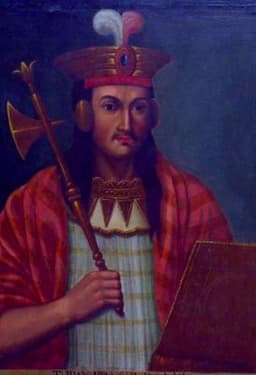
Titu Cusi Yupanqui
Emperor · Modern
51.6Total
Basic Information
Born
1955
1529
Died
—
1571
Era
Modern
Modern
Nationality
Bhutan
Inca Empire
Occupation
Emperor
Emperor
Civilization
Eastern
Western
Score Comparison
Military (10%)
52.8
50.0
Political (20%)
78.0
46.6
Influence (20%)
56.7
54.1
Legacy (20%)
54.0
45.0
Leadership (15%)
81.7
65.7
Strategy (15%)
65.0
50.0
TOTAL
63.4
51.6
Jigme Singye Wangchuck — Complete Timeline
1972 AD
Introduced Gross National Happiness as a development philosophyCultural
King Jigme Singye Wangchuck declared that Gross National Happiness (GNH) was more important than Gross Domestic Product (GDP). This philosophy prioritized well-being, cultural preservation, and environmental protection over material growth, shaping Bhutan's unique development path.
GNHDevelopment philosophyBhutan
Impact: globalconstructive
1974 AD
Crowned as the Fourth Dragon King of BhutanPolitical Action◆ Major
Jigme Singye Wangchuck was formally crowned as the Druk Gyalpo (Dragon King) of Bhutan at the age of 19. His coronation marked the beginning of a reign focused on modernization while preserving Bhutanese culture and traditions.
CoronationMonarchyBhutan
Impact: nationalconstructive
2006 AD
Abdicated the throne in favor of his sonPolitical Action◆ Major
King Jigme Singye Wangchuck announced his abdication, handing the throne to his son, Jigme Khesar Namgyel Wangchuck. The move was part of his plan to ensure a smooth transition to democracy and allow his son to lead the country through the new political system.
AbdicationSuccessionDemocracy
Impact: nationalconstructive
2008 AD
Introduced a constitutional monarchy and democratic reformsReform
King Jigme Singye Wangchuck voluntarily ceded absolute power and oversaw the drafting of Bhutan's first constitution. He transformed the country into a constitutional monarchy, with the first democratic elections held in 2008, ensuring a peaceful transition to democracy.
DemocracyConstitutionMonarchy
Impact: nationalconstructive
Titu Cusi Yupanqui — Complete Timeline
1561 AD
Coronation as Sapa Inca of VilcabambaPolitical Action◆ Major
Titu Cusi Yupanqui succeeded his brother Sayri Tupac as the ruler of the Neo-Inca state in Vilcabamba. He revived resistance against Spanish rule, refusing to accept Spanish authority and maintaining an independent Inca kingdom.
CoronationVilcabambaInca
Impact: regional
1568 AD
Negotiations with Spanish EnvoysPolitical Action
Titu Cusi Yupanqui engaged in negotiations with Spanish envoys, including the viceroy's representatives, seeking a peace treaty. The talks failed due to mutual distrust, and Titu Cusi continued guerrilla warfare against Spanish settlements.
NegotiationPeaceInca
Impact: regional
1570 AD
Dictation of the 'Instrucción al Rey'Cultural◆ Major
Titu Cusi Yupanqui dictated a chronicle to Spanish missionary Fray Marcos Garc
ChronicleIncaSpanish
Impact: regional
1571 AD
Death of Titu Cusi YupanquiOther◆ Major
Titu Cusi Yupanqui died suddenly, possibly from illness or poisoning. His death led to the succession of his brother Tupac Amaru, who was later captured and executed by the Spanish, ending the Vilcabamba resistance.
DeathSuccessionInca
Impact: regionaltragic
Expert Analysis
Origins
Jigme Singye Wangchuck was born on November 11, 1955, in Thimphu, Bhutan, as the son of King Jigme Dorji Wangchuck and Queen Kesang Choden. He was educated in Bhutan and the United Kingdom, attending Heatherdown School in England. His upbringing was deeply rooted in Bhutanese Buddhist traditions, preparing him for his future role as monarch.
Titu Cusi Yupanqui was born around 1529 in Cusco, Peru, as a son of Emperor Manco Inca Yupanqui. He grew up during the Spanish conquest, witnessing the fall of the Inca Empire. His formative years were marked by conflict and resistance, as his father led a rebellion from the remote jungle city of Vilcabamba.
Rise to Power
Jigme Singye Wangchuck ascended the throne at age 17 in 1972, after his father's sudden death. He was crowned as the Fourth Dragon King of Bhutan in 1974. His early reign focused on modernizing Bhutan while preserving its culture, a delicate balance that would define his rule.
Titu Cusi Yupanqui became Sapa Inca in 1561 after his brother Sayri Tupac's death. He ruled the Neo-Inca state of Vilcabamba, a small remnant of the once-great empire. His rise was steeped in resistance against Spanish domination, seeking to maintain Inca sovereignty through both military and diplomatic means.
Leadership & Governance
Jigme Singye Wangchuck introduced the philosophy of Gross National Happiness (GNH) in the 1970s, prioritizing well-being over economic growth. He voluntarily ceded absolute power, overseeing the drafting of Bhutan's first constitution and transitioning to a constitutional monarchy in 2008. His leadership scored 81.7, reflecting his innovative governance.
Titu Cusi Yupanqui led with a mix of military resistance and negotiation. He revived the Inca army and launched raids against Spanish settlements. Simultaneously, he engaged in diplomatic talks with Spanish envoys, seeking a peace treaty that would recognize Inca autonomy. His leadership score of 65.7 indicates his efforts, but ultimately his strategies (50.0) failed to secure lasting independence.
Triumph & Tragedy
Jigme Singye Wangchuck's greatest triumph was establishing GNH as a global alternative development model, influencing international discussions on well-being. His successful democratic transition without conflict is a major legacy. However, his reign also faced challenges: Bhutan's isolationism limited economic growth, and the ethnic Nepali crisis in the 1990s led to the expulsion of over 100,000 people, a tragedy that stains his record.
Titu Cusi Yupanqui's triumph was his resistance against Spanish rule, keeping the Inca state alive for over a decade. His dictated chronicle, 'Instrucción al Rey', provides a rare indigenous perspective on the conquest. His tragedy was the failure of negotiations: he died suddenly in 1571, possibly poisoned, and his brother Tupac Amaru was captured and executed, ending the Inca resistance.
Character & Destiny
Jigme Singye Wangchuck was characterized by his visionary yet pragmatic approach. He prioritized long-term happiness over short-term gains, and his willingness to share power was rare among monarchs. His character shaped a peaceful transition, but his handling of the ethnic crisis revealed a less tolerant side.
Titu Cusi Yupanqui was determined and strategic, but also cautious. He sought a negotiated settlement, a departure from his father's militant stance. His death, likely by Spanish agents, sealed the fate of the Inca rebellion. His character's blend of resistance and diplomacy defined his tragic destiny.
Legacy
Jigme Singye Wangchuck's legacy is profound: GNH has been adopted by international organizations like the UN, and Bhutan's democracy remains stable. His political score of 78.0 and legacy of 54.0 reflect his transformative impact on a small nation. Titu Cusi Yupanqui's legacy is more limited: his chronicle survives as a historical document, but his political and military efforts scored 46.6 and 50.0, respectively, and the Inca state fell shortly after his death.
Conclusion
Jigme Singye Wangchuck had greater impact, with a total score of 63.4 compared to Titu Cusi Yupanqui's 51.6. His GNH philosophy influenced global development discourse, and his peaceful democratic transition set a precedent. Titu Cusi Yupanqui's resistance, while valiant, was ultimately unsuccessful and left little lasting change. Wangchuck's visionary leadership and enduring institutions outweigh Yupanqui's ephemeral rebellion.
Rankings
🥇
Jigme Singye WangchuckLeader
Mil: 52.8Pol: 78.0Inf: 56.7
63.4
🥈
Titu Cusi Yupanqui
Mil: 50.0Pol: 46.6Inf: 54.1
51.6
+11.8 behind
How This Comparison Works
Algorithm
Each figure is scored on 6 dimensions (0—100 scale) based on structured historical data: Military (10%), Political (20%), Influence (20%), Legacy (20%), Leadership (15%), Strategy (15%). The weighted total produces the final ranking.
Data Sources
Scores are computed from structured sub-indicators in the database. Scale factors adjust for era (Ancient ×0.85, Modern ×1.0) and civilization size (Eastern ×1.05, Other ×0.80) to account for differences in population and military scale.
Maximum 3 Figures
Comparisons are limited to 2—3 figures to ensure readability and statistical meaningfulness.
Error Margins
±5 points per dimension — Sub-scores are derived from historical records with inherent uncertainty. Two figures within 5 points on a dimension should be considered roughly equivalent in that area.
Total Score Accuracy
±3 points overall — The weighted combination of 6 dimensions produces a total score with approximately ±3 points of uncertainty. Differences of less than 3 points are not statistically significant— the figures are effectively tied.
Known Limitations
- Historical records are incomplete and uneven across civilizations
- Figures from oral-tradition societies may be underrepresented
- Occupation labels can misclassify multi-role figures
- Scores measure capability and impact, not moral character
- Quantitative scoring is a comparison tool, not absolute truth
Capability Radar
Military (10%) — Battles & Warfare
Battles
50
25
Win Rate
57
20
Expansion
58
10
Political (20%) — Governance & Reform
Reform
80
30
Diplomacy
75
50
Economy
60
20
Influence (20%) — Cultural & Global Reach
Cultural
70
35
Global
55
20
Legacy (20%) — Historical Impact
Historical
65
40
Longevity
60
30
Leadership (15%) — Power & Stability
Tenure
85
40
Stability
90
25
Strategy (15%) — Tactics & Innovation
Strategy
60
25
Tactics
62
30
Reform
69
15
Similar Comparisons
Comments & Discussion
No comments yet. Be the first to share your thoughts!