Loading...
Joao Goulart vs Xavier Bettel
Xavier Bettel leads by 0.3 pts · 2 figures compared
…
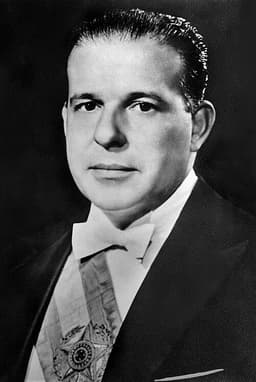
Joao Goulart
Politician · Modern
46.8Total

Xavier Bettel
Politician · Modern
47.1Total
Basic Information
Born
1918
1973
Died
1976
—
Era
Modern
Modern
Nationality
Brazil
Luxembourg
Occupation
Politician
Politician
Civilization
Western
Western
Score Comparison
Military (10%)
49.8
19.9
Political (20%)
42.3
45.0
Influence (20%)
50.2
54.9
Legacy (20%)
40.8
40.0
Leadership (15%)
51.9
72.0
Strategy (15%)
49.2
38.5
TOTAL
46.8
47.1
Joao Goulart — Complete Timeline
1960 AD
Elected Vice President of BrazilPolitical Action◆ Major
João Goulart was elected vice president of Brazil in 1960 on the ticket of the Brazilian Labor Party (PTB), alongside President Jânio Quadros. He assumed office on January 31, 1961.
Vice PresidencyElectionBrazil
Impact: nationalconstructive
1961 AD
Assumed the Presidency After Quadros' ResignationPolitical Action
After Quadros resigned in August 1961, Goulart assumed the presidency on September 7, 1961, following a political crisis and a compromise that established a parliamentary system. He was the first president from the PTB.
PresidencyPolitical CrisisBrazil
Impact: nationalconstructive
1962 AD
Nationalized the American-owned ITT and CSN CompaniesPolitical Action
Goulart nationalized the International Telephone and Telegraph (ITT) company and the Companhia Sider
NationalizationEconomic PolicyBrazil
Impact: national
1963 AD
Proposed the Basic ReformsReform◆ Major
Goulart proposed a series of 'Basic Reforms' (Reformas de Base) in 1963, including land reform, tax reform, educational reform, and the nationalization of foreign-owned utilities. These proposals faced strong opposition from conservative sectors and the military.
ReformLand ReformBrazil
Impact: nationalprogressive
1964 AD
Overthrown in the 1964 Military CoupPolitical Action
Goulart was overthrown by a military coup on April 1, 1964, which established a military dictatorship that lasted until 1985. He fled to Uruguay and later to Argentina, where he lived in exile until his death.
CoupExileMilitary Dictatorship
Impact: nationaltragic
Xavier Bettel — Complete Timeline
2011 AD
Elected Mayor of Luxembourg CityPolitical Action
Xavier Bettel was elected Mayor of Luxembourg City, the capital of Luxembourg. He served in this role until 2013, overseeing urban development and municipal services.
Luxembourg PoliticsMayorLocal Government
constructive
2013 AD
Became Prime Minister of LuxembourgPolitical Action◆ Major
Bettel became Prime Minister of Luxembourg, leading a coalition government of the Democratic Party, the Luxembourg Socialist Workers' Party, and The Greens. He was the first openly gay prime minister in the country's history.
Luxembourg PoliticsPrime MinisterLGBTQ+
Impact: nationalconstructive
2015 AD
Legalized Same-Sex Marriage in LuxembourgReform◆ Major
Bettel's government passed legislation legalizing same-sex marriage and adoption, making Luxembourg one of the first countries to do so. The law reflected his personal advocacy as an openly gay leader.
LGBTQ+ RightsSame-Sex MarriageSocial Reform
Impact: nationalprogressive
2020 AD
Led Luxembourg Through COVID-19 PandemicPolitical Action◆ Major
Bettel oversaw Luxembourg's response to COVID-19, including testing, contact tracing, and vaccination. Luxembourg had one of the highest testing rates per capita in Europe, though it also faced high infection rates early in the pandemic.
COVID-19Luxembourg PoliticsPublic Health
Impact: national
2023 AD
Re-elected for Third Term as Prime MinisterPolitical Action
Bettel was re-elected for a third term after the 2023 general election, though his coalition lost seats. He continued as prime minister, focusing on economic diversification and digital innovation.
Luxembourg PoliticsElectionRe-election
Impact: nationalconstructive
Expert Analysis
Origins
João Goulart was born on March 1, 1919, in São Borja, Rio Grande do Sul, Brazil, into a wealthy landowning family. His father, Vicente Rodrigues Goulart, was a rancher and local politician. Goulart studied law at the Universidade Federal do Rio Grande do Sul, graduating in 1939. He entered politics early, serving as a state deputy and later federal deputy. His political mentor was Getúlio Vargas, the former president and populist leader, under whom Goulart served as Minister of Labor in 1953–1954. This connection shaped his leftist, nationalist orientation.
Xavier Bettel was born on March 3, 1973, in Luxembourg City, to a French mother and a Luxembourgish father. He studied law at the University of Nancy (France) and later at the University of Aix-Marseille, earning a master's degree in public law and political science. Bettel also studied at the University of Thessaloniki and the University of London. He began his political career as a member of the Luxembourg City council in 1999, later serving as mayor from 2011 to 2013. His background is urban, liberal, and European.
Rise to Power
Goulart rose to national prominence as a protégé of Vargas. He was elected Vice President in 1960 on the ticket of Jânio Quadros, a conservative who resigned in 1961 after just seven months. Goulart was abroad at the time, and his return was blocked by military ministers, leading to a political crisis. A compromise installed a parliamentary system with reduced presidential powers. Goulart took office on September 7, 1961. In 1963, a plebiscite restored full presidential powers, giving Goulart a mandate to pursue his reform agenda.
Bettel became Prime Minister on December 4, 2013, after leading the Democratic Party (DP) to a strong electoral performance. He formed a coalition with the Luxembourg Socialist Workers' Party (LSAP) and The Greens. Bettel had previously served as Mayor of Luxembourg City (2011–2013) and as a member of the Chamber of Deputies. His rise was steady, built on local governance and liberal policies. He was re-elected in 2018 and again in 2023, though his coalition lost seats.
Leadership & Governance
Goulart's governance was marked by a confrontational style. He proposed the 'Basic Reforms' in 1963, including land redistribution, nationalization of key industries, and expansion of voting rights to illiterates. He nationalized American-owned ITT and CSN in 1962. His speeches often mobilized unions and leftist groups, alienating the military, conservative elites, and the United States. He lacked strong institutional support and faced a hostile Congress. His leadership score of 51.9 reflects his inability to build broad coalitions.
Bettel's leadership is pragmatic and consensus-oriented. He legalized same-sex marriage in 2014, making Luxembourg one of the first countries to do so. He led the COVID-19 response with high testing rates (one of the highest per capita) and efficient vaccination. His government focused on digitalization, climate action, and European integration. Bettel's leadership score of 72.0 highlights his effectiveness in a stable parliamentary system, but his political score of 45.0 and strategy of 38.5 indicate limited transformative impact.
Triumph & Tragedy
Goulart's greatest triumph was his vision for social justice: the Basic Reforms aimed to reduce inequality in a deeply stratified society. His nationalizations asserted Brazilian sovereignty. However, his tragedy was the 1964 military coup on April 1, 1964, which overthrew him and installed a dictatorship lasting 21 years. He fled to Uruguay and died in exile in 1976. His failure was strategic: he polarized society without securing institutional power, leading to his downfall. His political score of 42.3 and legacy of 40.8 reflect this.
Bettel's triumphs include legalizing same-sex marriage and leading Luxembourg through COVID-19 with low mortality. He also secured a third term, a rare feat in Luxembourg politics. His tragedy is more muted: his coalition lost seats in 2023, and his influence is limited by Luxembourg's small size. He scored 54.9 in influence and 40.0 in legacy. His biggest failure may be the lack of deep structural change, as Luxembourg remains a financial hub without major shifts.
Character & Destiny
Goulart was seen as indecisive yet stubborn. He hesitated to confront the military directly, even as coup plots emerged. His character—a wealthy landowner championing the poor—created contradictions. He trusted his charisma but ignored warnings. His destiny was shaped by Cold War tensions and Brazilian elite resistance. Historians often view him as well-intentioned but politically inept. His total score of 46.8 reflects a tragic figure.
Bettel is known for his affable, media-savvy style. He is the first openly gay prime minister of Luxembourg, a symbol of social progress. His character is pragmatic and adaptable, which helped him survive in coalition politics. His destiny is as a steady leader in a stable democracy, but his impact is constrained by his nation's size. His total score of 47.1 edges out Goulart by 0.3 points.
Legacy
Goulart's legacy is contested: he is remembered as a martyr of democracy and a victim of U.S.-backed coups. His reforms were partially implemented after the return to democracy in 1985, especially land reform and labor rights. The 1964 coup set back Brazilian democracy for decades. His influence on Latin American leftism is significant, but his direct achievements were undone. His legacy score of 40.8 reflects this mixed outcome.
Bettel's legacy includes Luxembourg's role as a global LGBTQ+ rights leader and efficient pandemic management. He also advanced digital governance. However, his legacy is likely to be seen as that of a competent manager rather than a transformative figure. His legacy score of 40.0 is slightly lower than Goulart's, indicating less lasting impact.
Conclusion
While Bettel achieves a higher total score (47.1 vs 46.8), his impact is confined to a small, wealthy nation. Goulart, despite his failure, attempted to reshape Brazil, a major global player, and his overthrow had international consequences. Goulart's legacy in Latin American history is more profound, even if tragic. Therefore, João Goulart had greater historical impact. His actions sparked a coup that altered Brazil's trajectory for decades, while Bettel's tenure, though successful, represents incremental change in a stable system.
Rankings
🥇
Xavier BettelLeader
Mil: 19.9Pol: 45.0Inf: 54.9
47.1
🥈
Joao Goulart
Mil: 49.8Pol: 42.3Inf: 50.2
46.8
+0.3 behind
How This Comparison Works
Algorithm
Each figure is scored on 6 dimensions (0—100 scale) based on structured historical data: Military (10%), Political (20%), Influence (20%), Legacy (20%), Leadership (15%), Strategy (15%). The weighted total produces the final ranking.
Data Sources
Scores are computed from structured sub-indicators in the database. Scale factors adjust for era (Ancient ×0.85, Modern ×1.0) and civilization size (Eastern ×1.05, Other ×0.80) to account for differences in population and military scale.
Maximum 3 Figures
Comparisons are limited to 2—3 figures to ensure readability and statistical meaningfulness.
Error Margins
±5 points per dimension — Sub-scores are derived from historical records with inherent uncertainty. Two figures within 5 points on a dimension should be considered roughly equivalent in that area.
Total Score Accuracy
±3 points overall — The weighted combination of 6 dimensions produces a total score with approximately ±3 points of uncertainty. Differences of less than 3 points are not statistically significant— the figures are effectively tied.
Known Limitations
- Historical records are incomplete and uneven across civilizations
- Figures from oral-tradition societies may be underrepresented
- Occupation labels can misclassify multi-role figures
- Scores measure capability and impact, not moral character
- Quantitative scoring is a comparison tool, not absolute truth
Capability Radar
Military (10%) — Battles & Warfare
Battles
31
25
Win Rate
30
25
Expansion
34
30
Political (20%) — Governance & Reform
Reform
40
55
Diplomacy
35
65
Economy
25
60
Influence (20%) — Cultural & Global Reach
Cultural
20
30
Global
20
40
Legacy (20%) — Historical Impact
Historical
30
30
Longevity
15
20
Leadership (15%) — Power & Stability
Tenure
30
60
Stability
15
65
Strategy (15%) — Tactics & Innovation
Strategy
37
34
Tactics
40
37
Reform
44
35
Similar Comparisons
Comments & Discussion
No comments yet. Be the first to share your thoughts!