Loading...
John Diefenbaker vs Laisenia Qarase
John Diefenbaker leads by 9.2 pts · 2 figures compared
…
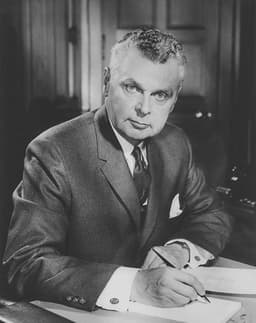
John Diefenbaker
Politician · Modern
53.4Total

Laisenia Qarase
Politician · Modern
44.2Total
Basic Information
Born
1895
1941
Died
1979
—
Era
Modern
Modern
Nationality
Canada
Fiji
Occupation
Politician
Politician
Civilization
Western
Other
Score Comparison
Military (10%)
50.0
50.0
Political (20%)
68.0
37.9
Influence (20%)
56.4
47.9
Legacy (20%)
47.5
36.7
Leadership (15%)
53.2
55.3
Strategy (15%)
42.5
41.2
TOTAL
53.4
44.2
John Diefenbaker — Complete Timeline
1957 AD
Became Prime Minister of CanadaPolitical Action◆ Major
Diefenbaker became the 13th Prime Minister of Canada, leading the Progressive Conservative Party. His victory ended 22 years of Liberal rule and was built on a populist platform.
Government FormationElectionConservatism
Impact: national
1959 AD
Cancelled the Avro Arrow projectPolitical Action◆ Major
Diefenbaker's government cancelled the Avro CF-105 Arrow, a state-of-the-art supersonic interceptor aircraft. The decision was controversial, leading to the loss of thousands of jobs and the destruction of the prototypes, but was driven by cost concerns.
AviationDefenseEconomic Policy
Impact: nationaldestructive
1960 AD
Passed the Canadian Bill of RightsReform◆ Major
Diefenbaker's government passed the Canadian Bill of Rights, a federal statute that guaranteed fundamental freedoms such as speech, assembly, and religion. Though not constitutional, it was a landmark in human rights protection.
Human RightsLegislationCivil Liberties
Impact: nationalconstructive
Extended the franchise to Indigenous peoplesReform◆ Major
Diefenbaker's government amended the Canada Elections Act to give First Nations people the right to vote in federal elections without losing their status. This was a significant step toward Indigenous rights.
Indigenous RightsVoting RightsEquality
Impact: nationalconstructive
Laisenia Qarase — Complete Timeline
2000 AD
Became Prime Minister of FijiPolitical Action◆ Major
Qarase was appointed Prime Minister by President Josefa Iloilo after the 2000 coup, leading an interim government. He later won the 2001 election as leader of the United Fiji Party.
Prime MinisterInterim GovernmentElection
Impact: national
2001 AD
Promotion of affirmative action for indigenous FijiansReform◆ Major
Qarase's government implemented policies favoring indigenous Fijians in land rights, education, and business, which were criticized by Indo-Fijians as discriminatory.
Affirmative ActionEthnic PolicyIndigenous Rights
Impact: nationaldestructive
2006 AD
Deposed in the 2006 Fijian coup d'étatPolitical Action◆ Major
Qarase was overthrown in a military coup led by Commodore Frank Bainimarama, who accused his government of corruption and ethnic bias. Qarase was forced to resign and went into exile.
CoupMilitaryExile
Impact: nationaltragic
Expert Analysis
Origins
John Diefenbaker was born on September 18, 1895, in Neustadt, Ontario, to a German immigrant father and a Scottish mother. His family moved to Saskatchewan, where he grew up in modest circumstances. He studied at the University of Saskatchewan, earning a law degree, and practiced as a defense lawyer, often representing marginalized clients. This background shaped his later commitment to civil rights. Laisenia Qarase was born on February 4, 1941, in Mavana, Vanua Levu, Fiji, to indigenous Fijian parents. He studied at Queen Victoria School and the University of Auckland, New Zealand, earning a degree in commerce. He worked as a civil servant and later in the private sector, becoming CEO of the Fiji Development Bank. His career focused on economic development, particularly for indigenous Fijians.
Rise to Power
Diefenbaker entered federal politics in 1940, winning a seat in the House of Commons. He rose through the Progressive Conservative Party, becoming party leader in 1956. In the 1957 federal election, he led the PCs to a minority government, ending 22 years of Liberal rule. He became Prime Minister on June 21, 1957. His populist appeal and oratory skills attracted voters. Qarase rose to power after the 2000 Fijian coup, which overthrew the elected government of Mahendra Chaudhry. Following the coup, Qarase was appointed interim Prime Minister by President Josefa Iloilo on July 4, 2000. He then led the newly formed United Fiji Party (SDL) to victory in the 2001 election, becoming Prime Minister on September 10, 2001. His rise was based on promoting indigenous Fijian interests.
Leadership & Governance
Diefenbaker's leadership style was confrontational and populist. He championed the Canadian Bill of Rights, passed in 1960, which guaranteed fundamental freedoms at the federal level. He also extended the franchise to First Nations people in 1960, a significant step for Indigenous rights. However, his governance was marked by indecision on economic issues, such as the cancellation of the Avro Arrow project in 1959, which cost jobs and technological prestige. His foreign policy, including opposition to nuclear weapons on Canadian soil, strained relations with the US. Qarase's governance focused on affirmative action for indigenous Fijians through policies like the Blueprint for the Protection of Fijian Rights and Interests, which favored ethnic Fijians in land rights, education, and business. This alienated the Indo-Fijian minority, who comprised about 38% of the population. His government was also accused of corruption and cronyism. Qarase's leadership was reactive, often bowing to nationalist pressures.
Triumph & Tragedy
Diefenbaker's greatest triumph was the Canadian Bill of Rights, which laid the groundwork for the later Charter of Rights and Freedoms. Extending the vote to Indigenous peoples was another lasting achievement. However, his cancellation of the Avro Arrow was a major failure, costing $1.3 billion (CAD 2023 adjusted) and ending Canada's advanced aviation industry. His indecision during the Cuban Missile Crisis and refusal to accept nuclear warheads weakened NATO ties. Qarase's triumph was stabilizing Fiji after the 2000 coup and winning democratic elections in 2001 and 2006. His affirmative action policies improved economic opportunities for some indigenous Fijians. But his failure was the 2006 coup, when he was deposed by Commodore Frank Bainimarama. Qarase's government was seen as corrupt and ethnically divisive, leading to his downfall. He scored 36.7 in legacy, reflecting his controversial impact.
Character & Destiny
Diefenbaker was idealistic and stubborn, often clashing with colleagues and allies. His commitment to civil rights was genuine, but his inability to compromise led to political isolation. He was a skilled orator but poor administrator. His destiny was to be a transformative but ultimately defeated figure, losing the 1963 election due to his nuclear weapons stance. Qarase was pragmatic but ethnocentric, prioritizing indigenous Fijian interests over national unity. He was not a strong leader, often deferring to military and nationalist elements. His character led to polarization, culminating in his overthrow. Both men's fates were shaped by their inability to balance competing interests.
Legacy
Diefenbaker's legacy is mixed: he is remembered for the Bill of Rights and Indigenous voting rights, but also for the Avro Arrow cancellation. His political score of 68.0 reflects his influence on Canadian law. His total score of 53.4 places him as a moderately impactful leader. Qarase's legacy is more negative: he is seen as a divisive figure whose policies contributed to ethnic tension and a coup. His total score of 44.2 reflects his limited positive impact. In Fiji, his affirmative action policies were largely reversed after 2006.
Conclusion
John Diefenbaker had greater impact than Laisenia Qarase. Diefenbaker's Bill of Rights influenced Canadian constitutional law and set a precedent for human rights protections. His extension of the franchise to Indigenous peoples was a landmark. Despite his failures, his contributions to civil rights endure. Qarase's impact was largely negative, exacerbating ethnic divisions and leading to a coup. Diefenbaker's political score of 68.0 against Qarase's 37.9 underscores his superior political influence. While neither achieved unqualified success, Diefenbaker's legacy is more substantial and lasting.
Rankings
🥇
John DiefenbakerLeader
Mil: 50.0Pol: 68.0Inf: 56.4
53.4
🥈
Laisenia Qarase
Mil: 50.0Pol: 37.9Inf: 47.9
44.2
+9.2 behind
How This Comparison Works
Algorithm
Each figure is scored on 6 dimensions (0—100 scale) based on structured historical data: Military (10%), Political (20%), Influence (20%), Legacy (20%), Leadership (15%), Strategy (15%). The weighted total produces the final ranking.
Data Sources
Scores are computed from structured sub-indicators in the database. Scale factors adjust for era (Ancient ×0.85, Modern ×1.0) and civilization size (Eastern ×1.05, Other ×0.80) to account for differences in population and military scale.
Maximum 3 Figures
Comparisons are limited to 2—3 figures to ensure readability and statistical meaningfulness.
Error Margins
±5 points per dimension — Sub-scores are derived from historical records with inherent uncertainty. Two figures within 5 points on a dimension should be considered roughly equivalent in that area.
Total Score Accuracy
±3 points overall — The weighted combination of 6 dimensions produces a total score with approximately ±3 points of uncertainty. Differences of less than 3 points are not statistically significant— the figures are effectively tied.
Known Limitations
- Historical records are incomplete and uneven across civilizations
- Figures from oral-tradition societies may be underrepresented
- Occupation labels can misclassify multi-role figures
- Scores measure capability and impact, not moral character
- Quantitative scoring is a comparison tool, not absolute truth
Capability Radar
Military (10%) — Battles & Warfare
Battles
29
24
Win Rate
31
24
Expansion
32
30
Political (20%) — Governance & Reform
Reform
60
30
Diplomacy
50
25
Economy
40
30
Influence (20%) — Cultural & Global Reach
Cultural
40
15
Global
30
10
Legacy (20%) — Historical Impact
Historical
50
20
Longevity
35
10
Leadership (15%) — Power & Stability
Tenure
55
40
Stability
45
10
Strategy (15%) — Tactics & Innovation
Strategy
36
31
Tactics
40
36
Reform
47
37
Similar Comparisons
Comments & Discussion
No comments yet. Be the first to share your thoughts!