Loading...
John Hawkwood vs Pei Xingjian
Pei Xingjian leads by 9.9 pts · 2 figures compared
…
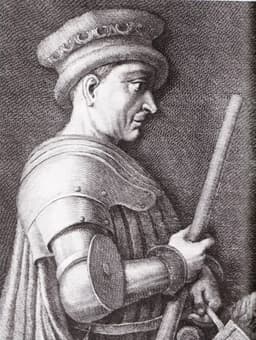
John Hawkwood
General · Medieval
52.9Total

Pei Xingjian
General · Medieval
62.8Total
Basic Information
Born
1323
619
Died
1394
682
Era
Medieval
Medieval
Nationality
Italy
China
Occupation
General
General
Civilization
Western
Eastern
Score Comparison
Military (10%)
60.0
85.0
Political (20%)
42.3
68.0
Influence (20%)
53.3
56.4
Legacy (20%)
45.0
49.2
Leadership (15%)
68.0
70.0
Strategy (15%)
58.0
72.0
TOTAL
52.9
62.8
John Hawkwood — Complete Timeline
1363 AD
Commanded the White CompanyPolitical Action◆ Major
Hawkwood took command of the White Company, a mercenary band of English and German soldiers. He led them into Italy, where they became a major military force, selling their services to various Italian city-states.
MercenaryItalyMilitary
Impact: regional
1377 AD
Sack of CesenaWar◆ Major
Hawkwood, in the service of Cardinal Robert of Geneva, participated in the massacre of thousands of civilians in Cesena. The city was sacked after its surrender, an event that tarnished his reputation.
MassacreWar CrimeItaly
destructive
1387 AD
Battle of CastagnaroWar◆ Major
Hawkwood led the Paduan army to victory against Verona. Using a feigned retreat, he broke the Veronese lines, capturing many prisoners. This battle is considered a masterpiece of medieval tactical deception.
BattleCondottieroItaly
Impact: regional
1390 AD
Appointed Captain-General of FlorencePolitical Action◆ Major
The Republic of Florence appointed Hawkwood as its Captain-General, granting him command of its armies. This position made him the highest-ranking military officer in Florence, a role he held until his death.
AppointmentFlorenceMilitary
Impact: regionalconstructive
Pei Xingjian — Complete Timeline
657 AD
Campaign against the Western TurksWar◆ Major
Pei Xingjian led a Tang expedition against the Western Turkic Khaganate. He defeated the Turks and captured their khagan, extending Tang control over the Western Regions.
CampaignWestern TurksTang Expansion
Impact: regionalconstructive
670 AD
Defended the Western Regions against TibetWar◆ Major
Pei Xingjian commanded Tang forces in the Western Regions against Tibetan expansion. He successfully defended the Tarim Basin and maintained Tang influence in the region.
DefenseTibetWestern Regions
Impact: regionalconstructive
682 AD
Death from illnessOther
Pei Xingjian died of illness. His death was a loss to the Tang military, but his campaigns had secured the Western Regions for the dynasty.
DeathMilitary Loss
Impact: nationaltragic
Expert Analysis
Origins
John Hawkwood was born around 1323 in Sible Hedingham, Essex, England, into a family of minor gentry. Little is known of his early life, but he likely served as an archer in the Hundred Years' War under Edward III. He later joined the White Company, a mercenary band of English and German soldiers, which he eventually commanded. Hawkwood's formative experiences were shaped by the brutal warfare of medieval Europe, where loyalty was often bought and sold.
Pei Xingjian was born in 619 in Jiangzhou, Tang China, into an aristocratic family. His father, Pei Renji, was a high-ranking official. Pei Xingjian passed the imperial examinations and entered civil service, but his military talent was recognized during the Tang campaigns. He studied military strategy and served under Emperor Gaozong, learning from the empire's expansionist policies. His upbringing in a stable, centralized state contrasted sharply with Hawkwood's fragmented feudal world.
Rise to Power
Hawkwood's rise began when he took command of the White Company in the 1360s, leading them to Italy where they became a major military force. He offered his services to various city-states, notably Pisa, Milan, and Padua. His key turning point was the Battle of Castagnaro in 1387, where he led the Paduan army to victory against Verona using a feigned retreat that broke the enemy lines and captured many prisoners. This victory cemented his reputation as a master tactician. He was appointed Captain-General of Florence in 1390, making him the highest-ranking military officer in the republic.
Pei Xingjian rose through the Tang military hierarchy due to his successes in the Western Regions. His major breakthrough came in 657 when he led a campaign against the Western Turkic Khaganate, defeating them and capturing their khagan, Ashina Helu. This victory extended Tang control over the Silk Road. He was then appointed Protector-General of the Western Regions, tasked with defending against Tibetan expansion. His ability to combine military force with diplomacy earned him imperial favor.
Leadership & Governance
Hawkwood's leadership style was pragmatic and profit-driven. He maintained discipline through harsh measures but also shared spoils with his men. As a condottiero, he negotiated contracts (condotte) with city-states, often switching sides for better pay. His governance was minimal; he did not administer cities but rather led armies. For example, his sack of Cesena in 1377 under Cardinal Robert of Geneva involved massacring thousands of civilians, showing a willingness to use terror.
Pei Xingjian led by example, emphasizing strategy and logistics. He was known for his careful planning and use of intelligence. He governed the Western Regions by establishing military colonies and alliances with local tribes. His approach was defensive-offensive: he built fortifications and conducted campaigns to preempt Tibetan attacks. He scored 72.0 in strategy compared to Hawkwood's 58.0, reflecting his systematic approach.
Triumph & Tragedy
Hawkwood's greatest success was the Battle of Castagnaro, where his tactical brilliance secured a decisive victory. His appointment as Captain-General of Florence marked the peak of his career, making him a respected figure in Italian politics. However, his greatest failure was the Sack of Cesena, where his participation in a massacre tarnished his legacy. He also failed to build a lasting state; his power died with him.
Pei Xingjian's triumph was his campaign against the Western Turks, which secured the Tarim Basin for Tang. He successfully defended the Western Regions from Tibetan expansion, maintaining Tang influence for decades. His tragedy was dying of illness in 679, which prevented him from further consolidating gains. Additionally, later Tang losses in the region suggest his achievements were not permanent.
Character & Destiny
Hawkwood was pragmatic, ruthless, and adaptable. He prioritized survival and profit over loyalty. His character led him to switch allegiances frequently, which made him successful as a mercenary but limited his long-term impact. He died in 1394 in Florence, wealthy and honored, but his legacy was confined to Italy.
Pei Xingjian was disciplined, strategic, and loyal to the Tang dynasty. He was known for his integrity and careful planning. His character made him a reliable imperial servant, but his early death prevented him from reaching higher office. Historical assessments praise his military skill but note that his campaigns were part of a larger imperial system.
Legacy
Hawkwood's legacy is mixed. He is remembered as a skilled condottiero who influenced Italian warfare, but his methods were brutal. His tomb in Florence Cathedral, painted by Paolo Uccello, symbolizes his adopted home. However, his military tactics did not survive him as a distinct school. He scored 45.0 in legacy.
Pei Xingjian's legacy is more substantial. He is remembered as a key figure in Tang expansion, with his campaigns securing the Western Regions for decades. His strategies influenced later Tang generals. He scored 49.2 in legacy, slightly higher, but his impact was limited to China. The Tang dynasty's eventual decline diminished his long-term influence.
Conclusion
Pei Xingjian had greater overall impact. His military score of 85.0 dwarfs Hawkwood's 60.0, and his strategic score of 72.0 surpasses 58.0. While Hawkwood was a master of mercenary warfare, his influence was ephemeral and local. Pei Xingjian's campaigns shaped the geopolitics of Central Asia and protected the Silk Road, a vital trade artery. His disciplined leadership and strategic vision contrast with Hawkwood's profit-driven tactics. Though Hawkwood's story is more colorful, Pei Xingjian's achievements were more consequential for the course of history.
Rankings
🥇
Pei XingjianLeader
Mil: 85.0Pol: 68.0Inf: 56.4
62.8
🥈
John Hawkwood
Mil: 60.0Pol: 42.3Inf: 53.3
52.9
+9.9 behind
How This Comparison Works
Algorithm
Each figure is scored on 6 dimensions (0—100 scale) based on structured historical data: Military (10%), Political (20%), Influence (20%), Legacy (20%), Leadership (15%), Strategy (15%). The weighted total produces the final ranking.
Data Sources
Scores are computed from structured sub-indicators in the database. Scale factors adjust for era (Ancient ×0.85, Modern ×1.0) and civilization size (Eastern ×1.05, Other ×0.80) to account for differences in population and military scale.
Maximum 3 Figures
Comparisons are limited to 2—3 figures to ensure readability and statistical meaningfulness.
Error Margins
±5 points per dimension — Sub-scores are derived from historical records with inherent uncertainty. Two figures within 5 points on a dimension should be considered roughly equivalent in that area.
Total Score Accuracy
±3 points overall — The weighted combination of 6 dimensions produces a total score with approximately ±3 points of uncertainty. Differences of less than 3 points are not statistically significant— the figures are effectively tied.
Known Limitations
- Historical records are incomplete and uneven across civilizations
- Figures from oral-tradition societies may be underrepresented
- Occupation labels can misclassify multi-role figures
- Scores measure capability and impact, not moral character
- Quantitative scoring is a comparison tool, not absolute truth
Capability Radar
Military (10%) — Battles & Warfare
Battles
65
75
Win Rate
60
80
Expansion
55
70
Political (20%) — Governance & Reform
Reform
20
55
Diplomacy
70
75
Economy
40
60
Influence (20%) — Cultural & Global Reach
Cultural
45
55
Global
35
55
Legacy (20%) — Historical Impact
Historical
50
65
Longevity
40
60
Leadership (15%) — Power & Stability
Tenure
50
65
Stability
45
70
Strategy (15%) — Tactics & Innovation
Strategy
65
82
Tactics
70
78
Reform
30
60
Similar Comparisons
Comments & Discussion
No comments yet. Be the first to share your thoughts!