Loading...
John Howard vs Julius Caesar
Julius Caesar leads by 26.2 pts · 2 figures compared
…
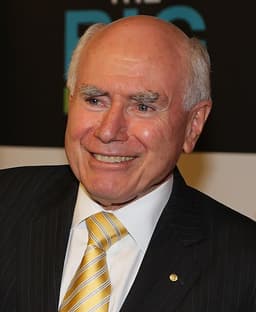
John Howard
Politician · Modern
56.6Total

Julius Caesar
General · Ancient
82.8Total
Basic Information
Born
1939
-100
Died
—
-44
Era
Modern
Ancient
Nationality
Australia
Roman Republic
Occupation
Politician
General
Civilization
Western
Western
Score Comparison
Military (10%)
50.0
88.0
Political (20%)
59.3
78.0
Influence (20%)
57.2
85.0
Legacy (20%)
50.0
82.0
Leadership (15%)
78.0
80.0
Strategy (15%)
41.8
85.0
TOTAL
56.6
82.8
John Howard — Complete Timeline
1996 AD
Implemented Gun Control After Port ArthurReform◆ Major
Following the Port Arthur massacre, Howard's government introduced strict gun control laws, including a ban on automatic and semi-automatic weapons and a mandatory buyback scheme. The reforms significantly reduced gun violence in Australia.
Gun ControlPort ArthurPublic Safety
Impact: nationalprogressive
Elected Prime Minister of AustraliaPolitical Action◆ Major
Howard led the Liberal-National coalition to a landslide victory in the 1996 federal election, defeating Paul Keating's Labor government. His campaign focused on economic reform, family values, and a more conservative social agenda.
ElectionLiberal PartyCoalition
Impact: national
2000 AD
Introduced the Goods and Services Tax (GST)Reform◆ Major
Howard's government introduced a 10% Goods and Services Tax, replacing the previous wholesale sales tax. The GST was a major tax reform that broadened the tax base and provided revenue for state governments, though it was politically controversial.
Tax ReformGSTEconomic Policy
Impact: nationalconstructive
2003 AD
Led Australia into the Iraq WarWar◆ Major
Howard committed Australian troops to the US-led invasion of Iraq, citing weapons of mass destruction. The decision was highly controversial and led to large public protests, but Howard argued it was necessary for global security.
Iraq WarForeign PolicyUS Alliance
Impact: globaldestructive
2007 AD
Defeated in 2007 ElectionPolitical Action◆ Major
Howard lost the 2007 federal election to Kevin Rudd's Labor Party, ending his 11-year tenure as prime minister. He also lost his own seat of Bennelong, becoming only the second sitting prime minister to lose his seat.
ElectionDefeatLabor Party
Impact: nationaltragic
Julius Caesar — Complete Timeline
58 BC
Gallic WarsWar◆ Major
Caesar, as proconsul of Gaul, launched a series of campaigns that conquered all of Gaul (modern France, Belgium, and parts of Switzerland). He fought numerous battles, including against the Helvetii, the Belgae, and the Gallic chieftain Vercingetorix. The wars brought immense wealth and a loyal army to Caesar.
Gallic WarsConquestRoman Expansion
Impact: regional
49 BC
Crossing the RubiconPolitical Action◆ Major
Caesar led Legio XIII across the Rubicon River into Italy, defying the Roman Senate's order to disband his army. This act triggered a civil war against Pompey and the Optimates, ultimately leading to Caesar's dictatorship and the end of the Roman Republic.
Roman Civil WarEnd of RepublicPower Struggle
Impact: global
48 BC
Battle of PharsalusWar◆ Major
Caesar's outnumbered army defeated the larger forces of Pompey the Great at Pharsalus in Greece. Caesar's tactical use of a reserve line to counter Pompey's cavalry charge proved decisive. Pompey fled to Egypt, where he was assassinated, leaving Caesar as the undisputed master of the Roman world.
Roman Civil WarBattleDecisive Victory
Impact: regional
44 BC
Appointment as Dictator for LifePolitical Action◆ Major
The Roman Senate appointed Caesar dictator perpetuo (dictator for life), granting him unprecedented personal power. This move concentrated military, legislative, and judicial authority in one person, effectively ending the Roman Republic's traditional system of checks and balances and alarming many senators.
DictatorshipEnd of RepublicPower Consolidation
Impact: regionaldestructive
Assassination on the Ides of MarchPolitical Action◆ Major
A group of Roman senators, led by Marcus Junius Brutus and Gaius Cassius Longinus, stabbed Caesar to death at a meeting of the Senate in the Theatre of Pompey. The assassination was intended to restore the Republic, but instead triggered another civil war that led to the rise of the Roman Empire.
AssassinationRoman PoliticsEnd of Republic
Impact: globaldestructive
Expert Analysis
john-howard-vs-julius-caesar
# The Dictator and the Democrat
On a March morning in 44 BCE, the most powerful man in the Roman world fell bleeding at the feet of a statue of his great rival, Pompey. Sixty senators had just stabbed him twenty-three times. Across the millennia and half a world away, on a September evening in 2007, an Australian prime minister stood in a suburban Sydney church hall, conceding defeat in an election he had seemed certain to lose. One man had seized absolute power and died for it; the other had wielded power for eleven years and relinquished it with a handshake. What drives such different destinies? The answer lies not merely in personality, but in the very fabric of the worlds they inhabited.
Origins
Gaius Julius Caesar was born into a patrician family that had fallen on hard times, both financially and politically. The Roman Republic of the first century BCE was already dying—a system designed for a city-state struggling to govern an empire, riven by civil wars between populists and oligarchs, generals and senators. Caesar’s aunt had married Gaius Marius, the great populist general, and his own wife was the daughter of Marius’s rival Cinna. From childhood, Caesar breathed the air of factional violence and ambition. His world was one where a man could rise by courting the mob, buying votes with borrowed money, and winning military glory on distant frontiers.
John Winston Howard was born in 1939 in the Sydney suburb of Earlwood, the son of a garage proprietor and a mother who worked as a typist. Australia was a stable, prosperous democracy, part of the British Commonwealth, with a political system designed to produce compromise and consensus. Howard’s boyhood was shaped by the certainties of the 1950s: respect for authority, belief in the family, and a deep suspicion of change. He studied law, entered politics in the 1970s, and climbed the ranks of the Liberal Party through patient loyalty and a gift for policy detail. His world was one where ambition had to be cloaked in moderation, where power was won not by crossing rivers but by winning marginal seats.
Rise to Power
Caesar’s path to supremacy was a masterpiece of calculated risk. He borrowed fortunes to fund public games and feasts, making himself the darling of the Roman mob. He forged the First Triumvirate with Pompey and Crassus, an informal alliance that dominated the state. Then came the conquest of Gaul—eight years of brutal warfare that made him the richest and most feared man in the Republic, commanding legions fanatically loyal to him alone. When the Senate ordered him to disband his army and return to Rome as a private citizen, Caesar faced a choice: submit to his enemies’ vengeance, or defy the Republic itself. At the Rubicon River in 49 BCE, he chose defiance. “The die is cast,” he reportedly said, and marched on Rome.
Howard’s rise was slower, more methodical. He first became Liberal Party leader in 1985, but his conservatism seemed out of step with the times, and he was ousted in 1989 after a poor election showing. He spent the next six years in the political wilderness, rebuilding his image, softening his edges, waiting for the tide to turn. When it did, in 1996, he won a landslide victory against a tired Labor government. His crossing of a Rubicon was not a river in northern Italy, but a television studio where he promised to govern “for all Australians”—a phrase that hinted at his ambition without alarming the electorate.
Leadership & Governance
Caesar governed as a dictator in all but name. He reformed the calendar, granted citizenship to Gauls, launched public works to employ the poor, and centralized power in his own hands. His military genius is beyond dispute: at Alesia, he besieged 80,000 Gauls while simultaneously fighting off a relief army of 250,000—a feat of logistics and nerve that still astonishes. But his political wisdom was fatally flawed. He pardoned his enemies, showered them with honors, and assumed they would be grateful. They were not. He believed his personal popularity could substitute for institutional legitimacy, and he was wrong.
Howard governed as a master of the possible. His greatest domestic achievement was the 1996 gun control laws, pushed through within weeks of the Port Arthur massacre that killed 35 people. He faced furious opposition from rural voters and his own party’s right wing, but he held firm, and the laws remain a global model. In 2000, he introduced the Goods and Services Tax, a reform that had destroyed previous leaders but that he nursed through Parliament with relentless negotiation. His military decisions were less sure-footed: committing troops to the Iraq War in 2003, based on flawed intelligence, proved a strategic error that haunted his later years. Yet his leadership style—steady, uncharismatic, dogged—kept Australia stable through the Asian financial crisis, the Bali bombings, and the rise of China.
Triumph & Tragedy
Caesar’s greatest triumph was Gaul—the conquest of a vast territory, the enrichment of Rome, and the creation of a legend that would outlast the Republic itself. His greatest tragedy was the Ides of March. He had achieved everything, and then he bled to death on the Senate floor, his assassins believing they had saved the Republic. Instead, they plunged Rome into another generation of civil war, ending with the rise of his adopted heir, Octavian, as the first emperor.
Howard’s greatest triumph was the gun control legislation, a moral and political victory that saved countless lives. His greatest tragedy was the Iraq War, which damaged Australia’s international reputation and left a stain on his legacy. He also suffered the personal blow of losing his own seat in the 2007 election—the first time a sitting prime minister had been defeated in his own constituency since 1929. He took it with characteristic stoicism, but the humiliation was real.
Character & Destiny
Caesar was audacious, brilliant, and dangerously convinced of his own invincibility. He wrote his own history, both in his Commentaries and in his life. He believed that will and genius could overcome any obstacle, and for a long time, he was right. But his contempt for the forms of the Republic blinded him to the reality that even dictators need legitimacy. He once said, “It is easier to find men who will volunteer to die, than to find those who are willing to endure pain with patience.” He found plenty of men willing to die for him; he found none willing to endure the slow, patient work of building institutions.
Howard was cautious, pragmatic, and deeply aware of his limitations. He once described himself as “a little boy from Earlwood who never expected to be prime minister.” His ambition was no less real than Caesar’s, but it was channeled through the slow machinery of democracy. He understood that power in a free society is borrowed, not owned. His greatest strength was his ability to wait, to listen, to compromise. His greatest weakness was a certain narrowness of vision—he governed well within the boundaries of the possible, but rarely asked whether those boundaries should be expanded.
Legacy
Caesar’s legacy is the Roman Empire itself. He did not found it, but he made it inevitable. His name became a title—Kaiser, Tsar—and his reforms shaped Western civilization for two millennia. He is remembered as a genius, a tyrant, a martyr, a warning. His story is told in every language, studied in every military academy, debated in every classroom. He is the archetype of the man who changed the world and was destroyed by it.
Howard’s legacy is more modest but more precise. He is remembered for the gun laws, for the GST, for the Iraq War, and for a decade of prosperity. He is the second-longest-serving Australian prime minister, but he is not a figure of world-historical significance. He is a reminder that democracy produces leaders who are competent, cautious, and limited—and that this may be enough.
Conclusion
Caesar and Howard stand at opposite ends of the spectrum of political power. One changed the world through conquest and ambition; the other through legislation and patience. One died at the hands of his enemies; the other retired to write his memoirs. Their differences are not merely personal; they are the differences between an age of iron and an age of law, between a republic that could not contain its greatest citizens and a democracy that could. The Rubicon and the ballot box are both thresholds, but they lead to very different places. Caesar crossed his and changed history forever. Howard crossed his and changed Australia—and then, when his time was up, he walked away. In that difference lies the entire story of how power has been won, held, and lost across the centuries.
Rankings
🥇
Julius CaesarLeader
Mil: 88.0Pol: 78.0Inf: 85.0
82.8
🥈
John Howard
Mil: 50.0Pol: 59.3Inf: 57.2
56.6
+26.2 behind
How This Comparison Works
Algorithm
Each figure is scored on 6 dimensions (0—100 scale) based on structured historical data: Military (10%), Political (20%), Influence (20%), Legacy (20%), Leadership (15%), Strategy (15%). The weighted total produces the final ranking.
Data Sources
Scores are computed from structured sub-indicators in the database. Scale factors adjust for era (Ancient ×0.85, Modern ×1.0) and civilization size (Eastern ×1.05, Other ×0.80) to account for differences in population and military scale.
Maximum 3 Figures
Comparisons are limited to 2—3 figures to ensure readability and statistical meaningfulness.
Error Margins
±5 points per dimension — Sub-scores are derived from historical records with inherent uncertainty. Two figures within 5 points on a dimension should be considered roughly equivalent in that area.
Total Score Accuracy
±3 points overall — The weighted combination of 6 dimensions produces a total score with approximately ±3 points of uncertainty. Differences of less than 3 points are not statistically significant— the figures are effectively tied.
Known Limitations
- Historical records are incomplete and uneven across civilizations
- Figures from oral-tradition societies may be underrepresented
- Occupation labels can misclassify multi-role figures
- Scores measure capability and impact, not moral character
- Quantitative scoring is a comparison tool, not absolute truth
Capability Radar
Military (10%) — Battles & Warfare
Battles
26
95
Win Rate
29
92
Expansion
37
97
Political (20%) — Governance & Reform
Reform
65
90
Diplomacy
70
85
Economy
75
82
Influence (20%) — Cultural & Global Reach
Cultural
40
88
Global
45
94
Legacy (20%) — Historical Impact
Historical
55
95
Longevity
50
96
Leadership (15%) — Power & Stability
Tenure
70
75
Stability
75
60
Strategy (15%) — Tactics & Innovation
Strategy
37
94
Tactics
40
96
Reform
44
88
Similar Comparisons
Comments & Discussion
No comments yet. Be the first to share your thoughts!