Loading...
John III of Sweden vs Joseph II
Joseph II leads by 5.1 pts · 2 figures compared
…
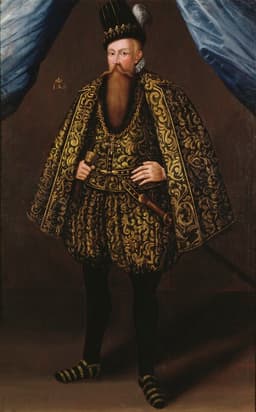
John III of Sweden
Emperor · Modern
51.4Total

Joseph II
Emperor · Modern
56.5Total
Basic Information
Born
1537
1741
Died
1592
1790
Era
Modern
Modern
Nationality
Sweden
Holy Roman Empire
Occupation
Emperor
Emperor
Civilization
Western
Western
Score Comparison
Military (10%)
50.0
50.0
Political (20%)
68.0
59.3
Influence (20%)
53.3
61.0
Legacy (20%)
44.2
50.0
Leadership (15%)
53.2
66.0
Strategy (15%)
38.3
50.0
TOTAL
51.4
56.5
John III of Sweden — Complete Timeline
1569 AD
Coronation of John IIIPolitical Action◆ Major
John III was crowned King of Sweden after deposing his half-brother Eric XIV. His reign focused on religious reconciliation and cultural patronage, including the introduction of the Red Book liturgy.
CoronationSuccession
Impact: national
Imprisonment of Eric XIVPolitical Action
John III ordered the continued imprisonment of his deposed half-brother Eric XIV, who was held at various castles until his death in 1577. This secured John's throne but created a lasting stain on his reign.
ImprisonmentDynastic Conflict
Impact: nationaldestructive
1570 AD
War against Russia (Livonian War)War◆ Major
John III continued Sweden's involvement in the Livonian War against Russia, seeking control over Estonia and Livonia. The war ended inconclusively in 1583 with the Treaty of Plussa, ceding some territories to Sweden.
Livonian WarRussiaTerritorial Conflict
Impact: regional
1574 AD
Establishment of the Swedish Jesuit MissionPolitical Action
John III invited Jesuit priests to Sweden to promote Catholic-Lutheran dialogue and secretly negotiated with the Papacy about a possible reunion. The mission failed due to Protestant opposition and the Jesuits' expulsion in 1580.
JesuitsCatholicismReligious Diplomacy
Impact: national
1576 AD
Promulgation of the Red BookCultural◆ Major
John III issued the Red Book (Liturgy of 1576), a new church liturgy that incorporated Catholic elements into Lutheran worship. This attempt to reconcile Catholicism and Lutheranism caused conflict with the Swedish clergy and nobility.
LiturgyReligious ReformCatholic-Lutheran
Impact: national
Joseph II — Complete Timeline
1778 AD
War of the Bavarian SuccessionWar
Joseph II attempted to exchange the Austrian Netherlands for Bavaria, triggering the War of the Bavarian Succession against Prussia. The conflict, known as the 'Potato War,' ended with the Treaty of Teschen in 1779, which prevented the exchange and left Joseph's ambitions unfulfilled.
War of the Bavarian SuccessionPrussiaTerritorial Exchange
Impact: regional
1781 AD
Abolished serfdom in the Habsburg monarchyReform
Joseph II issued the Serfdom Patent, abolishing serfdom in the Habsburg hereditary lands. Peasants were granted personal freedom, the right to marry without seigneurial permission, and the ability to move freely, though they still owed labor obligations to landlords.
SerfdomReformEnlightenment
Impact: regionalprogressive
Edict of TolerationReform◆ Major
Joseph II issued the Edict of Toleration, granting religious freedom to non-Catholic Christians, including Protestants and Orthodox, in the Habsburg monarchy. Jews also received limited civil rights. This was a major step toward religious pluralism in a Catholic state.
Religious TolerationEnlightenmentReform
Impact: regionalprogressive
1782 AD
Dissolved monasteriesReform◆ Major
Joseph II dissolved over 700 monasteries that were deemed non-contributory to society, using their wealth to fund education, hospitals, and other state institutions. This secularization policy provoked strong opposition from the Catholic Church and conservative nobles.
SecularizationMonasteriesChurch Reform
Impact: regionalconstructive
Expert Analysis
Origins
John III of Sweden (born 1537) was the son of King Gustav Vasa and Margaret Leijonhufvud. Raised in a Lutheran court, he received a humanist education and developed an interest in theology and architecture. His half-brother Eric XIV's unstable reign led John to conspire and eventually depose him. Joseph II (born 1741) was the eldest son of Empress Maria Theresa and Francis I, Holy Roman Emperor. Educated in Enlightenment philosophy by tutors like Christian August Beck, he was exposed to ideas of religious tolerance and social reform from an early age. His mother's pragmatic rule shaped his understanding of statecraft, though he often chafed at her caution.
Rise to Power
John III rose by deposing his half-brother Eric XIV in 1568, after Eric's mental instability and conflicts with the nobility. John's coronation in 1569 marked the start of his reign. He leveraged his marriage to Catherine Jagellon of Poland to strengthen ties with Catholic Europe. Joseph II became Holy Roman Emperor in 1765 after his father's death, but his mother Maria Theresa retained effective control until her death in 1780. Upon her death, Joseph implemented sweeping reforms without the constraints of co-rule. His rise was thus a gradual transition from co-regent to absolute ruler.
Leadership & Governance
John III's leadership focused on religious reconciliation. He issued the Red Book in 1576, a liturgy blending Catholic and Lutheran elements, aiming to reunite the churches. He also invited Jesuits to Sweden and secretly negotiated with the Papacy. However, his reforms faced strong opposition from Lutheran clergy and nobles, leading to limited success. His political score of 68.0 reflects his ability to maintain power, but his military score of 50.0 and strategy of 38.3 indicate indecisive warfare. Joseph II, an enlightened despot, implemented radical reforms: the 1781 Serfdom Patent abolished serfdom, granting peasants freedom; the Edict of Toleration (1781) granted religious freedom to non-Catholic Christians; and he dissolved over 700 monasteries, redirecting funds to education and hospitals. His leadership score of 66.0 and political score of 59.3 show decisive governance, but his reforms provoked backlash from nobles and clergy, leading to many being reversed after his death.
Triumph & Tragedy
John III's triumph was his cultural patronage, including the construction of the Uppsala Cathedral and the promotion of Renaissance art. His tragedy was the failure of his religious policy: the Red Book was rejected, and his Catholic sympathies alienated his subjects. His legacy score of 44.2 reflects this. Joseph II's triumphs include the abolition of serfdom and the Edict of Toleration, which modernized the Habsburg monarchy. His tragedy was the War of the Bavarian Succession (1778-1779), known as the "Potato War," which ended inconclusively and damaged his reputation. His military score of 50.0 reflects this mediocrity. His reforms, though visionary, were often too rapid and provoked resistance, leading to their partial reversal.
Character & Destiny
John III was a cultured and intellectual ruler, but his religious zeal and lack of political pragmatism led to isolation. His character, as described by historians, was that of a dreamer who overestimated his ability to change deeply entrenched beliefs. Joseph II was impatient and idealistic, believing in reason and progress. His famous quote, "Everything for the people, nothing by the people," encapsulates his autocratic approach. His destiny was to be a reformer whose work was undone by his own haste and the resistance of vested interests.
Legacy
John III's legacy is mixed: he is remembered for the Red Book and his cultural contributions, but his religious policies failed. His influence score of 53.3 indicates moderate impact. Joseph II's legacy is more enduring: his abolition of serfdom and religious tolerance influenced later reforms in Europe. The Josephine reforms set a precedent for state-led modernization. His legacy score of 50.0 is higher than John's 44.2, reflecting his broader impact.
Conclusion
While John III scored 51.4 and Joseph II 56.5 overall, the gap of 5.1 points understates Joseph's greater impact. Joseph II's reforms, though partially reversed, laid groundwork for modern secular states. John III's religious reconciliation attempt, while innovative, failed to take root. Joseph II's legacy in abolishing serfdom and promoting religious tolerance had lasting effects on Central Europe, whereas John III's influence remained confined to Sweden. Therefore, Joseph II had a greater and more transformative impact.
Rankings
🥇
Joseph IILeader
Mil: 50.0Pol: 59.3Inf: 61.0
56.5
🥈
John III of Sweden
Mil: 50.0Pol: 68.0Inf: 53.3
51.4
+5.1 behind
How This Comparison Works
Algorithm
Each figure is scored on 6 dimensions (0—100 scale) based on structured historical data: Military (10%), Political (20%), Influence (20%), Legacy (20%), Leadership (15%), Strategy (15%). The weighted total produces the final ranking.
Data Sources
Scores are computed from structured sub-indicators in the database. Scale factors adjust for era (Ancient ×0.85, Modern ×1.0) and civilization size (Eastern ×1.05, Other ×0.80) to account for differences in population and military scale.
Maximum 3 Figures
Comparisons are limited to 2—3 figures to ensure readability and statistical meaningfulness.
Error Margins
±5 points per dimension — Sub-scores are derived from historical records with inherent uncertainty. Two figures within 5 points on a dimension should be considered roughly equivalent in that area.
Total Score Accuracy
±3 points overall — The weighted combination of 6 dimensions produces a total score with approximately ±3 points of uncertainty. Differences of less than 3 points are not statistically significant— the figures are effectively tied.
Known Limitations
- Historical records are incomplete and uneven across civilizations
- Figures from oral-tradition societies may be underrepresented
- Occupation labels can misclassify multi-role figures
- Scores measure capability and impact, not moral character
- Quantitative scoring is a comparison tool, not absolute truth
Capability Radar
Military (10%) — Battles & Warfare
Battles
20
25
Win Rate
25
30
Expansion
15
15
Political (20%) — Governance & Reform
Reform
55
85
Diplomacy
50
60
Economy
45
65
Influence (20%) — Cultural & Global Reach
Cultural
40
55
Global
20
50
Legacy (20%) — Historical Impact
Historical
45
60
Longevity
30
50
Leadership (15%) — Power & Stability
Tenure
60
70
Stability
40
45
Strategy (15%) — Tactics & Innovation
Strategy
20
25
Tactics
15
20
Reform
30
40
Similar Comparisons
Comments & Discussion
No comments yet. Be the first to share your thoughts!