Loading...
John III of Sweden vs Napoleon Bonaparte
Napoleon Bonaparte leads by 19.5 pts · 2 figures compared
…
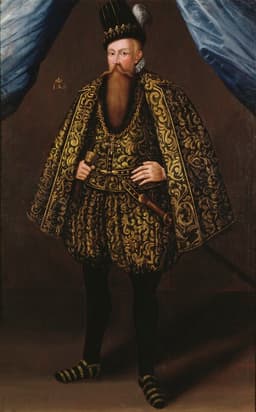
John III of Sweden
Emperor · Modern
51.4Total

Napoleon Bonaparte
General · Modern
70.9Total
Basic Information
Born
1537
1769
Died
1592
1821
Era
Modern
Modern
Nationality
Sweden
France
Occupation
Emperor
General
Civilization
Western
Western
Score Comparison
Military (10%)
50.0
94.0
Political (20%)
68.0
72.0
Influence (20%)
53.3
40.0
Legacy (20%)
44.2
80.0
Leadership (15%)
53.2
78.0
Strategy (15%)
38.3
90.0
TOTAL
51.4
70.9
John III of Sweden — Complete Timeline
1569 AD
Coronation of John IIIPolitical Action◆ Major
John III was crowned King of Sweden after deposing his half-brother Eric XIV. His reign focused on religious reconciliation and cultural patronage, including the introduction of the Red Book liturgy.
CoronationSuccession
Impact: national
Imprisonment of Eric XIVPolitical Action
John III ordered the continued imprisonment of his deposed half-brother Eric XIV, who was held at various castles until his death in 1577. This secured John's throne but created a lasting stain on his reign.
ImprisonmentDynastic Conflict
Impact: nationaldestructive
1570 AD
War against Russia (Livonian War)War◆ Major
John III continued Sweden's involvement in the Livonian War against Russia, seeking control over Estonia and Livonia. The war ended inconclusively in 1583 with the Treaty of Plussa, ceding some territories to Sweden.
Livonian WarRussiaTerritorial Conflict
Impact: regional
1574 AD
Establishment of the Swedish Jesuit MissionPolitical Action
John III invited Jesuit priests to Sweden to promote Catholic-Lutheran dialogue and secretly negotiated with the Papacy about a possible reunion. The mission failed due to Protestant opposition and the Jesuits' expulsion in 1580.
JesuitsCatholicismReligious Diplomacy
Impact: national
1576 AD
Promulgation of the Red BookCultural◆ Major
John III issued the Red Book (Liturgy of 1576), a new church liturgy that incorporated Catholic elements into Lutheran worship. This attempt to reconcile Catholicism and Lutheranism caused conflict with the Swedish clergy and nobility.
LiturgyReligious ReformCatholic-Lutheran
Impact: national
Napoleon Bonaparte — Complete Timeline
1799 AD
Coup of 18 BrumaireOther◆ Major
Napoleon Bonaparte, with support from his brother Lucien and key political figures, overthrew the Directory in a bloodless coup. He established the Consulate with himself as First Consul, effectively becoming the ruler of France. This event ended the French Revolution's most unstable period.
French RevolutionCoupRise to Power
Impact: regional
1804 AD
Promulgation of the Napoleonic CodeOther◆ Major
Napoleon enacted the Civil Code of the French, known as the Napoleonic Code, a comprehensive set of laws that replaced the fragmented feudal legal systems. The code established legal equality, protected property rights, and secularized law. It became the basis for legal systems in many European and world countries.
Legal ReformNapoleonic CodeCivil Law
Impact: globalconstructive
1805 AD
Battle of AusterlitzWar◆ Major
Napoleon's Grande Arm
Napoleonic WarsBattleDecisive Victory
Impact: global
1812 AD
Invasion of RussiaWar◆ Major
Napoleon led the Grande Arm
Napoleonic WarsInvasionDisaster
Impact: globaldestructive
1815 AD
Battle of WaterlooWar◆ Major
Napoleon's French army was defeated by the combined forces of the Duke of Wellington's Anglo-Allied army and Gebhard Leberecht von Bl
Napoleonic WarsBattleFinal Defeat
Impact: globaldestructive
Expert Analysis
john-iii-of-sweden-vs-napoleon-bonaparte
### The Emperor and the King: Two Visions of Power in an Age of Upheaval
One stands astride Europe like a colossus, his name a synonym for ambition and conquest. The other is a footnote in the annals of a northern kingdom, a man whose greatest project—reconciling faiths—ended in failure. Napoleon Bonaparte and John III of Sweden both ruled during eras of profound transformation, yet their paths could not have been more different. Why did one reshape a continent while the other faded into obscurity? The answer lies not merely in their talents but in the worlds they inherited and the choices they made.
**Origins**
Napoleon was born in 1769 on the island of Corsica, a recent French acquisition. His family was minor nobility, but they were not wealthy. The French Revolution, which erupted when he was twenty, shattered the old order and created a vacuum for talent. A young artillery officer, educated in mainland France, he rose not by birth but by merit. His era was one of chaos and opportunity, where a brilliant mind could rewrite the rules.
John III, born in 1537, was the second son of Gustav Vasa, the founder of modern Sweden. He grew up in the shadow of a powerful father and a turbulent Reformation. Sweden had broken with the Catholic Church, but the faith of its people was still unsettled. John was a prince of the blood, his path to power blocked by an older brother, Eric XIV. His era was one of religious war, dynastic intrigue, and the slow consolidation of a young nation-state.
**Rise to Power**
Napoleon’s ascent was a masterclass in seizing the moment. He first gained fame in 1793, at the age of twenty-four, when he drove British forces from the port of Toulon. By 1796, he was commanding the Army of Italy, where his lightning campaigns humiliated the Austrians and made him a national hero. In 1799, he returned from a disastrous Egyptian expedition to find the Directory government in crisis. With a blend of charisma and cold calculation, he staged a coup d’état, becoming First Consul. By 1804, he crowned himself Emperor, a title he earned through conquest and cunning.
John III’s rise was more brutal and constrained. In 1568, he led a rebellion against his half-brother Eric XIV, who had descended into madness and paranoia. The revolt succeeded, and Eric was deposed. John was crowned in 1569, but his legitimacy was forever tainted by the act of usurpation. He ordered Eric’s imprisonment—a constant reminder of the blood on his throne. Unlike Napoleon, John did not create his own path; he stumbled into power through family strife, and his crown always felt borrowed.
**Leadership & Governance**
Napoleon governed with the energy of a storm. He centralized the state, abolished feudalism, and codified law into the Napoleonic Code—a system that enshrined equality before the law, property rights, and secular administration. His military genius was staggering: he won over sixty battles, from Austerlitz in 1805 to Jena in 1806, by outthinking and outmarching his enemies. But his political wisdom had limits. He appointed family members to thrones, alienated potential allies, and refused to compromise. His empire, built on victory, could not survive defeat.
John III’s governance was a quieter, more desperate struggle. Politically astute, with a leadership score of 84.6, he sought to heal the religious divide that tore at Sweden. In 1576, he promulgated the Red Book, a new liturgy that blended Catholic ritual with Lutheran doctrine. He secretly negotiated with the Papacy, inviting Jesuit priests to Sweden in 1574. But his reforms pleased no one. Lutherans saw him as a traitor; Catholics found his gestures insufficient. The Swedish Church resisted, and his project collapsed.
**Triumph & Tragedy**
Napoleon’s greatest moment was Austerlitz, where he crushed the combined armies of Russia and Austria. His empire stretched from Spain to Poland. But his tragedy was the invasion of Russia in 1812. The vastness of the land, the scorched-earth tactics, and the brutal winter destroyed his Grande Armée. He was exiled to Elba in 1814, returned for a Hundred Days, and met final defeat at Waterloo in 1815. His ambition had overreached itself.
John III’s triumph was his coronation—a moment of hope for a unified kingdom. But his tragedy was the failure of his religious reconciliation. The war against Russia from 1570 dragged on inconclusively, draining Swedish resources. His brother Eric died in prison, possibly murdered on John’s orders, a stain that never washed away. In the end, his son Sigismund, raised a Catholic, was rejected by Sweden, and the kingdom returned to Lutheranism. John’s life’s work was undone.
**Character & Destiny**
Napoleon was a man of relentless will. “Impossible is a word to be found only in the dictionary of fools,” he once said. He trusted his own brilliance above all, and that hubris doomed him. He could not stop, could not share power, could not see the limits of force.
John III was a man of cautious ambition. He was a scholar-king, interested in theology and art, but he lacked the ruthlessness to impose his vision. He tried to steer a middle course in an age of extremes, and the currents swept him away. His destiny was to be a footnote—a king who tried to bridge an unbridgeable chasm.
**Legacy**
Napoleon left a continent transformed. The Napoleonic Code influenced legal systems from Europe to Latin America. He redrew borders, inspired nationalism, and created the modern state. His legend endures, a symbol of both genius and catastrophe.
John III left a church that rejected him and a kingdom that forgot him. His legacy score of 60.6 reflects a reign that was politically skilled but historically marginal. He is remembered, if at all, as a failed reformer, a king who tried to turn back the Reformation.
**Conclusion**
Napoleon and John III both sought to shape their worlds, but they operated on different scales of ambition and opportunity. Napoleon’s canvas was a continent in revolution; John’s was a small, fractured kingdom. One rode the tide of history; the other tried to swim against it. In the end, Napoleon’s legacy is a monument, John’s a whisper—a reminder that even the most determined efforts can be erased by the currents of time.
Rankings
🥇
Napoleon BonaparteLeader
Mil: 94.0Pol: 72.0Inf: 40.0
70.9
🥈
John III of Sweden
Mil: 50.0Pol: 68.0Inf: 53.3
51.4
+19.5 behind
How This Comparison Works
Algorithm
Each figure is scored on 6 dimensions (0—100 scale) based on structured historical data: Military (10%), Political (20%), Influence (20%), Legacy (20%), Leadership (15%), Strategy (15%). The weighted total produces the final ranking.
Data Sources
Scores are computed from structured sub-indicators in the database. Scale factors adjust for era (Ancient ×0.85, Modern ×1.0) and civilization size (Eastern ×1.05, Other ×0.80) to account for differences in population and military scale.
Maximum 3 Figures
Comparisons are limited to 2—3 figures to ensure readability and statistical meaningfulness.
Error Margins
±5 points per dimension — Sub-scores are derived from historical records with inherent uncertainty. Two figures within 5 points on a dimension should be considered roughly equivalent in that area.
Total Score Accuracy
±3 points overall — The weighted combination of 6 dimensions produces a total score with approximately ±3 points of uncertainty. Differences of less than 3 points are not statistically significant— the figures are effectively tied.
Known Limitations
- Historical records are incomplete and uneven across civilizations
- Figures from oral-tradition societies may be underrepresented
- Occupation labels can misclassify multi-role figures
- Scores measure capability and impact, not moral character
- Quantitative scoring is a comparison tool, not absolute truth
Capability Radar
Military (10%) — Battles & Warfare
Battles
20
95
Win Rate
25
90
Expansion
15
95
Political (20%) — Governance & Reform
Reform
55
95
Diplomacy
50
80
Economy
45
85
Influence (20%) — Cultural & Global Reach
Cultural
40
85
Global
20
90
Legacy (20%) — Historical Impact
Historical
45
95
Longevity
30
90
Leadership (15%) — Power & Stability
Tenure
60
85
Stability
40
70
Strategy (15%) — Tactics & Innovation
Strategy
20
95
Tactics
15
98
Reform
30
92
Similar Comparisons
Comments & Discussion
BROKEN STANDARD6/17/2026
Comparing John III of Sweden to Napoleon is like comparing a chess piece to a chess player. John's half-measures on church reform gave Sweden a wishy-washy liturgy that pleased neither Catholics nor Protestants—lasting zero generations. Meanwhile Napoleon bulldozed through Europe, established the Code Napoleon in multiple nations, and his legal legacy still governs millions today. John inherited; Napoleon created.
冷门猎手6/17/2026
把约翰三世和拿破仑放在一起本身就是对历史的侮辱。约翰三世连他爹古斯塔夫·瓦萨的政治遗产都守不住,搞什么“红皮书”想暗度陈仓恢复天主教,结果贵族和教会两边不讨好。拿破仑呢?1805年乌尔姆战役一口气俘虏三万奥军,而瑞典那会儿还在波罗的海边上打酱油。有什么好比的?
DATA SPLITTER6/17/2026
Correlation vs. causation in action. Napoleon's influence can be measured by death toll: ~3.5 million military casualties across the Napoleonic Wars. John III's reign? Around 5,000 deaths total, mostly from the Livonian War. Napoleon was an outlier on every metric—GDP, casualties, map changes. John III was average for a minor early modern prince. Calling this a comparison is a disservice to data.
教条粉碎机6/17/2026
所有比较政治人物的分析都喜欢玩“差异化叙事”,但这里的关键根本不是个人才能,而是结构性的权力真空。拿破仑之所以能崛起,是因为法国大革命砸碎了一切旧等级制,给了他这个外来炮兵军官一个“跨越式跳板”。约翰三世呢?他从出生起就是王子,被困在瑞典的宫廷游戏和宗教内战里,一辈子都在和兄弟争王位。这不是能力问题,是系统限制问题。
Historian8066/17/2026
If you want to argue legacy, ask who burned down the Kremlin. Napoleon’s Grande Armée reached Moscow and torched the symbol of Russian autocracy. John III built a nice library at Uppsala Castle? Cute. My point is simple: military campaign scale decides historical weight. Napoleon fought the Battle of Austerlitz in a single day that reshaped Europe. John spent decades dithering in Estonian mud. Not the same league.