Loading...
Justin II vs Qin Er Shi
Qin Er Shi leads by 6.3 pts · 2 figures compared
…

Justin II
Emperor · Ancient
37.8Total
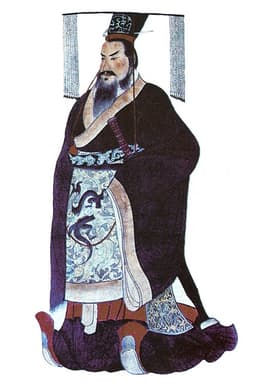
Qin Er Shi
Emperor · Ancient
44.1Total
Basic Information
Born
-520
-229
Died
—
-207
Era
Ancient
Ancient
Nationality
Byzantine Empire
China
Occupation
Emperor
Emperor
Civilization
Western
Eastern
Score Comparison
Military (10%)
50.0
20.2
Political (20%)
27.9
68.0
Influence (20%)
41.6
42.4
Legacy (20%)
34.2
35.0
Leadership (15%)
38.1
43.6
Strategy (15%)
39.6
60.0
TOTAL
37.8
44.1
Justin II — Complete Timeline
572 AD
Began war with the Sassanid EmpireWar◆ Major
Justin II, seeking to restore Roman prestige, refused to pay the annual tribute to the Sassanid Persians and initiated a war. The conflict initially went poorly for the Byzantines, leading to the loss of the fortress of Dara and a heavy defeat.
Roman-Persian WarsMilitary CampaignByzantine Empire
Impact: regionaldestructive
574 AD
Suffered a mental breakdownOther◆ Major
Overwhelmed by military defeats and the loss of Dara, Justin II suffered a period of insanity. He became incapable of ruling, leading to the appointment of Tiberius II as Caesar and regent.
Mental HealthSuccession CrisisByzantine Empire
Impact: nationaltragic
Adopted Tiberius as his son and heirPolitical Action◆ Major
In a moment of lucidity, Justin II formally adopted Tiberius, the commander of the excubitors, as his son and appointed him Caesar. This act ensured a stable transition of power and placed a capable ruler in charge of the empire.
SuccessionByzantine EmpireTiberius II
Impact: nationalconstructive
Qin Er Shi — Complete Timeline
210 BC
Accession as Second EmperorPolitical Action◆ Major
After Qin Shi Huang's death, Zhao Gao and Li Si forged a decree to force the crown prince Fusu to commit suicide and installed Huhai as Qin Er Shi. This illegitimate succession undermined the dynasty's legitimacy and placed an incompetent ruler on the throne.
SuccessionPalace IntrigueZhao Gao
Impact: nationaldestructive
209 BC
Outbreak of Dazexiang UprisingWar
Chen Sheng and Wu Guang led a rebellion of conscripted farmers at Dazexiang, sparking widespread revolts across the Qin empire. Qin Er Shi's harsh policies and heavy taxation had created widespread discontent, and the uprising quickly spread, leading to the dynasty's collapse.
RebellionQin CollapseChen Sheng
Impact: nationaldestructive
208 BC
Execution of Li SiPolitical Action◆ Major
Zhao Gao falsely accused Chancellor Li Si of treason. Qin Er Shi ordered Li Si's execution by the Five Pains method, along with his entire family. This removed the last capable administrator from the Qin court, accelerating the dynasty's decline.
ExecutionPolitical PurgeZhao Gao
Impact: nationaldestructive
207 BC
Death at the Hands of Zhao GaoPolitical Action◆ Major
Zhao Gao, fearing Qin Er Shi's anger over military defeats, staged a coup and forced the emperor to commit suicide. Zhao Gao then installed Ziying as the new king. This event marked the effective end of Qin rule, as Ziying surrendered to Liu Bang shortly after.
CoupDeathZhao Gao
Impact: nationaltragic
Expert Analysis
Origins
Justin II was born around 520 AD in Constantinople, the nephew of Emperor Justinian I. He was the son of Justinian's sister Vigilantia. Justin received a traditional Roman education and served as a courtier, but lacked military or administrative experience before his accession. His rise was due to family connections rather than merit.
Qin Er Shi, born Huhai in 230 BC, was the 18th son of Qin Shi Huang, the first emperor of China. He was spoiled and sheltered, with no preparation for rule. His father's obsession with immortality led to neglect of Huhai's education. He relied entirely on the eunuch Zhao Gao for guidance.
Rise to Power
Justin II became emperor in 565 AD upon the death of Justinian I. He was chosen by the imperial guard and the Senate, but his accession was criticized for nepotism. He immediately reversed Justinian's policies, including ending subsidies to the Avars and refusing tribute to the Sassanids, leading to war in 572 AD.
Qin Er Shi became emperor in 210 BC after a palace coup. Chief eunuch Zhao Gao and Chancellor Li Si forged a decree from Qin Shi Huang, ordering the crown prince Fusu to commit suicide. Huhai was then installed as emperor. He was completely controlled by Zhao Gao, who later executed Li Si and isolated the emperor.
Leadership & Governance
Justin II's governance was erratic. He initially tried to project strength by cutting payments to barbarians, but this backfired. His military strategy scored 39.6, reflecting poor decisions. He lost the key city of Dara to the Persians in 573 AD. His mental breakdown in 574 AD left the empire without effective leadership. He appointed Tiberius as Caesar in 574 AD, which provided stability but highlighted his own failure.
Qin Er Shi's political score of 68.0 reflects his ability to maintain control through terror, but his leadership score of 43.6 indicates poor governance. He continued his father's harsh policies, including forced labor and high taxes. He executed Li Si in 208 BC, eliminating the last competent advisor. His only strategy was to rely on Zhao Gao, who manipulated him into purging officials.
Triumph & Tragedy
Justin II's triumph was his adoption of Tiberius, which ensured a capable successor. Tiberius went on to restore some stability. However, his tragedy was his madness and the loss of Dara, which damaged Byzantine prestige. His war with Persia exhausted resources and set the stage for future conflicts. He scored 50.0 in military, but this was due to early skirmishes, not lasting victories.
Qin Er Shi's triumph was none; his entire reign was a tragedy. His accession was based on fraud. He failed to suppress the Dazexiang Uprising in 209 BC, which grew into widespread rebellions. His execution of Li Si eliminated the only person who could have saved the dynasty. He was forced to commit suicide by Zhao Gao in 207 BC, after only three years on the throne.
Character & Destiny
Justin II was proud and stubborn, refusing to continue his uncle's diplomatic approach. His mental instability was likely due to stress and possibly hereditary factors. His character led to isolation and paranoia. He scored 38.1 in leadership, reflecting his inability to command respect.
Qin Er Shi was weak and gullible, entirely dependent on Zhao Gao. He was cruel but indecisive. His destiny was sealed by his lack of judgment. He scored 20.2 in military, the lowest among comparable rulers, showing his complete incompetence.
Legacy
Justin II's legacy is mixed. He is remembered as the emperor who went mad. His war with Persia weakened the empire, but his adoption of Tiberius allowed recovery. His total score of 37.8 reflects limited impact.
Qin Er Shi's legacy is universally negative. He is blamed for the fall of the Qin dynasty, which collapsed within three years of his reign. His misrule led to the rise of the Han dynasty. His influence score of 42.4 is higher than Justin's 41.6, as his failure had greater historical consequences.
Conclusion
Qin Er Shi had greater impact, though negative. His total score of 44.1 exceeds Justin II's 37.8 by 6.3 points. While Justin II's madness caused problems, Qin Er Shi's incompetence destroyed an entire dynasty. The Qin dynasty's collapse reshaped Chinese history, while Justin II's reign was a brief crisis within the Byzantine Empire. Thus, Qin Er Shi's failure was more consequential.
Rankings
🥇
Qin Er ShiLeader
Mil: 20.2Pol: 68.0Inf: 42.4
44.1
🥈
Justin II
Mil: 50.0Pol: 27.9Inf: 41.6
37.8
+6.3 behind
How This Comparison Works
Algorithm
Each figure is scored on 6 dimensions (0—100 scale) based on structured historical data: Military (10%), Political (20%), Influence (20%), Legacy (20%), Leadership (15%), Strategy (15%). The weighted total produces the final ranking.
Data Sources
Scores are computed from structured sub-indicators in the database. Scale factors adjust for era (Ancient ×0.85, Modern ×1.0) and civilization size (Eastern ×1.05, Other ×0.80) to account for differences in population and military scale.
Maximum 3 Figures
Comparisons are limited to 2—3 figures to ensure readability and statistical meaningfulness.
Error Margins
±5 points per dimension — Sub-scores are derived from historical records with inherent uncertainty. Two figures within 5 points on a dimension should be considered roughly equivalent in that area.
Total Score Accuracy
±3 points overall — The weighted combination of 6 dimensions produces a total score with approximately ±3 points of uncertainty. Differences of less than 3 points are not statistically significant— the figures are effectively tied.
Known Limitations
- Historical records are incomplete and uneven across civilizations
- Figures from oral-tradition societies may be underrepresented
- Occupation labels can misclassify multi-role figures
- Scores measure capability and impact, not moral character
- Quantitative scoring is a comparison tool, not absolute truth
Capability Radar
Military (10%) — Battles & Warfare
Battles
20
33
Win Rate
15
37
Expansion
5
37
Political (20%) — Governance & Reform
Reform
20
0
Diplomacy
15
0
Economy
10
0
Influence (20%) — Cultural & Global Reach
Cultural
10
5
Global
5
5
Legacy (20%) — Historical Impact
Historical
15
15
Longevity
10
5
Leadership (15%) — Power & Stability
Tenure
40
3
Stability
5
0
Strategy (15%) — Tactics & Innovation
Strategy
10
41
Tactics
10
48
Reform
5
48
Similar Comparisons
Comments & Discussion
No comments yet. Be the first to share your thoughts!