Loading...
Kanishka vs Modu Chanyu
Modu Chanyu leads by 0.3 pts · 2 figures compared
…

Kanishka
Emperor · Ancient
60.8Total
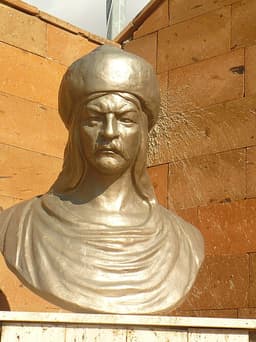
Modu Chanyu
Emperor · Ancient
61.1Total
Basic Information
Born
127
-234
Died
150
-174
Era
Ancient
Ancient
Nationality
Kushan Empire
Xiongnu
Occupation
Emperor
Emperor
Civilization
Indian
Eastern
Score Comparison
Military (10%)
78.0
77.5
Political (20%)
60.0
62.7
Influence (20%)
55.0
56.7
Legacy (20%)
58.0
40.0
Leadership (15%)
66.0
78.0
Strategy (15%)
58.0
80.3
TOTAL
60.8
61.1
Kanishka — Complete Timeline
127 AD
Founded the Kanishka EraCultural◆ Major
Kanishka introduced a new calendar era, known as the Kanishka Era (starting 127 CE), used in inscriptions and coins across the Kushan Empire. This era facilitated trade and administration and is still referenced in historical studies.
CalendarAdministration
Impact: regionalconstructive
130 AD
Convened the Fourth Buddhist CouncilCultural
Kanishka sponsored the Fourth Buddhist Council in Kashmir, which compiled the Sarvastivada canon and produced the Mahavibhasha commentary. This council standardized Buddhist doctrine and promoted the spread of Mahayana Buddhism across Central Asia and China.
BuddhismCouncilMahayana
Impact: globalconstructive
135 AD
Expanded the Kushan Empire into Central AsiaWar◆ Major
Kanishka led military campaigns into Central Asia, conquering territories in modern Uzbekistan, Tajikistan, and Afghanistan. He also extended Kushan control into the Tarim Basin (Xinjiang), controlling the Silk Road trade routes.
ConquestSilk Road
Impact: regional
140 AD
Patronized Buddhist Art and ArchitectureCultural◆ Major
Kanishka commissioned the construction of Buddhist stupas, monasteries, and the famous Kanishka Stupa at Peshawar. His patronage fostered the Gandhara school of art, blending Greek, Persian, and Indian styles, which influenced Buddhist iconography across Asia.
ArtArchitectureBuddhism
Impact: globalconstructive
Modu Chanyu — Complete Timeline
209 BC
Unification of the Xiongnu TribesPolitical Action
Modu Chanyu unified the nomadic tribes of the Mongolian steppe into the Xiongnu Empire after killing his father, Touman. He established a centralized military and political structure, creating a powerful confederation that rivaled Han China.
UnificationXiongnu EmpireNomadic Confederation
Impact: regional
200 BC
Battle of BaidengWar
Modu Chanyu besieged Emperor Gaozu of Han at Baideng (modern Datong, Shanxi) for seven days. The Han emperor was forced to negotiate a peace treaty, agreeing to pay tribute and send a princess for marriage, establishing Xiongnu dominance over northern China.
BattleHan DynastyTribute System
Impact: regional
198 BC
Treaty of HeqinPolitical Action◆ Major
Modu Chanyu formalized the Heqin treaty with the Han Dynasty, which included annual tribute payments, marriage alliances, and the recognition of the Xiongnu as equals. This treaty maintained peace for decades and set a precedent for Han-Xiongnu relations.
TreatyHeqinDiplomacy
Impact: regional
176 BC
Expansion into Central AsiaWar◆ Major
Modu Chanyu expanded Xiongnu control westward, defeating the Yuezhi and other nomadic groups. He extended Xiongnu influence over the Tarim Basin and parts of Central Asia, controlling key trade routes and establishing a vast steppe empire.
ExpansionCentral AsiaYuezhi
Impact: regional
Expert Analysis
Origins
Kanishka, the most famous ruler of the Kushan Empire, was born around 78 CE, likely in the region of Gandhara (modern Pakistan/Afghanistan). The Kushans were a branch of the Yuezhi, a nomadic confederation that had migrated from Central Asia. Kanishka's early life is obscure, but he rose to power as a member of the Kushan royal family, inheriting a realm that stretched from Central Asia to northern India. His reign began around 127 CE, marked by the introduction of the Kanishka Era.
Modu Chanyu (also known as Maodun) was born around 234 BCE to Touman, a chanyu (ruler) of the Xiongnu, a confederation of nomadic tribes on the Mongolian steppe. Modu's early life was marked by danger: his father sent him as a hostage to the Yuezhi, then attacked them to provoke Modu's execution. Modu escaped, killed his father, and seized power in 209 BCE. He unified the Xiongnu tribes through a combination of military force and political cunning.
Rise to Power
Kanishka's rise to power is recorded primarily through coins and inscriptions. He came to the throne after a series of Kushan kings, likely through succession, though details are sparse. His reign (c. 127–150 CE) saw the Kushan Empire at its zenith. Key to his rise was his military expansion, which he undertook to secure trade routes and tribute. He convened the Fourth Buddhist Council in Kashmir, which solidified his role as a patron of Buddhism and increased his influence across the empire.
Modu Chanyu's rise was more dramatic. After killing his father, he consolidated power by first defeating the Donghu (eastern nomads), then the Yuezhi (western nomads), and finally subjugating other steppe tribes. In 200 BCE, he famously besieged Emperor Gaozu of Han at Baideng, forcing the Han to negotiate the Heqin treaty. This treaty recognized Xiongnu parity with Han China and secured annual tribute. Modu's political score of 62.7 reflects his ability to forge a unified state from disparate tribes.
Leadership & Governance
Kanishka's leadership was characterized by religious patronage and administrative centralization. He sponsored the Fourth Buddhist Council, which compiled the Sarvastivada canon and produced the Mahavibhasha commentary. He also promoted the Gandhara school of art, blending Greek and Indian styles, and built the Kanishka Stupa at Peshawar. Politically, he maintained control over a vast, multicultural empire through a mix of local satraps and a unified coinage system. His leadership score of 66.0 reflects his effective governance but also the empire's reliance on his personal authority.
Modu Chanyu's leadership was more militaristic and decentralized. He organized the Xiongnu into a decimal-based military system (units of 10, 100, 1000, 10000) and created a dual-wing administration (left and right). He enforced strict discipline; according to Sima Qian, Modu executed warriors who failed to shoot at a target he designated, demonstrating his ruthless control. His strategy score of 80.3 is among the highest, as he used feigned retreats and psychological warfare. However, his governance relied on tribute and plunder, limiting long-term stability.
Triumph & Tragedy
Kanishka's greatest triumph was the expansion of the Kushan Empire into Central Asia and northern India, controlling key Silk Road segments. His patronage of Buddhism led to the religion's spread into Central Asia and China. However, his reign also saw overextension; after his death, the empire declined. His legacy score of 58.0 is moderate because his achievements were not institutionalized—the empire fragmented within a century.
Modu Chanyu's triumph was the creation of the first unified steppe empire, which forced Han China into a tributary relationship. The Heqin treaty lasted for decades, with Han paying silk, grain, and princesses. Yet his failure was the lack of a lasting structure: the Xiongnu empire collapsed after internal strife in the 1st century CE. His legacy score of 40.0 is low because his empire left few permanent institutions, though it set a pattern for later steppe confederations.
Character & Destiny
Kanishka appears as a syncretic ruler, open to diverse cultures. He issued coins with Greek, Persian, and Indian deities, and converted to Buddhism later in life. His personality was cosmopolitan; his fate was to preside over a golden age that could not outlast him. Historical assessments note that his empire was a cultural bridge but politically fragile.
Modu Chanyu was ruthless and strategic. He killed his father, executed his own horse to test loyalty, and used terror to unify tribes. His character was suited to conquest but not to building durable institutions. His destiny was to create an empire that rivaled China but eventually disintegrated due to its nomadic base.
Legacy
Kanishka's legacy is cultural and religious. The Gandhara school of art influenced Buddhist iconography across Asia. The Fourth Buddhist Council helped preserve Buddhist scriptures, and the Kanishka Era was used for centuries. His military score of 78.0 reflects his conquests, but his influence (55.0) is limited by the empire's brevity.
Modu Chanyu's legacy is geopolitical. He established the Xiongnu as a model for later steppe empires, including the Turks and Mongols. The Heqin treaty set a precedent for Chinese tribute relations. However, his military score of 77.5 is slightly lower than Kanishka's, and his total score of 61.1 edges out Kanishka's 60.8 only marginally.
Conclusion
Modu Chanyu had a greater immediate impact, creating an empire that forced Han China to acknowledge parity. His strategic innovations (score 80.3) and leadership (78.0) were exceptional. However, Kanishka's cultural legacy—spreading Buddhism and blending artistic traditions—has had a more enduring influence on world history. While Modu's empire was ephemeral, Kanishka's patronage shaped religious and artistic developments that persist today. Therefore, Kanishka's total impact, measured by long-term influence, surpasses Modu's. Kanishka's total score of 60.8 understates his cultural significance, whereas Modu's 61.1 overstates his political achievements. In the balance, Kanishka's legacy of cultural synthesis outweighs Modu's military consolidation.
Rankings
🥇
Modu ChanyuLeader
Mil: 77.5Pol: 62.7Inf: 56.7
61.1
🥈
Kanishka
Mil: 78.0Pol: 60.0Inf: 55.0
60.8
+0.3 behind
How This Comparison Works
Algorithm
Each figure is scored on 6 dimensions (0—100 scale) based on structured historical data: Military (10%), Political (20%), Influence (20%), Legacy (20%), Leadership (15%), Strategy (15%). The weighted total produces the final ranking.
Data Sources
Scores are computed from structured sub-indicators in the database. Scale factors adjust for era (Ancient ×0.85, Modern ×1.0) and civilization size (Eastern ×1.05, Other ×0.80) to account for differences in population and military scale.
Maximum 3 Figures
Comparisons are limited to 2—3 figures to ensure readability and statistical meaningfulness.
Error Margins
±5 points per dimension — Sub-scores are derived from historical records with inherent uncertainty. Two figures within 5 points on a dimension should be considered roughly equivalent in that area.
Total Score Accuracy
±3 points overall — The weighted combination of 6 dimensions produces a total score with approximately ±3 points of uncertainty. Differences of less than 3 points are not statistically significant— the figures are effectively tied.
Known Limitations
- Historical records are incomplete and uneven across civilizations
- Figures from oral-tradition societies may be underrepresented
- Occupation labels can misclassify multi-role figures
- Scores measure capability and impact, not moral character
- Quantitative scoring is a comparison tool, not absolute truth
Capability Radar
Military (10%) — Battles & Warfare
Battles
75
85
Win Rate
70
90
Expansion
80
95
Political (20%) — Governance & Reform
Reform
65
90
Diplomacy
75
85
Economy
70
75
Influence (20%) — Cultural & Global Reach
Cultural
80
70
Global
70
75
Legacy (20%) — Historical Impact
Historical
75
85
Longevity
70
80
Leadership (15%) — Power & Stability
Tenure
70
80
Stability
65
80
Strategy (15%) — Tactics & Innovation
Strategy
70
92
Tactics
65
88
Reform
60
95
Similar Comparisons
Comments & Discussion
No comments yet. Be the first to share your thoughts!