Loading...
Karan Singh vs Ludwig Erhard
Ludwig Erhard leads by 22.4 pts · 2 figures compared
…

Karan Singh
Politician · Modern
48.5Total
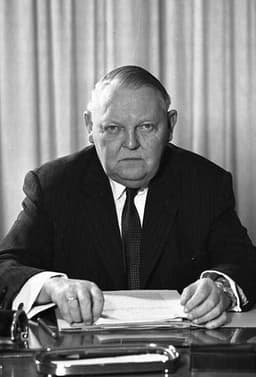
Ludwig Erhard
Politician · Modern
70.9Total
Basic Information
Born
1931
1897
Died
—
1977
Era
Modern
Modern
Nationality
India
Germany
Occupation
Politician
Politician
Civilization
Indian
Western
Score Comparison
Military (10%)
41.5
47.5
Political (20%)
37.9
75.0
Influence (20%)
51.8
88.0
Legacy (20%)
41.7
68.0
Leadership (15%)
62.2
78.0
Strategy (15%)
60.0
42.4
TOTAL
48.5
70.9
Karan Singh — Complete Timeline
1949 AD
Appointment as Regent of Jammu and KashmirPolitical Action◆ Major
Karan Singh was appointed Regent of Jammu and Kashmir by the Indian government after his father Hari Singh's departure. He served as the constitutional head of the state during a period of political transition and integration with India.
RegencyJammu and KashmirIndian Integration
Impact: regionalconstructive
1952 AD
Signing of the Delhi AgreementPolitical Action◆ Major
Karan Singh signed the Delhi Agreement with Indian Prime Minister Jawaharlal Nehru, defining the special status of Jammu and Kashmir within India. The agreement granted the state autonomy in certain matters, shaping its constitutional relationship.
Delhi AgreementKashmirAutonomy
Impact: regionalconstructive
1967 AD
Election to Lok SabhaPolitical Action
Karan Singh was elected to the Lok Sabha, the lower house of the Indian Parliament, as a member of the Indian National Congress. He served as a Member of Parliament, representing the Jammu constituency.
ParliamentIndian PoliticsCongress
Impact: nationalconstructive
1989 AD
Appointment as Ambassador to the United StatesPolitical Action
Karan Singh was appointed as India's Ambassador to the United States by Prime Minister Rajiv Gandhi. He served in Washington D.C., representing Indian interests during a period of diplomatic engagement.
DiplomacyAmbassadorIndia-US Relations
Impact: globalconstructive
Ludwig Erhard — Complete Timeline
1948 AD
Currency Reform and Abolition of Price ControlsReform
Erhard oversaw the introduction of the Deutsche Mark and simultaneously abolished most price controls and rationing. This bold move, against Allied advice, triggered the 'economic miracle' by stimulating production and ending the black market.
Currency ReformEconomic MiracleFree Market
Impact: nationalconstructive
Appointment as Director of the Economic Policy DepartmentPolitical Action◆ Major
Ludwig Erhard was appointed Director of the Economic Policy Department in the Bizone, effectively becoming the chief architect of West Germany's economic policy. This position allowed him to implement his free-market ideas.
Economic PolicyWest GermanyPost-War
Impact: nationalconstructive
1963 AD
Election as Chancellor of West GermanyPolitical Action◆ Major
Erhard succeeded Konrad Adenauer as Chancellor of West Germany. His chancellorship continued the economic policies of the 'social market economy' but faced challenges from a slowing economy and coalition tensions.
ChancellorWest GermanyCDU
Impact: nationalconstructive
1966 AD
Resignation as ChancellorPolitical Action◆ Major
Erhard resigned as Chancellor after the Free Democratic Party (FDP) left his coalition government over budget disputes. His resignation marked the end of his political career and led to the formation of the Grand Coalition under Kiesinger.
ResignationCoalition CollapsePolitical End
Impact: national
Expert Analysis
Origins
Karan Singh was born on March 9, 1931, in Cannes, France, into the royal Dogra dynasty of Jammu and Kashmir. His father, Maharaja Hari Singh, was the reigning prince, and his mother, Maharani Tara Devi, was a member of the royal family of Mandi. Karan Singh was educated at the Doon School in Dehradun and later at the University of Jammu and Kashmir, where he studied political science. His early life was shaped by the privileges and responsibilities of royalty, but also by the tumultuous events surrounding the partition of India and the accession of Jammu and Kashmir to India.
Ludwig Erhard was born on February 4, 1897, in Fürth, Bavaria, into a middle-class family. His father, Philipp Erhard, was a textile salesman, and his mother, Auguste Erhard, was a homemaker. Erhard studied economics at the University of Frankfurt, where he earned his doctorate under the supervision of Franz Oppenheimer. He served as a soldier in World War I and was wounded, an experience that shaped his later commitment to peace and prosperity. After the war, he worked as an economist and later became director of the Institute for Economic Observation in Nuremberg.
Rise to Power
Karan Singh's rise to prominence came suddenly in 1949 when his father, Maharaja Hari Singh, was forced to leave Jammu and Kashmir after the Indian government's intervention. At age 18, Karan Singh was appointed Regent of Jammu and Kashmir by Prime Minister Jawaharlal Nehru, effectively becoming the head of state of the princely state. He signed the Delhi Agreement in 1952 with Nehru, which defined the special status of Jammu and Kashmir within India. He later became the Sadr-e-Riyasat (constitutional head) and served as a member of the Indian National Congress. He was elected to the Lok Sabha in 1967 and served as a Member of Parliament until 1984. His political career was marked by his role as a diplomat, serving as India's Ambassador to the United States from 1989 to 1990.
Ludwig Erhard's rise was rooted in his economic expertise. In 1945, he was appointed as an economic advisor to the American occupation authorities. In 1947, he became director of the Economic Policy Department in the Bizone, the merged British and American occupation zones. His major turning point came on June 20, 1948, when he oversaw the currency reform that introduced the Deutsche Mark and simultaneously abolished most price controls and rationing. This bold move, against the advice of the Allies, led to the West German economic miracle. He became Minister of Economics under Chancellor Konrad Adenauer in 1949 and succeeded Adenauer as Chancellor in 1963.
Leadership & Governance
Karan Singh's leadership was characterized by his role as a constitutional figurehead and a diplomat. As Regent and Sadr-e-Riyasat, he acted within the framework of the Indian Constitution, focusing on maintaining the special status of Jammu and Kashmir. His governance was largely symbolic, as real power rested with the Indian government and local political leaders. He scored 62.2 in leadership, reflecting his ability to navigate complex political situations, but his political score of 37.9 indicates limited direct impact on policy. He was a proponent of secularism and education, serving as a chancellor of several universities.
Ludwig Erhard's leadership was transformative and direct. As Minister of Economics and later Chancellor, he implemented the social market economy, a blend of free-market capitalism and social welfare. His policies led to rapid economic growth, low unemployment, and rising living standards. He scored 78.0 in leadership and 75.0 in political influence. However, his chancellorship (1963-1966) was less successful, as he struggled with coalition politics and economic slowdown. His strategy score of 42.4 reflects his later difficulties, but his overall impact on West Germany's economy earned him a legacy score of 68.0.
Triumph & Tragedy
Karan Singh's greatest triumph was his role in the peaceful transition of Jammu and Kashmir from a princely state to a state within India, avoiding immediate conflict. He signed the Delhi Agreement, which granted special autonomy to the region. His greatest failure was his inability to prevent the erosion of that autonomy over time, as the Indian government gradually revoked special status. He also faced criticism for his lack of independent political power, as he was seen as a figurehead. His influence score of 51.8 reflects his moderate impact.
Ludwig Erhard's greatest triumph was the economic miracle (Wirtschaftswunder), which transformed West Germany from a war-torn nation into an economic powerhouse. His currency reform and abolition of price controls were masterstrokes. His greatest failure was his chancellorship, which ended in resignation in 1966 due to a budget crisis and coalition collapse. He was unable to replicate his earlier success as a minister, and his later years were marked by political weakness. His military score of 47.5 is irrelevant, but his influence score of 88.0 underscores his lasting impact.
Character & Destiny
Karan Singh was a cultured and intellectual figure, known for his diplomatic skills and commitment to Indian unity. He was a prolific writer and speaker, advocating for spirituality and education. His character was shaped by his royal upbringing and his role as a bridge between the old princely order and modern democracy. His destiny was to be a symbol rather than a decision-maker, which limited his historical impact.
Ludwig Erhard was a pragmatic and bold economist, willing to take risks against prevailing opinion. He was a strong believer in free markets but also in social responsibility. His character was marked by stubbornness and a lack of political tact, which contributed to his downfall as chancellor. His destiny was to be the architect of Germany's post-war recovery, but his political career ended in disappointment.
Legacy
Karan Singh's legacy is tied to the special status of Jammu and Kashmir, which was revoked in 2019. He is remembered as a constitutional figure who helped integrate the state into India peacefully. His influence on Indian politics is limited, but he remains a respected elder statesman. His total score of 48.5 reflects his moderate impact.
Ludwig Erhard's legacy is immense. He is known as the 'father of the German economic miracle' and his social market economy became the model for post-war Germany and influenced economic policy worldwide. His policies shaped the modern German economy, and his name is synonymous with prosperity. His total score of 70.9 is significantly higher, reflecting his transformative impact.
Conclusion
Ludwig Erhard had a far greater impact than Karan Singh. Erhard's economic policies rebuilt a nation and created the foundation for Germany's post-war prosperity, while Singh's role was largely ceremonial and limited to a specific region. Erhard's total score of 70.9 versus Singh's 48.5 underscores this gap. Erhard's influence on global economic thought and his tangible achievements in raising living standards make him the more consequential figure. While Singh played a role in a delicate political transition, Erhard changed the course of an entire nation's history.
Rankings
🥇
Ludwig ErhardLeader
Mil: 47.5Pol: 75.0Inf: 88.0
70.9
🥈
Karan Singh
Mil: 41.5Pol: 37.9Inf: 51.8
48.5
+22.4 behind
How This Comparison Works
Algorithm
Each figure is scored on 6 dimensions (0—100 scale) based on structured historical data: Military (10%), Political (20%), Influence (20%), Legacy (20%), Leadership (15%), Strategy (15%). The weighted total produces the final ranking.
Data Sources
Scores are computed from structured sub-indicators in the database. Scale factors adjust for era (Ancient ×0.85, Modern ×1.0) and civilization size (Eastern ×1.05, Other ×0.80) to account for differences in population and military scale.
Maximum 3 Figures
Comparisons are limited to 2—3 figures to ensure readability and statistical meaningfulness.
Error Margins
±5 points per dimension — Sub-scores are derived from historical records with inherent uncertainty. Two figures within 5 points on a dimension should be considered roughly equivalent in that area.
Total Score Accuracy
±3 points overall — The weighted combination of 6 dimensions produces a total score with approximately ±3 points of uncertainty. Differences of less than 3 points are not statistically significant— the figures are effectively tied.
Known Limitations
- Historical records are incomplete and uneven across civilizations
- Figures from oral-tradition societies may be underrepresented
- Occupation labels can misclassify multi-role figures
- Scores measure capability and impact, not moral character
- Quantitative scoring is a comparison tool, not absolute truth
Capability Radar
Military (10%) — Battles & Warfare
Battles
45
28
Win Rate
46
35
Expansion
48
37
Political (20%) — Governance & Reform
Reform
25
85
Diplomacy
40
75
Economy
20
95
Influence (20%) — Cultural & Global Reach
Cultural
20
60
Global
20
75
Legacy (20%) — Historical Impact
Historical
25
80
Longevity
15
70
Leadership (15%) — Power & Stability
Tenure
30
65
Stability
30
80
Strategy (15%) — Tactics & Innovation
Strategy
53
35
Tactics
53
41
Reform
60
46
Similar Comparisons
Comments & Discussion
No comments yet. Be the first to share your thoughts!