Loading...
Ludwig Erhard vs Nawab Hamidullah Khan
Ludwig Erhard leads by 27.0 pts · 2 figures compared
…
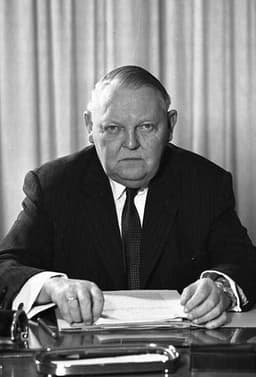
Ludwig Erhard
Politician · Modern
70.9Total

Nawab Hamidullah Khan
Politician · Modern
43.9Total
Basic Information
Born
1897
1894
Died
1977
1960
Era
Modern
Modern
Nationality
Germany
India
Occupation
Politician
Politician
Civilization
Western
Indian
Score Comparison
Military (10%)
47.5
15.1
Political (20%)
75.0
48.0
Influence (20%)
88.0
49.4
Legacy (20%)
68.0
37.5
Leadership (15%)
78.0
65.0
Strategy (15%)
42.4
37.0
TOTAL
70.9
43.9
Ludwig Erhard — Complete Timeline
1948 AD
Currency Reform and Abolition of Price ControlsReform
Erhard oversaw the introduction of the Deutsche Mark and simultaneously abolished most price controls and rationing. This bold move, against Allied advice, triggered the 'economic miracle' by stimulating production and ending the black market.
Currency ReformEconomic MiracleFree Market
Impact: nationalconstructive
Appointment as Director of the Economic Policy DepartmentPolitical Action◆ Major
Ludwig Erhard was appointed Director of the Economic Policy Department in the Bizone, effectively becoming the chief architect of West Germany's economic policy. This position allowed him to implement his free-market ideas.
Economic PolicyWest GermanyPost-War
Impact: nationalconstructive
1963 AD
Election as Chancellor of West GermanyPolitical Action◆ Major
Erhard succeeded Konrad Adenauer as Chancellor of West Germany. His chancellorship continued the economic policies of the 'social market economy' but faced challenges from a slowing economy and coalition tensions.
ChancellorWest GermanyCDU
Impact: nationalconstructive
1966 AD
Resignation as ChancellorPolitical Action◆ Major
Erhard resigned as Chancellor after the Free Democratic Party (FDP) left his coalition government over budget disputes. His resignation marked the end of his political career and led to the formation of the Grand Coalition under Kiesinger.
ResignationCoalition CollapsePolitical End
Impact: national
Nawab Hamidullah Khan — Complete Timeline
1926 AD
Implemented Administrative Reforms in BhopalReform
Hamidullah Khan introduced modern administrative reforms in Bhopal, including a council of ministers and a judiciary system. These reforms improved governance efficiency and reduced feudal practices in the state.
AdministrationBhopalReform
constructive
1931 AD
Served as Chancellor of the Chamber of PrincesPolitical Action◆ Major
Hamidullah Khan was elected Chancellor of the Chamber of Princes, representing princely states in negotiations with the British government. He played a key role in the Round Table Conferences on Indian constitutional reforms.
Chamber of PrincesBritish IndiaConstitutional Reform
Impact: nationalconstructive
1947 AD
Acceded to the Dominion of IndiaPolitical Action
Hamidullah Khan, as Nawab of Bhopal, signed the Instrument of Accession to join the Dominion of India after Indian independence. This decision integrated Bhopal into the Indian Union, ending its princely sovereignty.
Indian IndependencePrincely StateAccession
Impact: national
Opposed the Partition of IndiaPolitical Action◆ Major
Hamidullah Khan advocated for a united India and opposed the partition that created Pakistan. He argued for a federal system where princely states would retain autonomy within a unified Indian nation.
PartitionIndian PoliticsPrincely States
Impact: national
Expert Analysis
Origins
Ludwig Erhard was born on February 4, 1897, in Fürth, Bavaria, into a middle-class Protestant family. His father was a textile merchant. Erhard studied economics at the University of Frankfurt, earning a doctorate in 1925 under Franz Oppenheimer, whose liberal ideas influenced him. He worked at the Institute for Economic Observation in Nuremberg and later became a business consultant. During the Nazi era, he avoided party membership and focused on economic research, writing memoranda on post-war reconstruction.
Nawab Hamidullah Khan was born on September 9, 1894, in Bhopal, India, into the ruling dynasty of the princely state. He was the son of Nawab Sultan Jahan Begum, one of the few female rulers in India. He was educated at the Minto Circle in Aligarh and later at the Aligarh Muslim University. He ascended the throne in 1926 after his mother's abdication. His upbringing was steeped in administrative duties and princely politics.
Rise to Power
Erhard's rise began after World War II. In 1945, he was appointed Minister of Economics in Bavaria, and in 1948, he became Director of the Economic Policy Department of the Bizone, the combined American and British occupation zones. His key turning point was the 1948 currency reform, where he introduced the Deutsche Mark and abolished price controls on June 20, 1948, against Allied advice. This unleashed market forces and ended black markets, leading to rapid recovery. He gained popularity as the architect of the Wirtschaftswunder (economic miracle). In 1949, he was elected to the Bundestag and served as Minister of Economics under Chancellor Adenauer. He succeeded Adenauer as Chancellor in 1963.
Hamidullah Khan became Nawab in 1926. He was elected Chancellor of the Chamber of Princes in 1931, representing princely states in negotiations with the British. He played a role in the Round Table Conferences in London (1930-1932). During the 1940s, he opposed the partition of India, advocating for a united federal India. After independence, he signed the Instrument of Accession to India on April 30, 1949, integrating Bhopal into the Indian Union. He remained as titular ruler until his death in 1960.
Leadership & Governance
Erhard's leadership was defined by his commitment to the 'social market economy', a blend of free-market capitalism with social welfare. He prioritized currency stability, free trade, and anti-cartel policies. As Chancellor, his governance style was more hands-off compared to Adenauer, focusing on economic policy. His reforms included tax cuts, deregulation, and integration into European institutions. However, his chancellorship (1963-1966) faced economic slowdown and budget disputes, leading to his resignation in 1966.
Hamidullah Khan ruled Bhopal as a constitutional monarch, introducing a council of ministers and a judiciary. He implemented administrative reforms, improved education, and built infrastructure. He was a moderate leader who sought to preserve Bhopal's autonomy while cooperating with British and Indian authorities. His governance score of 65.0 reflects his effective but limited scope compared to Erhard.
Triumph & Tragedy
Erhard's greatest triumph was the 1948 currency reform and abolition of price controls, which sparked the German economic miracle. West Germany's GDP grew 8% annually in the 1950s. His tragedy was his brief chancellorship, marred by coalition infighting and economic stagnation, ending with his resignation in 1966. He failed to maintain the momentum of the miracle.
Hamidullah's triumph was successfully integrating Bhopal into India peacefully, avoiding bloodshed. He also championed a united India. His tragedy was the loss of his princely sovereignty and influence after accession. He died as a titular ruler, with his political legacy overshadowed by the larger nationalist movement.
Character & Destiny
Erhard was a pragmatic economist, often clashing with Adenauer's political style. He was reserved and intellectual, focused on policy rather than power. His character shaped his destiny: his economic vision created prosperity but his political naivety led to a short chancellorship. He is rated 78.0 in leadership, reflecting his effectiveness in economic governance.
Hamidullah was a royal diplomat, skilled in negotiation but constrained by history. His loyalty to a united India and his princely status placed him in a losing position as the subcontinent partitioned. He scored 65.0 in leadership, but his political influence was limited to princely circles.
Legacy
Erhard's legacy is immense: he is credited with creating the social market economy that underpins modern Germany. His policies influenced post-war European integration and global economic thought. He scored 88.0 in influence and 68.0 in legacy. His name is synonymous with the German economic miracle.
Hamidullah's legacy is regional. He is remembered as the last Nawab of Bhopal, a modernizer who preserved his state's identity. His scores (influence 49.4, legacy 37.5) reflect his limited impact beyond princely India. His role in opposing partition is noted but not widely influential.
Conclusion
Ludwig Erhard had a far greater impact than Nawab Hamidullah Khan. Erhard's economic reforms transformed a devastated Germany into an economic powerhouse, shaping global economics. Hamidullah's influence was confined to a princely state in a transitional period. The score gap of 27.0 points confirms this: Erhard's total score of 70.9 versus Hamidullah's 43.9. While Hamidullah was a competent ruler in difficult circumstances, Erhard's policies had continental and lasting significance.
Rankings
🥇
Ludwig ErhardLeader
Mil: 47.5Pol: 75.0Inf: 88.0
70.9
🥈
Nawab Hamidullah Khan
Mil: 15.1Pol: 48.0Inf: 49.4
43.9
+27.0 behind
How This Comparison Works
Algorithm
Each figure is scored on 6 dimensions (0—100 scale) based on structured historical data: Military (10%), Political (20%), Influence (20%), Legacy (20%), Leadership (15%), Strategy (15%). The weighted total produces the final ranking.
Data Sources
Scores are computed from structured sub-indicators in the database. Scale factors adjust for era (Ancient ×0.85, Modern ×1.0) and civilization size (Eastern ×1.05, Other ×0.80) to account for differences in population and military scale.
Maximum 3 Figures
Comparisons are limited to 2—3 figures to ensure readability and statistical meaningfulness.
Error Margins
±5 points per dimension — Sub-scores are derived from historical records with inherent uncertainty. Two figures within 5 points on a dimension should be considered roughly equivalent in that area.
Total Score Accuracy
±3 points overall — The weighted combination of 6 dimensions produces a total score with approximately ±3 points of uncertainty. Differences of less than 3 points are not statistically significant— the figures are effectively tied.
Known Limitations
- Historical records are incomplete and uneven across civilizations
- Figures from oral-tradition societies may be underrepresented
- Occupation labels can misclassify multi-role figures
- Scores measure capability and impact, not moral character
- Quantitative scoring is a comparison tool, not absolute truth
Capability Radar
Military (10%) — Battles & Warfare
Battles
28
24
Win Rate
35
24
Expansion
37
29
Political (20%) — Governance & Reform
Reform
85
40
Diplomacy
75
45
Economy
95
35
Influence (20%) — Cultural & Global Reach
Cultural
60
25
Global
75
10
Legacy (20%) — Historical Impact
Historical
80
20
Longevity
70
15
Leadership (15%) — Power & Stability
Tenure
65
34
Stability
80
30
Strategy (15%) — Tactics & Innovation
Strategy
35
30
Tactics
41
36
Reform
46
40
Similar Comparisons
Comments & Discussion
No comments yet. Be the first to share your thoughts!