Loading...
This comparison has not been analyzed yet.
One-time AI generation (~1 minute). Scores and timeline are already available below.
Kenneth Kaunda vs Wasfi al-Tal
Kenneth Kaunda leads by 14.7 pts · 2 figures compared
…
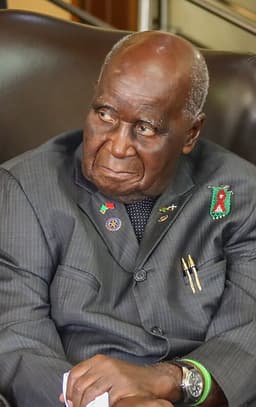
Kenneth Kaunda
Politician · Modern
56.9Total

Wasfi al-Tal
Politician · Modern
42.2Total
Basic Information
Born
1924
1919
Died
—
1971
Era
Modern
Modern
Nationality
Zambia
Jordan
Occupation
Politician
Politician
Civilization
Other
Middle Eastern
Score Comparison
Military (10%)
50.0
17.2
Political (20%)
68.0
40.8
Influence (20%)
58.0
49.4
Legacy (20%)
46.7
39.2
Leadership (15%)
74.0
51.9
Strategy (15%)
43.9
43.8
TOTAL
56.9
42.2
Kenneth Kaunda — Complete Timeline
1964 AD
Led Zambia to independencePolitical Action
Kaunda, as leader of the United National Independence Party, negotiated with Britain for Zambia's independence from colonial rule. He became the first president of the Republic of Zambia on October 24, 1964, ending 73 years of British control.
IndependenceDecolonizationFounding President
Impact: nationalconstructive
1972 AD
Introduced one-party statePolitical Action◆ Major
Kaunda's government enacted a constitutional amendment making the United National Independence Party the sole legal political party in Zambia. This move centralized power under his control and suppressed political opposition, remaining in effect until 1990.
AuthoritarianismConstitutional ChangeOne-Party Rule
Impact: nationaldestructive
1975 AD
Hosted frontline states against apartheidPolitical Action◆ Major
Kaunda became a key leader of the Frontline States, a coalition of southern African nations opposing apartheid in South Africa and white minority rule in Rhodesia. Zambia provided bases and support for liberation movements like ZAPU and ANC, incurring economic costs from retaliatory attacks.
Anti-ApartheidDiplomacyLiberation Movements
Impact: regionalconstructive
1991 AD
Lost multi-party elections and stepped downPolitical Action
Under domestic and international pressure, Kaunda legalized opposition parties. In the 1991 presidential election, he was defeated by Frederick Chiluba of the Movement for Multi-Party Democracy. Kaunda peacefully transferred power, a rare event in post-independence Africa.
DemocratizationPeaceful TransitionElectoral Defeat
Impact: nationalconstructive
Wasfi al-Tal — Complete Timeline
1962 AD
Appointment as Prime Minister of JordanPolitical Action◆ Major
Wasfi al-Tal was appointed Prime Minister of Jordan in January 1962 by King Hussein. He served multiple terms, known for his strong anti-communist stance and efforts to modernize Jordan's economy and military.
Prime MinisterGovernmentModernization
Impact: nationalconstructive
1965 AD
Economic and Administrative ReformsReform
During his tenure, Talal implemented economic reforms including the establishment of the Jordanian Central Bank and the development of the Aqaba port. He also pushed for administrative modernization, reducing corruption and improving government efficiency.
Economic ReformCentral BankModernization
Impact: nationalconstructive
1970 AD
Suppression of the Black September UprisingWar◆ Major
As Prime Minister, Talal played a key role in the Jordanian military's suppression of the Black September uprising in September 1970, when Palestinian factions challenged the monarchy. The conflict resulted in thousands of casualties and the expulsion of the PLO from Jordan.
Black SeptemberCivil ConflictPLO
Impact: regionaldestructive
1971 AD
Assassination by Black SeptemberPolitical Action◆ Major
Wasfi al-Tal was assassinated on November 28, 1971, in Cairo, Egypt, by members of the Black September Organization. The assassination was in retaliation for his role in the 1970 crackdown. His death marked a major escalation in Palestinian-Jordanian tensions.
AssassinationBlack SeptemberRetaliation
Impact: regionaltragic
This comparison has not been analyzed yet.
One-time AI generation (~1 minute). Scores and timeline are already available below.
Rankings
🥇
Kenneth KaundaLeader
Mil: 50.0Pol: 68.0Inf: 58.0
56.9
🥈
Wasfi al-Tal
Mil: 17.2Pol: 40.8Inf: 49.4
42.2
+14.7 behind
How This Comparison Works
Algorithm
Each figure is scored on 6 dimensions (0—100 scale) based on structured historical data: Military (10%), Political (20%), Influence (20%), Legacy (20%), Leadership (15%), Strategy (15%). The weighted total produces the final ranking.
Data Sources
Scores are computed from structured sub-indicators in the database. Scale factors adjust for era (Ancient ×0.85, Modern ×1.0) and civilization size (Eastern ×1.05, Other ×0.80) to account for differences in population and military scale.
Maximum 3 Figures
Comparisons are limited to 2—3 figures to ensure readability and statistical meaningfulness.
Error Margins
±5 points per dimension — Sub-scores are derived from historical records with inherent uncertainty. Two figures within 5 points on a dimension should be considered roughly equivalent in that area.
Total Score Accuracy
±3 points overall — The weighted combination of 6 dimensions produces a total score with approximately ±3 points of uncertainty. Differences of less than 3 points are not statistically significant— the figures are effectively tied.
Known Limitations
- Historical records are incomplete and uneven across civilizations
- Figures from oral-tradition societies may be underrepresented
- Occupation labels can misclassify multi-role figures
- Scores measure capability and impact, not moral character
- Quantitative scoring is a comparison tool, not absolute truth
Capability Radar
Military (10%) — Battles & Warfare
Battles
20
21
Win Rate
27
22
Expansion
29
25
Political (20%) — Governance & Reform
Reform
55
25
Diplomacy
55
35
Economy
30
20
Influence (20%) — Cultural & Global Reach
Cultural
40
10
Global
40
15
Legacy (20%) — Historical Impact
Historical
50
20
Longevity
30
15
Leadership (15%) — Power & Stability
Tenure
60
30
Stability
25
15
Strategy (15%) — Tactics & Innovation
Strategy
29
30
Tactics
32
33
Reform
36
37
Similar Comparisons
Comments & Discussion
No comments yet. Be the first to share your thoughts!