Loading...
This comparison has not been analyzed yet.
One-time AI generation (~1 minute). Scores and timeline are already available below.
Khadga Prasad Oli vs Thein Sein
Khadga Prasad Oli leads by 3.2 pts · 2 figures compared
…
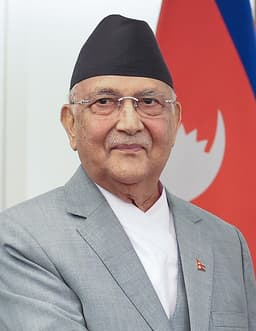
Khadga Prasad Oli
Politician · Modern
54.1Total

Thein Sein
Politician · Modern
50.9Total
Basic Information
Born
1952
1944
Died
—
—
Era
Modern
Modern
Nationality
Nepal
Myanmar
Occupation
Politician
Politician
Civilization
Indian
Eastern
Score Comparison
Military (10%)
36.4
17.2
Political (20%)
68.0
72.0
Influence (20%)
51.0
54.9
Legacy (20%)
41.7
45.0
Leadership (15%)
74.0
72.0
Strategy (15%)
60.0
26.3
TOTAL
54.1
50.9
Khadga Prasad Oli — Complete Timeline
2015 AD
Promulgation of 2015 ConstitutionReform◆ Major
Under Oli's premiership, Nepal adopted a new constitution that established the country as a federal democratic republic. The constitution was criticized by some ethnic groups for its provincial boundaries and citizenship provisions.
ConstitutionFederalismNepal
Impact: nationalconstructive
Election as Prime MinisterPolitical Action◆ Major
Khadga Prasad Oli was elected prime minister of Nepal by the parliament. His first term was marked by the promulgation of the new constitution in 2015 and a subsequent economic blockade along the India-Nepal border.
ElectionGovernmentNepal
Impact: national
2020 AD
Nationalist Stance on Border DisputesPolitical Action
Oli's government published a new political map showing disputed territories with India, including Kalapani and Lipulekh. This nationalist move escalated tensions with India and led to a diplomatic rift between the two countries.
Border DisputeNationalismDiplomacy
Impact: regional
Thein Sein — Complete Timeline
2007 AD
Became Prime Minister of MyanmarPolitical Action◆ Major
Thein Sein was appointed Prime Minister of Myanmar by the military junta. His appointment came during a period of international isolation and economic stagnation, and he was seen as a reformist within the military establishment.
LeadershipMyanmarMilitary
Impact: national
2011 AD
Initiated Political ReformsReform◆ Major
Thein Sein's government implemented significant political reforms, including easing media censorship, allowing labor unions, and engaging in peace talks with ethnic armed groups. These reforms led to the lifting of many international sanctions.
ReformMyanmarDemocracy
Impact: nationalconstructive
Elected President of MyanmarPolitical Action
Thein Sein was elected President by the parliament, marking the end of direct military rule. His presidency initiated a series of political and economic reforms, including releasing political prisoners and opening up the economy.
ElectionMyanmarReform
Impact: nationalconstructive
Hosted Aung San Suu KyiPolitical Action◆ Major
Thein Sein met with opposition leader Aung San Suu Kyi at the presidential residence, a historic gesture of reconciliation. The meeting paved the way for her party's participation in by-elections and further political opening.
ReconciliationMyanmarPolitics
Impact: nationalconstructive
2016 AD
Stepped Down as PresidentPolitical Action◆ Major
Thein Sein stepped down as President after the National League for Democracy won the 2015 elections. He peacefully handed over power to Htin Kyaw, marking a historic transition from military-backed rule to a civilian government.
TransitionMyanmarDemocracy
Impact: nationalconstructive
This comparison has not been analyzed yet.
One-time AI generation (~1 minute). Scores and timeline are already available below.
Rankings
🥇
Khadga Prasad OliLeader
Mil: 36.4Pol: 68.0Inf: 51.0
54.1
🥈
Thein Sein
Mil: 17.2Pol: 72.0Inf: 54.9
50.9
+3.2 behind
How This Comparison Works
Algorithm
Each figure is scored on 6 dimensions (0—100 scale) based on structured historical data: Military (10%), Political (20%), Influence (20%), Legacy (20%), Leadership (15%), Strategy (15%). The weighted total produces the final ranking.
Data Sources
Scores are computed from structured sub-indicators in the database. Scale factors adjust for era (Ancient ×0.85, Modern ×1.0) and civilization size (Eastern ×1.05, Other ×0.80) to account for differences in population and military scale.
Maximum 3 Figures
Comparisons are limited to 2—3 figures to ensure readability and statistical meaningfulness.
Error Margins
±5 points per dimension — Sub-scores are derived from historical records with inherent uncertainty. Two figures within 5 points on a dimension should be considered roughly equivalent in that area.
Total Score Accuracy
±3 points overall — The weighted combination of 6 dimensions produces a total score with approximately ±3 points of uncertainty. Differences of less than 3 points are not statistically significant— the figures are effectively tied.
Known Limitations
- Historical records are incomplete and uneven across civilizations
- Figures from oral-tradition societies may be underrepresented
- Occupation labels can misclassify multi-role figures
- Scores measure capability and impact, not moral character
- Quantitative scoring is a comparison tool, not absolute truth
Capability Radar
Military (10%) — Battles & Warfare
Battles
44
13
Win Rate
46
15
Expansion
52
20
Political (20%) — Governance & Reform
Reform
40
70
Diplomacy
45
65
Economy
35
55
Influence (20%) — Cultural & Global Reach
Cultural
25
30
Global
20
40
Legacy (20%) — Historical Impact
Historical
30
40
Longevity
20
30
Leadership (15%) — Power & Stability
Tenure
55
60
Stability
30
50
Strategy (15%) — Tactics & Innovation
Strategy
50
24
Tactics
54
27
Reform
57
31
Similar Comparisons
Comments & Discussion
No comments yet. Be the first to share your thoughts!