Loading...
This comparison has not been analyzed yet.
One-time AI generation (~1 minute). Scores and timeline are already available below.
Kim Il-sung vs Luvsannamsrain Oyun-Erdene
Kim Il-sung leads by 24.5 pts · 2 figures compared
…
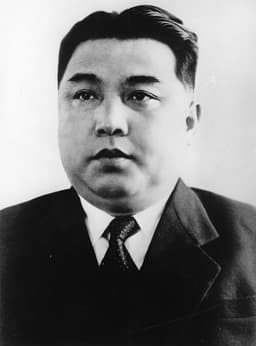
Kim Il-sung
Politician · Modern
64.0Total

Luvsannamsrain Oyun-Erdene
Politician · Modern
39.5Total
Basic Information
Born
1912
1980
Died
1994
—
Era
Modern
Modern
Nationality
North Korea
Mongolia
Occupation
Politician
Politician
Civilization
Eastern
Eastern
Score Comparison
Military (10%)
43.3
12.0
Political (20%)
68.0
40.8
Influence (20%)
65.0
47.9
Legacy (20%)
70.0
36.7
Leadership (15%)
80.0
48.4
Strategy (15%)
36.8
37.3
TOTAL
64.0
39.5
Kim Il-sung — Complete Timeline
1948 AD
Establishment of the Democratic People's Republic of KoreaPolitical Action
Kim Il-sung proclaimed the Democratic People's Republic of Korea (North Korea) with Soviet backing, becoming its first Premier. This established a communist state in the northern half of the Korean Peninsula, separate from the US-backed South.
FoundingNorth KoreaCold War
Impact: regional
1950 AD
Start of the Korean WarWar
Kim Il-sung ordered the North Korean invasion of South Korea, initiating the Korean War. The war resulted in millions of casualties and ended in a stalemate with the 1953 armistice, leaving Korea divided.
WarInvasionKorean War
Impact: globaldestructive
1955 AD
Adoption of the Juche IdeologyCultural◆ Major
Kim Il-sung formally introduced Juche, a self-reliance ideology, as the guiding principle of North Korea. Juche emphasized political independence, economic self-sufficiency, and military autonomy, shaping the country's isolationist policies.
IdeologyJucheSelf-Reliance
Impact: national
1960 AD
Consolidation of the Kim Il-sung Cult of PersonalityPolitical Action◆ Major
Kim Il-sung established an extensive cult of personality, portraying himself as the 'Great Leader' and founder of the Juche ideology. This included rewriting history, erecting statues, and mandating loyalty oaths, creating a totalitarian state.
Cult of PersonalityJucheTotalitarianism
Impact: nationaldestructive
1994 AD
Death and Designation as Eternal PresidentPolitical Action◆ Major
Kim Il-sung died of a heart attack, and the North Korean constitution was amended to designate him 'Eternal President'. His son Kim Jong-il succeeded him, continuing the dynastic rule of the Kim family.
DeathSuccessionEternal President
Impact: national
Luvsannamsrain Oyun-Erdene — Complete Timeline
2021 AD
Launched 'New Revival Policy'Reform◆ Major
Oyun-Erdene launched the 'New Revival Policy' in 2021, a comprehensive economic reform plan. The policy aimed to boost infrastructure, diversify the economy away from mining, and improve energy independence.
MongoliaEconomic ReformInfrastructure
Impact: nationalconstructive
Appointed Prime Minister of MongoliaPolitical Action◆ Major
Oyun-Erdene became Prime Minister in 2021 at age 40, making him one of the youngest leaders in Mongolia's history. He succeeded Ukhnaagiin Kh
MongoliaGovernmentYouth
Impact: nationalconstructive
2024 AD
Re-elected as Prime MinisterPolitical Action◆ Major
Oyun-Erdene was re-elected as Prime Minister in 2024 after the Mongolian People's Party won the parliamentary election. His second term focused on continuing economic reforms and addressing social issues.
MongoliaElectionGovernment
Impact: national
This comparison has not been analyzed yet.
One-time AI generation (~1 minute). Scores and timeline are already available below.
Rankings
🥇
Kim Il-sungLeader
Mil: 43.3Pol: 68.0Inf: 65.0
64.0
🥈
Luvsannamsrain Oyun-Erdene
Mil: 12.0Pol: 40.8Inf: 47.9
39.5
+24.5 behind
How This Comparison Works
Algorithm
Each figure is scored on 6 dimensions (0—100 scale) based on structured historical data: Military (10%), Political (20%), Influence (20%), Legacy (20%), Leadership (15%), Strategy (15%). The weighted total produces the final ranking.
Data Sources
Scores are computed from structured sub-indicators in the database. Scale factors adjust for era (Ancient ×0.85, Modern ×1.0) and civilization size (Eastern ×1.05, Other ×0.80) to account for differences in population and military scale.
Maximum 3 Figures
Comparisons are limited to 2—3 figures to ensure readability and statistical meaningfulness.
Error Margins
±5 points per dimension — Sub-scores are derived from historical records with inherent uncertainty. Two figures within 5 points on a dimension should be considered roughly equivalent in that area.
Total Score Accuracy
±3 points overall — The weighted combination of 6 dimensions produces a total score with approximately ±3 points of uncertainty. Differences of less than 3 points are not statistically significant— the figures are effectively tied.
Known Limitations
- Historical records are incomplete and uneven across civilizations
- Figures from oral-tradition societies may be underrepresented
- Occupation labels can misclassify multi-role figures
- Scores measure capability and impact, not moral character
- Quantitative scoring is a comparison tool, not absolute truth
Capability Radar
Military (10%) — Battles & Warfare
Battles
15
17
Win Rate
10
17
Expansion
10
22
Political (20%) — Governance & Reform
Reform
70
30
Diplomacy
30
35
Economy
20
30
Influence (20%) — Cultural & Global Reach
Cultural
60
10
Global
60
15
Legacy (20%) — Historical Impact
Historical
70
10
Longevity
80
10
Leadership (15%) — Power & Stability
Tenure
95
15
Stability
40
25
Strategy (15%) — Tactics & Innovation
Strategy
25
20
Tactics
20
28
Reform
30
26
Similar Comparisons
Comments & Discussion
No comments yet. Be the first to share your thoughts!