Loading...
This comparison has not been analyzed yet.
One-time AI generation (~1 minute). Scores and timeline are already available below.
King Gyanendra of Nepal vs Sher Singh
Sher Singh leads by 3.6 pts · 2 figures compared
…
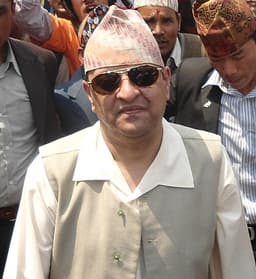
King Gyanendra of Nepal
Emperor · Modern
34.5Total

Sher Singh
Emperor · Modern
38.1Total
Basic Information
Born
1947
1807
Died
—
1843
Era
Modern
Modern
Nationality
Nepal
India
Occupation
Emperor
Emperor
Civilization
Indian
Indian
Score Comparison
Military (10%)
16.2
25.9
Political (20%)
29.3
26.4
Influence (20%)
47.1
46.3
Legacy (20%)
35.0
35.0
Leadership (15%)
31.2
38.1
Strategy (15%)
33.3
54.8
TOTAL
34.5
38.1
King Gyanendra of Nepal — Complete Timeline
2001 AD
First coronation as King of NepalPolitical Action◆ Major
Gyanendra was crowned King of Nepal after the royal massacre killed his brother King Birendra and most of the royal family. His accession was met with public suspicion due to the disputed circumstances of the massacre.
CoronationMonarchyNepal
Impact: national
2005 AD
Dismissed elected government and assumed absolute powerPolitical Action
King Gyanendra dismissed the elected government of Prime Minister Sher Bahadur Deuba, declared a state of emergency, and assumed direct executive authority. He cited the need to combat the Maoist insurgency, but the move was widely condemned as a coup.
CoupAuthoritarianismNepal
Impact: nationaldestructive
2008 AD
Abdicated the throne after the abolition of monarchyPolitical Action
Following the 2006 democracy movement and the Comprehensive Peace Agreement, the newly elected Constituent Assembly voted to abolish the monarchy. King Gyanendra was given 15 days to vacate the Narayanhiti Palace, ending 240 years of Shah dynasty rule.
AbdicationRepublicNepal
Impact: national
Sher Singh — Complete Timeline
1841 AD
Battle of JammuWar
Sher Singh led a military campaign against the Dogra ruler Gulab Singh of Jammu. He defeated Gulab Singh and forced him to pay tribute, temporarily asserting his authority over the rebellious Dogra kingdom.
Sikh-Dogra WarBattleJammu
Impact: regional
Accession to the ThronePolitical Action◆ Major
Sher Singh became Maharaja of the Sikh Empire after a power struggle following Nau Nihal Singh's death. He defeated rival claimants with the support of the army, but his rule was contested by the Dogra faction.
AccessionSikh EmpirePower Struggle
Impact: national
1843 AD
Assassination by CousinsPolitical Action◆ Major
Sher Singh was assassinated by his cousins, Ajit Singh and Lehna Singh, during a court ceremony in Lahore. His death ended his four-year reign and plunged the Sikh Empire into further instability and civil war.
AssassinationSikh EmpireSuccession Crisis
Impact: nationaltragic
This comparison has not been analyzed yet.
One-time AI generation (~1 minute). Scores and timeline are already available below.
Rankings
🥇
Sher SinghLeader
Mil: 25.9Pol: 26.4Inf: 46.3
38.1
🥈
King Gyanendra of Nepal
Mil: 16.2Pol: 29.3Inf: 47.1
34.5
+3.6 behind
How This Comparison Works
Algorithm
Each figure is scored on 6 dimensions (0—100 scale) based on structured historical data: Military (10%), Political (20%), Influence (20%), Legacy (20%), Leadership (15%), Strategy (15%). The weighted total produces the final ranking.
Data Sources
Scores are computed from structured sub-indicators in the database. Scale factors adjust for era (Ancient ×0.85, Modern ×1.0) and civilization size (Eastern ×1.05, Other ×0.80) to account for differences in population and military scale.
Maximum 3 Figures
Comparisons are limited to 2—3 figures to ensure readability and statistical meaningfulness.
Error Margins
±5 points per dimension — Sub-scores are derived from historical records with inherent uncertainty. Two figures within 5 points on a dimension should be considered roughly equivalent in that area.
Total Score Accuracy
±3 points overall — The weighted combination of 6 dimensions produces a total score with approximately ±3 points of uncertainty. Differences of less than 3 points are not statistically significant— the figures are effectively tied.
Known Limitations
- Historical records are incomplete and uneven across civilizations
- Figures from oral-tradition societies may be underrepresented
- Occupation labels can misclassify multi-role figures
- Scores measure capability and impact, not moral character
- Quantitative scoring is a comparison tool, not absolute truth
Capability Radar
Military (10%) — Battles & Warfare
Battles
8
15
Win Rate
8
15
Expansion
12
10
Political (20%) — Governance & Reform
Reform
5
10
Diplomacy
15
15
Economy
5
10
Influence (20%) — Cultural & Global Reach
Cultural
10
10
Global
10
5
Legacy (20%) — Historical Impact
Historical
15
15
Longevity
5
5
Leadership (15%) — Power & Stability
Tenure
10
20
Stability
5
5
Strategy (15%) — Tactics & Innovation
Strategy
17
10
Tactics
17
10
Reform
24
5
Similar Comparisons
Comments & Discussion
No comments yet. Be the first to share your thoughts!