Loading...
King Gyanendra of Nepal vs Napoleon Bonaparte
Napoleon Bonaparte leads by 36.4 pts · 2 figures compared
…
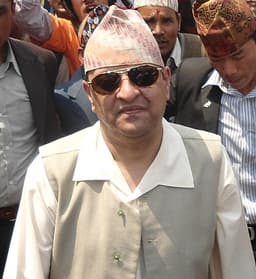
King Gyanendra of Nepal
Emperor · Modern
34.5Total

Napoleon Bonaparte
General · Modern
70.9Total
Basic Information
Born
1947
1769
Died
—
1821
Era
Modern
Modern
Nationality
Nepal
France
Occupation
Emperor
General
Civilization
Indian
Western
Score Comparison
Military (10%)
16.2
94.0
Political (20%)
29.3
72.0
Influence (20%)
47.1
40.0
Legacy (20%)
35.0
80.0
Leadership (15%)
31.2
78.0
Strategy (15%)
33.3
90.0
TOTAL
34.5
70.9
King Gyanendra of Nepal — Complete Timeline
2001 AD
First coronation as King of NepalPolitical Action◆ Major
Gyanendra was crowned King of Nepal after the royal massacre killed his brother King Birendra and most of the royal family. His accession was met with public suspicion due to the disputed circumstances of the massacre.
CoronationMonarchyNepal
Impact: national
2005 AD
Dismissed elected government and assumed absolute powerPolitical Action
King Gyanendra dismissed the elected government of Prime Minister Sher Bahadur Deuba, declared a state of emergency, and assumed direct executive authority. He cited the need to combat the Maoist insurgency, but the move was widely condemned as a coup.
CoupAuthoritarianismNepal
Impact: nationaldestructive
2008 AD
Abdicated the throne after the abolition of monarchyPolitical Action
Following the 2006 democracy movement and the Comprehensive Peace Agreement, the newly elected Constituent Assembly voted to abolish the monarchy. King Gyanendra was given 15 days to vacate the Narayanhiti Palace, ending 240 years of Shah dynasty rule.
AbdicationRepublicNepal
Impact: national
Napoleon Bonaparte — Complete Timeline
1799 AD
Coup of 18 BrumaireOther◆ Major
Napoleon Bonaparte, with support from his brother Lucien and key political figures, overthrew the Directory in a bloodless coup. He established the Consulate with himself as First Consul, effectively becoming the ruler of France. This event ended the French Revolution's most unstable period.
French RevolutionCoupRise to Power
Impact: regional
1804 AD
Promulgation of the Napoleonic CodeOther◆ Major
Napoleon enacted the Civil Code of the French, known as the Napoleonic Code, a comprehensive set of laws that replaced the fragmented feudal legal systems. The code established legal equality, protected property rights, and secularized law. It became the basis for legal systems in many European and world countries.
Legal ReformNapoleonic CodeCivil Law
Impact: globalconstructive
1805 AD
Battle of AusterlitzWar◆ Major
Napoleon's Grande Arm
Napoleonic WarsBattleDecisive Victory
Impact: global
1812 AD
Invasion of RussiaWar◆ Major
Napoleon led the Grande Arm
Napoleonic WarsInvasionDisaster
Impact: globaldestructive
1815 AD
Battle of WaterlooWar◆ Major
Napoleon's French army was defeated by the combined forces of the Duke of Wellington's Anglo-Allied army and Gebhard Leberecht von Bl
Napoleonic WarsBattleFinal Defeat
Impact: globaldestructive
Expert Analysis
king-gyanendra-of-nepal-vs-napoleon-bonaparte
# The Emperor and the King: Two Paths to Power, Two Destinies
In the winter of 1815, Napoleon Bonaparte stood on the deck of a British warship, watching the coast of France dissolve into the gray Atlantic. He was a prisoner of his own ambition, bound for a remote island in the South Atlantic. Nearly two centuries later, in the spring of 2008, King Gyanendra of Nepal walked out of the Narayanhiti Palace in Kathmandu, a former monarch now a common citizen, his crown surrendered to a Constituent Assembly. Both men had held absolute power. Both had seen it vanish. But the forces that lifted them, and the forces that cast them down, could not have been more different.
Origins
Napoleon Bonaparte was born in 1769 on the island of Corsica, a rugged Mediterranean territory that had just passed from Genoese to French control. His family was minor nobility, poor but proud, and young Napoleon grew up speaking Corsican Italian, not French. He was an outsider in the French world he would one day conquer. Yet the French Revolution, erupting when he was twenty, shattered the old hierarchies of birth and privilege. A talented artillery officer could rise on merit alone. Napoleon seized that opening with ferocious energy.
King Gyanendra, born in 1947, came from a very different world. His family, the Shah dynasty, had ruled Nepal for over two centuries, claiming descent from the warrior-princes of Rajasthan. He was raised in the Narayanhiti Palace, surrounded by rituals of divine kingship. In Nepal, the king was not merely a ruler; he was an incarnation of the god Vishnu. Gyanendra’s path was written before he could walk. Yet his era was no less revolutionary. Across Asia, monarchies were crumbling. India had abolished its princely states. China had executed its last emperor. Nepal’s absolute monarchy was an anachronism, preserved by geography and the careful balancing of India and China.
Rise to Power
Napoleon’s ascent was meteoric. At the age of twenty-four, he drove the British out of Toulon and was promoted to brigadier general. By twenty-six, he had crushed a royalist uprising in Paris and was given command of the Army of Italy. In 1796, he led that ragged army across the Alps and smashed the Austrian Empire in a series of lightning campaigns. He was not yet thirty. His rise was a product of chaos—the chaos of revolution, war, and the collapse of old orders. He filled the vacuum with his will.
Gyanendra’s rise was a product of tragedy. In June 2001, his brother King Birendra, his sister-in-law Queen Aishwarya, and most of the royal family were massacred in the Narayanhiti Palace. The official account blamed Crown Prince Dipendra, who died of self-inflicted wounds. The truth remains murky. Gyanendra, who had been out of the country, returned to a throne soaked in blood. He was crowned king under a cloud of suspicion and grief. His first coronation had been as a child in 1950, when he was two years old and his grandfather was in exile. That reign lasted only months. The second, in 2001, would last seven years.
Leadership & Governance
Napoleon governed with a blend of military genius and political calculation. As First Consul and later Emperor, he reformed France from top to bottom. The Napoleonic Code, enacted in 1804, standardized laws across a fractured nation, guaranteeing equality before the law and protecting property rights—though women and workers gained little. He centralized the bureaucracy, founded the Bank of France, and built a system of lycées to train future elites. His military campaigns were masterpieces of speed and deception. At Austerlitz in 1805, he destroyed the combined armies of Russia and Austria, a victory so complete it became a synonym for brilliance. But his governance was ultimately personal. He trusted no one, delegated little, and demanded total loyalty. His empire was an extension of his ego.
Gyanendra governed in a different key. He inherited a monarchy already weakened by the rise of democratic movements and a brutal Maoist insurgency that had killed thousands. His brother Birendra had accepted constitutional limits, allowing multiparty elections in 1990. Gyanendra resented these constraints. In 2005, he dismissed the elected government of Prime Minister Sher Bahadur Deuba, declared a state of emergency, and assumed absolute power. He appointed his own cabinet, censored the press, and arrested political leaders. His military score of 16.4 reflects a king who never led troops in battle. His political score of 44.5 reflects a ruler who misread his people. He believed he could restore the monarchy’s glory by force. Instead, he united his enemies.
Triumph & Tragedy
Napoleon’s greatest triumph was the Empire at its height, around 1810. He ruled from Madrid to Warsaw, placed his brothers on European thrones, and dictated terms to the Pope. His tragedy was the invasion of Russia in 1812. He marched with 600,000 men; fewer than 100,000 returned. The disaster shattered his aura of invincibility. After his first abdication in 1814, he was exiled to Elba. He escaped, rallied France, and was defeated at Waterloo in 1815. His final exile on Saint Helena was a slow death, poisoned by the British and by his own memories.
Gyanendra’s triumph was brief. In 2001, he was the last absolute monarch on Earth, and for a moment, he seemed to control Nepal. But his tragedy was the democracy movement of 2006. After months of strikes and protests, the army refused to fire on civilians. Gyanendra was forced to restore parliament. In 2008, the newly elected Constituent Assembly voted to abolish the monarchy, 560 votes to 4. He abdicated, becoming a common citizen. The man who had been a god was now a man.
Character & Destiny
Napoleon was driven by an insatiable hunger for glory. “I live only for posterity,” he once said. His personality was a paradox: ruthless yet charismatic, brilliant yet blind to his limits. He could inspire men to die for him, but he could not stop himself from pushing too far. His destiny was shaped by his refusal to compromise, his belief that will alone could conquer fate.
Gyanendra was driven by a different hunger: the need to restore what was slipping away. He was cautious, stubborn, and isolated. He trusted few outside his family, and his advisors were sycophants. He believed that the monarchy was Nepal’s only anchor of stability. When the people proved otherwise, he could not adapt. His destiny was shaped by his inability to see that the world had changed.
Legacy
Napoleon’s legacy is colossal. He reshaped Europe, spread the ideals of the French Revolution, and created the template for modern state-building. His influence score of 82.0 and legacy score of 78.0 reflect a man whose name still appears in legal codes, military academies, and political debates. He is remembered as both hero and tyrant, liberator and conqueror.
Gyanendra’s legacy is faint. His influence score of 63.4 and legacy score of 46.6 reflect a king who was the last of his line, but who accelerated the end he feared. He is remembered as a footnote in Nepal’s transition to democracy, a cautionary tale of what happens when a ruler refuses to share power.
Conclusion
Napoleon and Gyanendra both reached for absolute power. One built an empire that shook the world. The other defended a throne that crumbled in his hands. The difference was not in ambition—both had that in abundance. It was in the currents of history. Napoleon rode the wave of revolution, a force that destroyed old orders and created new ones. Gyanendra tried to swim against the tide of democracy, a force that swept away kings. In the end, both were defeated by the same truth: power is a loan from history, and history always calls it due.
Rankings
🥇
Napoleon BonaparteLeader
Mil: 94.0Pol: 72.0Inf: 40.0
70.9
🥈
King Gyanendra of Nepal
Mil: 16.2Pol: 29.3Inf: 47.1
34.5
+36.4 behind
How This Comparison Works
Algorithm
Each figure is scored on 6 dimensions (0—100 scale) based on structured historical data: Military (10%), Political (20%), Influence (20%), Legacy (20%), Leadership (15%), Strategy (15%). The weighted total produces the final ranking.
Data Sources
Scores are computed from structured sub-indicators in the database. Scale factors adjust for era (Ancient ×0.85, Modern ×1.0) and civilization size (Eastern ×1.05, Other ×0.80) to account for differences in population and military scale.
Maximum 3 Figures
Comparisons are limited to 2—3 figures to ensure readability and statistical meaningfulness.
Error Margins
±5 points per dimension — Sub-scores are derived from historical records with inherent uncertainty. Two figures within 5 points on a dimension should be considered roughly equivalent in that area.
Total Score Accuracy
±3 points overall — The weighted combination of 6 dimensions produces a total score with approximately ±3 points of uncertainty. Differences of less than 3 points are not statistically significant— the figures are effectively tied.
Known Limitations
- Historical records are incomplete and uneven across civilizations
- Figures from oral-tradition societies may be underrepresented
- Occupation labels can misclassify multi-role figures
- Scores measure capability and impact, not moral character
- Quantitative scoring is a comparison tool, not absolute truth
Capability Radar
Military (10%) — Battles & Warfare
Battles
8
95
Win Rate
8
90
Expansion
12
95
Political (20%) — Governance & Reform
Reform
5
95
Diplomacy
15
80
Economy
5
85
Influence (20%) — Cultural & Global Reach
Cultural
10
85
Global
10
90
Legacy (20%) — Historical Impact
Historical
15
95
Longevity
5
90
Leadership (15%) — Power & Stability
Tenure
10
85
Stability
5
70
Strategy (15%) — Tactics & Innovation
Strategy
17
95
Tactics
17
98
Reform
24
92
Similar Comparisons
Comments & Discussion
GUNPOWDER_TITAN6/17/2026
Napoleon built an empire from nothing but ambition and artillery—Gyanendra inherited one and suffocated it. The Corsican’s rise was a revolution in motion; the Shah’s fall was a dynasty too slow to evolve. One understood the people’s pulse, the other ignored it until they knocked on his palace gates. Power earned vs power assumed: there’s your real contrast.|
君主解剖学家6/17/2026
拿皇和贾南德拉完全不是一个物种。拿破仑把欧洲炼成了熔炉,贾南德拉把尼泊尔憋成闷罐。一个靠军功和法典称帝,一个靠血统和神权硬撑。2001年王室惨案后他本可以改革自救,结果倒行逆施搞绝对君主制,2006年就被人民运动赶下台。野心和愚蠢的区别,就在这里。|
REVOLUTION_SKEPTIC6/17/2026
Let’s be real: comparing a self-made emperor who reshaped Europe’s legal and military systems to a hereditary king who lost a small Himalayan country to protests is like comparing a typhoon to a hiccup. Napoleon’s failures were epic—Gyanendra’s were provincial. The only thing they share is an exit stage left, but even that varies. One sailed to St. Helena with a legend; the other drove to a hotel in Pokhara.|
史海钩沉客6/17/2026
两人都是旧秩序的殉道者,但殉道的方式天差地别。拿破仑的百日王朝是欧洲群狼围剿的结果,滑铁卢是军事赌博的终局;贾南德拉的下台纯粹是自绝于民,2005年他软禁首相、独揽大权,直接触发了七党联盟和毛派的联合反扑。一个输给了全欧洲的精锐,一个输给了自己的人民,格局高下立判。|
DATA_SMASHER6/17/2026
Napoleon’s Grand Army peaked at 600,000 men; Gyanendra’s entire kingdom had 27 million people. One conquered Moscow, the other couldn’t hold Kathmandu. The math is brutal: Napoleon’s military failures cost him a continent, Gyanendra’s political miscalculations cost him a dynasty. Different scales, same ending—but don’t pretend the stakes were equal.|