Loading...
King Jangsu vs King Zhaoxiang of Qin
King Zhaoxiang of Qin leads by 2.1 pts · 2 figures compared
…
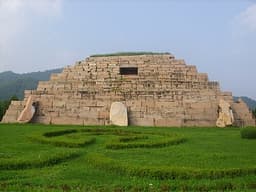
King Jangsu
Emperor · Ancient
59.8Total

King Zhaoxiang of Qin
Emperor · Ancient
61.9Total
Basic Information
Born
394
-325
Died
491
-251
Era
Ancient
Ancient
Nationality
Korea
China
Occupation
Emperor
Emperor
Civilization
Eastern
Eastern
Score Comparison
Military (10%)
60.0
77.5
Political (20%)
59.3
72.0
Influence (20%)
56.4
56.7
Legacy (20%)
50.0
40.0
Leadership (15%)
78.0
78.0
Strategy (15%)
66.3
75.0
TOTAL
59.8
61.9
King Jangsu — Complete Timeline
413 AD
Ascended to the Throne of GoguryeoPolitical Action◆ Major
Jangsu became king of Goguryeo upon the death of his father, Gwanggaeto the Great. He inherited a vast empire and continued its development.
AccessionGoguryeoKorea
Impact: regional
427 AD
Moved Capital to PyongyangPolitical Action
Jangsu moved the Goguryeo capital from Gungnae (Ji'an) to Pyongyang. This strategic relocation strengthened control over the Korean Peninsula and facilitated trade and diplomacy.
Capital MovePyongyangGoguryeo
Impact: regionalconstructive
435 AD
Established Diplomatic Relations with ChinaPolitical Action◆ Major
Jangsu sent envoys to the Northern Wei dynasty in China, establishing formal diplomatic relations. This helped secure Goguryeo's borders and facilitated cultural exchange.
DiplomacyChinaGoguryeo
Impact: regionalconstructive
475 AD
Defended Against Chinese InvasionsWar◆ Major
Jangsu successfully repelled invasions by the Northern Wei dynasty, maintaining Goguryeo's territorial integrity. His military leadership preserved the kingdom's independence.
DefenseGoguryeoNorthern Wei
Impact: regionalconstructive
491 AD
Died After Long ReignOther◆ Major
Jangsu died at the age of 97, after a reign of approximately 78 years, one of the longest in world history. His rule stabilized and expanded Goguryeo's power.
Long ReignGoguryeoKorea
Impact: regional
King Zhaoxiang of Qin — Complete Timeline
293 BC
Battle of YiqueWar◆ Major
Qin general Bai Qi, under King Zhaoxiang's command, defeated a coalition of Wei and Han forces at Yique, killing 240,000 enemy troops. This victory eliminated the main military threat from the central plains and opened the way for Qin's eastward expansion.
BattleQin ExpansionBai Qi
Impact: regionaldestructive
266 BC
Reforms of Fan JuReform◆ Major
King Zhaoxiang appointed Fan Ju as chancellor, who implemented policies to centralize power, reduce the influence of noble families, and promote capable officials. These reforms strengthened Qin's administrative efficiency and military capacity, laying the foundation for unification.
ReformCentralizationFan Ju
Impact: nationalconstructive
260 BC
Battle of ChangpingWar
Qin forces under Bai Qi besieged and defeated the Zhao army at Changping. After the Zhao surrender, Bai Qi ordered the execution of 400,000 Zhao soldiers, the largest massacre in ancient Chinese history. This victory crippled Zhao and solidified Qin's dominance.
BattleMassacreQin Unification
Impact: regionaldestructive
256 BC
Conquest of the Zhou Royal DomainWar
King Zhaoxiang's forces conquered the remaining territory of the Eastern Zhou dynasty, capturing King Nan of Zhou. This ended the Zhou dynasty's nominal rule after 800 years, symbolically clearing the way for Qin's eventual unification of China.
ConquestZhou DynastyEnd of Era
Impact: national
Expert Analysis
Origins
King Jangsu (born 394 CE, died 491 CE) was the son of Gwanggaeto the Great, the most expansionist ruler of Goguryeo, one of the Three Kingdoms of Korea. He inherited a sprawling territory that stretched from southern Manchuria to the Korean Peninsula. His father had already established Goguryeo as a regional power. Jangsu grew up in the capital Gungnae (modern Ji'an, China) and was educated in Confucian and military traditions. The royal family had a strong warrior ethos, and Jangsu was groomed to rule from a young age.
King Zhaoxiang of Qin (born 325 BCE, died 251 BCE) was the son of King Huiwen of Qin, a state that had already reformed under Shang Yang and was rising in power. Zhaoxiang was born into the turbulent Warring States period, where seven major states vied for supremacy. His mother, Queen Dowager Xuan, and her brother, Wei Ran, initially held power. Zhaoxiang's early life was overshadowed by court intrigues, but he eventually asserted his authority. He was educated in legalist philosophy, which emphasized strict laws and centralized control.
Rise to Power
Jangsu ascended the throne in 413 CE upon his father's death. There was no internal struggle: the succession was smooth due to Gwanggaeto's foresight and the stability of Goguryeo's monarchy. Jangsu immediately faced the challenge of maintaining his father's conquests. His first major decision was to move the capital from Gungnae to Pyongyang in 427 CE, a strategic shift that positioned Goguryeo closer to the Korean heartland and away from Chinese pressure. This move also facilitated control over the peninsula and allowed for better administration.
Zhaoxiang became king in 306 BCE at age 19, but real power rested with his mother and her allies. For decades, he was a figurehead. He gradually built his own faction, notably by promoting Fan Ju, a strategist who helped him remove the powerful Marquess of Rang (Wei Ran) in 266 BCE. Fan Ju's reforms centralized authority and weakened noble families, allowing Zhaoxiang to take full control. His rise was a slow, calculated process of eliminating rivals and consolidating power.
Leadership & Governance
Jangsu's leadership style was pragmatic and diplomatic. He focused on consolidating his father's gains rather than constant expansion. His governance emphasized stability: he established diplomatic relations with the Northern Wei dynasty in China, sending regular envoys to maintain peace. This secured Goguryeo's northern borders and allowed trade and cultural exchange. Domestically, he promoted Confucian values and strengthened the bureaucracy, but he did not implement radical reforms. His long reign (78 years) provided continuity.
Zhaoxiang, in contrast, was a relentless expansionist. Under his rule, Qin launched a series of wars that eliminated rival states. He appointed capable generals like Bai Qi, who executed the infamous Battle of Changping in 260 BCE, where 400,000 Zhao soldiers were killed. Zhaoxiang's governance was harsh and legalist: he centralized power, suppressed dissent, and built a war machine. His chancellor Fan Ju introduced reforms that weakened feudal lords and promoted meritocracy. Zhaoxiang scored 72.0 in political ability, higher than Jangsu's 59.3, reflecting his transformative state-building.
Triumph & Tragedy
Jangsu's greatest triumph was his successful defense of Goguryeo against Chinese invasions. Despite multiple campaigns by the Northern Wei, Goguryeo remained independent and strong. He also expanded southward into the Korean Peninsula, securing the Han River basin. His capital move to Pyongyang proved visionary, as it became a cultural and political center. However, his reign saw fewer dramatic conquests compared to his father, and some historians argue he was too cautious. His legacy score of 50.0 is lower than Zhaoxiang's 40.0, but this reflects different contexts.
Zhaoxiang's triumphs were military: he conquered the Zhou royal domain in 256 BCE, ending the Zhou dynasty, and his generals defeated Wei, Han, and Zhao. His military score of 77.5 dwarfs Jangsu's 60.0. Yet his tragedy was the brutality of his campaigns. The mass executions at Changping and elsewhere created deep resentment. He also failed to fully unify China before his death; that was left to his descendant, Qin Shi Huang. His legacy is mixed: he laid the foundation for unification but is remembered for cruelty.
Character & Destiny
Jangsu was patient and long-lived, reigning until age 97. His character was steady, preferring diplomacy over war. His destiny was to preserve and stabilize his kingdom, not to conquer new lands. He is remembered as a wise ruler who kept Goguryeo strong for centuries. His leadership score of 78.0 matches Zhaoxiang's, but his strategic score (66.3) is lower than Zhaoxiang's 75.0.
Zhaoxiang was ruthless and ambitious. He endured decades of being a puppet before seizing power, which made him shrewd and calculating. His destiny was to break the old order and create a centralized state. His total score of 61.9 inches ahead of Jangsu's 59.8, but the 2.1-point gap is minimal. Both were effective in their own contexts.
Legacy
Jangsu's legacy is the consolidation of Goguryeo. His capital Pyongyang remained the center of Korean power for centuries. His diplomatic ties with China set a pattern for Korean states. However, his reign is overshadowed by his father's glory. He scored 50.0 in legacy, reflecting his role as a consolidator rather than an innovator.
Zhaoxiang's legacy is more profound: he destroyed the old feudal system and paved the way for the first unified Chinese empire. His military campaigns and reforms were directly inherited by Qin Shi Huang. Despite his low legacy score (40.0), his impact on Chinese history is immense. He is often underrated because his grandson took the final glory.
Conclusion
King Zhaoxiang of Qin had a greater impact on history than King Jangsu. While Jangsu maintained his kingdom for a long reign, Zhaoxiang fundamentally changed the political landscape of China, eliminating the Zhou dynasty and setting the stage for unification. His military achievements (77.5 vs 60.0) and political reforms (72.0 vs 59.3) were more transformative. Jangsu was a capable ruler, but his influence was regional. Zhaoxiang's actions shaped the trajectory of Chinese civilization. Therefore, despite the narrow score gap, Zhaoxiang's legacy is more significant.
Rankings
🥇
King Zhaoxiang of QinLeader
Mil: 77.5Pol: 72.0Inf: 56.7
61.9
🥈
King Jangsu
Mil: 60.0Pol: 59.3Inf: 56.4
59.8
+2.1 behind
How This Comparison Works
Algorithm
Each figure is scored on 6 dimensions (0—100 scale) based on structured historical data: Military (10%), Political (20%), Influence (20%), Legacy (20%), Leadership (15%), Strategy (15%). The weighted total produces the final ranking.
Data Sources
Scores are computed from structured sub-indicators in the database. Scale factors adjust for era (Ancient ×0.85, Modern ×1.0) and civilization size (Eastern ×1.05, Other ×0.80) to account for differences in population and military scale.
Maximum 3 Figures
Comparisons are limited to 2—3 figures to ensure readability and statistical meaningfulness.
Error Margins
±5 points per dimension — Sub-scores are derived from historical records with inherent uncertainty. Two figures within 5 points on a dimension should be considered roughly equivalent in that area.
Total Score Accuracy
±3 points overall — The weighted combination of 6 dimensions produces a total score with approximately ±3 points of uncertainty. Differences of less than 3 points are not statistically significant— the figures are effectively tied.
Known Limitations
- Historical records are incomplete and uneven across civilizations
- Figures from oral-tradition societies may be underrepresented
- Occupation labels can misclassify multi-role figures
- Scores measure capability and impact, not moral character
- Quantitative scoring is a comparison tool, not absolute truth
Capability Radar
Military (10%) — Battles & Warfare
Battles
60
85
Win Rate
65
90
Expansion
75
95
Political (20%) — Governance & Reform
Reform
70
85
Diplomacy
80
80
Economy
75
75
Influence (20%) — Cultural & Global Reach
Cultural
55
65
Global
45
80
Legacy (20%) — Historical Impact
Historical
60
90
Longevity
65
85
Leadership (15%) — Power & Stability
Tenure
95
95
Stability
85
70
Strategy (15%) — Tactics & Innovation
Strategy
70
95
Tactics
55
80
Reform
50
70
Similar Comparisons
Comments & Discussion
No comments yet. Be the first to share your thoughts!