Loading...
King Jangsu vs Napoleon Bonaparte
Napoleon Bonaparte leads by 11.1 pts · 2 figures compared
…
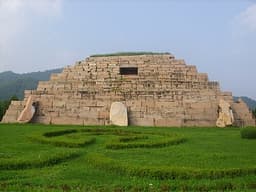
King Jangsu
Emperor · Ancient
59.8Total

Napoleon Bonaparte
General · Modern
70.9Total
Basic Information
Born
394
1769
Died
491
1821
Era
Ancient
Modern
Nationality
Korea
France
Occupation
Emperor
General
Civilization
Eastern
Western
Score Comparison
Military (10%)
60.0
94.0
Political (20%)
59.3
72.0
Influence (20%)
56.4
40.0
Legacy (20%)
50.0
80.0
Leadership (15%)
78.0
78.0
Strategy (15%)
66.3
90.0
TOTAL
59.8
70.9
King Jangsu — Complete Timeline
413 AD
Ascended to the Throne of GoguryeoPolitical Action◆ Major
Jangsu became king of Goguryeo upon the death of his father, Gwanggaeto the Great. He inherited a vast empire and continued its development.
AccessionGoguryeoKorea
Impact: regional
427 AD
Moved Capital to PyongyangPolitical Action
Jangsu moved the Goguryeo capital from Gungnae (Ji'an) to Pyongyang. This strategic relocation strengthened control over the Korean Peninsula and facilitated trade and diplomacy.
Capital MovePyongyangGoguryeo
Impact: regionalconstructive
435 AD
Established Diplomatic Relations with ChinaPolitical Action◆ Major
Jangsu sent envoys to the Northern Wei dynasty in China, establishing formal diplomatic relations. This helped secure Goguryeo's borders and facilitated cultural exchange.
DiplomacyChinaGoguryeo
Impact: regionalconstructive
475 AD
Defended Against Chinese InvasionsWar◆ Major
Jangsu successfully repelled invasions by the Northern Wei dynasty, maintaining Goguryeo's territorial integrity. His military leadership preserved the kingdom's independence.
DefenseGoguryeoNorthern Wei
Impact: regionalconstructive
491 AD
Died After Long ReignOther◆ Major
Jangsu died at the age of 97, after a reign of approximately 78 years, one of the longest in world history. His rule stabilized and expanded Goguryeo's power.
Long ReignGoguryeoKorea
Impact: regional
Napoleon Bonaparte — Complete Timeline
1799 AD
Coup of 18 BrumaireOther◆ Major
Napoleon Bonaparte, with support from his brother Lucien and key political figures, overthrew the Directory in a bloodless coup. He established the Consulate with himself as First Consul, effectively becoming the ruler of France. This event ended the French Revolution's most unstable period.
French RevolutionCoupRise to Power
Impact: regional
1804 AD
Promulgation of the Napoleonic CodeOther◆ Major
Napoleon enacted the Civil Code of the French, known as the Napoleonic Code, a comprehensive set of laws that replaced the fragmented feudal legal systems. The code established legal equality, protected property rights, and secularized law. It became the basis for legal systems in many European and world countries.
Legal ReformNapoleonic CodeCivil Law
Impact: globalconstructive
1805 AD
Battle of AusterlitzWar◆ Major
Napoleon's Grande Arm
Napoleonic WarsBattleDecisive Victory
Impact: global
1812 AD
Invasion of RussiaWar◆ Major
Napoleon led the Grande Arm
Napoleonic WarsInvasionDisaster
Impact: globaldestructive
1815 AD
Battle of WaterlooWar◆ Major
Napoleon's French army was defeated by the combined forces of the Duke of Wellington's Anglo-Allied army and Gebhard Leberecht von Bl
Napoleonic WarsBattleFinal Defeat
Impact: globaldestructive
Expert Analysis
king-jangsu-vs-napoleon-bonaparte
# The Emperor and the General: Two Paths to Power
On a June morning in 1815, Napoleon Bonaparte watched his dreams dissolve in the mud of Waterloo. Half a world away and fourteen centuries earlier, King Jangsu of Goguryeo sat on his throne in Pyongyang, having just completed his sixty-second year of rule—a reign that would stretch on for another sixteen years. One man conquered Europe in a decade and lost it all in a single day; the other held his kingdom for nearly eight decades and died in his bed at ninety-seven. What accounts for such radically different destinies?
Origins
Napoleon was born in 1769 on the island of Corsica, a place that had only recently become French. His family was minor nobility, poor enough that young Napoleon wore shabby clothes to military school. The French Revolution, which erupted when he was twenty, shattered the old order and created a world where ambition could vault a man from obscurity to empire. He was a child of upheaval, and upheaval became his element.
Jangsu, born in 394, was the son of Gwanggaeto the Great, the most fearsome conqueror in Korean history. He inherited not poverty but a sprawling kingdom that stretched from the Korean peninsula deep into Manchuria. His father had expanded Goguryeo through relentless warfare; Jangsu would have to hold it through wisdom. He was a child of stability, and stability became his art.
Rise to Power
Napoleon’s ascent was a rocket’s trajectory. At twenty-four, he drove the British from Toulon and was promoted to brigadier general. At twenty-six, he crushed a royalist uprising in Paris with a "whiff of grapeshot." At thirty, he was First Consul of France. The key turning point came in 1796, when he took command of the starving, unpaid Army of Italy and turned it into a legend, crossing the Alps and humbling Austria. He rose not by birth but by brilliance—and by being in the right revolution at the right time.
Jangsu’s rise was the opposite: seamless and inevitable. When his father died in 413, Jangsu ascended the throne at age nineteen. He faced no rivals, no coups, no existential threats. His challenge was not to seize power but to wield it wisely. Where Napoleon had to fight for every step, Jangsu simply took the throne and kept it.
Leadership & Governance
Napoleon ruled through energy and terror. He reorganized France’s laws into the Napoleonic Code, a rational system that influenced legal thinking across Europe. He built roads, banks, and schools. He also bled the continent dry, conscripting millions of young men into his wars. His military genius was unmatched: he won sixty battles and lost only seven, but his final defeat at Waterloo in 1815 was total. His strategy was aggressive, seeking decisive battle; his political wisdom was real but undermined by his refusal to compromise.
Jangsu ruled through patience and diplomacy. In 427, he moved Goguryeo’s capital from Gungnae to Pyongyang, a strategic relocation that strengthened control over the peninsula and reduced vulnerability to Chinese attack. In 435, he established formal relations with the Northern Wei dynasty, buying peace with diplomacy rather than blood. When war came anyway in 475, he repelled the Chinese invasion and maintained Goguryeo’s borders. His military score of 70.5 is modest, but his leadership score of 81.3 reflects a ruler who kept his kingdom stable for seventy-eight years—an eternity in ancient politics.
Triumph & Tragedy
Napoleon’s greatest moment was Austerlitz in 1805, where he destroyed a combined Russian and Austrian army and crowned himself master of Europe. His tragedy was the invasion of Russia in 1812: six hundred thousand men marched east; fewer than a hundred thousand came back. His character—restless, brilliant, insatiable—drove him to overreach until the continent united against him.
Jangsu’s triumph was his longevity. He outlasted enemies, allies, and entire dynasties. His tragedy, if it can be called that, is that we know so little of his interior life. History records his actions but not his voice. He left no memoirs, no famous last words, no dramatic battlefield quotes. He was a builder, not a performer.
Character & Destiny
Napoleon once said, "I am not a man, but a thing." He meant that he was an instrument of destiny, but his destiny was shaped by his own relentless ambition. He could not stop. When he had Europe, he wanted Egypt; when he had Egypt, he wanted Russia. His personality was a fire that consumed everything—including himself.
Jangsu’s personality remains opaque, but his actions reveal a man of patience and calculation. He did not need to conquer; he needed to preserve. He understood that the greatest victory is the war that never happens. His strategy score of 59.2 is low, but strategy for him meant something different than for Napoleon: not winning battles, but avoiding them.
Legacy
Napoleon left a continent reshaped. The Napoleonic Code governs law from France to Louisiana. He unified Germany and Italy by accident, destroying old feudal orders and planting the seeds of nationalism. He is remembered as both hero and tyrant, a man who wanted to liberate Europe and ended up enslaving it.
Jangsu left a kingdom that lasted. Goguryeo fell less than a century after his death, but his reign became the golden age of Korean history. His move to Pyongyang shaped the geopolitical center of the peninsula for centuries. He is remembered as the wise king who kept the barbarians at bay—a quieter legacy, but no less real.
Conclusion
Napoleon and Jangsu represent two eternal types: the conqueror and the preserver. Napoleon burned like a comet, dazzling the world before crashing to earth. Jangsu glowed like a steady flame, illuminating his kingdom for seventy-eight years. Which is greater? The question is perhaps unanswerable. But standing at Waterloo, mud-soaked and defeated, Napoleon might have envied the old king who died in his bed, having never known defeat—or having known it so rarely that history forgot. Jangsu, for his part, might have looked at Napoleon’s career and seen a man who could not bear his own success. Both were great. Only one was wise.
Rankings
🥇
Napoleon BonaparteLeader
Mil: 94.0Pol: 72.0Inf: 40.0
70.9
🥈
King Jangsu
Mil: 60.0Pol: 59.3Inf: 56.4
59.8
+11.1 behind
How This Comparison Works
Algorithm
Each figure is scored on 6 dimensions (0—100 scale) based on structured historical data: Military (10%), Political (20%), Influence (20%), Legacy (20%), Leadership (15%), Strategy (15%). The weighted total produces the final ranking.
Data Sources
Scores are computed from structured sub-indicators in the database. Scale factors adjust for era (Ancient ×0.85, Modern ×1.0) and civilization size (Eastern ×1.05, Other ×0.80) to account for differences in population and military scale.
Maximum 3 Figures
Comparisons are limited to 2—3 figures to ensure readability and statistical meaningfulness.
Error Margins
±5 points per dimension — Sub-scores are derived from historical records with inherent uncertainty. Two figures within 5 points on a dimension should be considered roughly equivalent in that area.
Total Score Accuracy
±3 points overall — The weighted combination of 6 dimensions produces a total score with approximately ±3 points of uncertainty. Differences of less than 3 points are not statistically significant— the figures are effectively tied.
Known Limitations
- Historical records are incomplete and uneven across civilizations
- Figures from oral-tradition societies may be underrepresented
- Occupation labels can misclassify multi-role figures
- Scores measure capability and impact, not moral character
- Quantitative scoring is a comparison tool, not absolute truth
Capability Radar
Military (10%) — Battles & Warfare
Battles
60
95
Win Rate
65
90
Expansion
75
95
Political (20%) — Governance & Reform
Reform
70
95
Diplomacy
80
80
Economy
75
85
Influence (20%) — Cultural & Global Reach
Cultural
55
85
Global
45
90
Legacy (20%) — Historical Impact
Historical
60
95
Longevity
65
90
Leadership (15%) — Power & Stability
Tenure
95
85
Stability
85
70
Strategy (15%) — Tactics & Innovation
Strategy
70
95
Tactics
55
98
Reform
50
92
Similar Comparisons
Comments & Discussion
TheBlitzKriegKing6/17/2026
Comparing Jangsu to Napoleon is like comparing a tortoise to a meteor. Sure, longevity counts, but Napoleon’s lightning campaigns—Austerlitz, Jena, Borodino—rewrote the rulebook of war. Jangsu’s “victories” are mostly defensive against China's Wei and Sui dynasties; he never marched an army across a continent. Napoleon’s Grande Armée was the terror of Europe for a decade, while Jangsu just outlasted his enemies. Give me the genius who burned bright over the fossil who sat still.
长寿将军6/17/2026
拿江蓟跟拿破仑比?江蓟一辈子打的基本都是防守战,撑死了算是“开明守成君主”。拿破仑从意大利到埃及到莫斯科,亲手改写战争史。江蓟活得久是因为他没碰上欧洲那帮狼。活得长不代表活得精彩,拿破仑十年干的事比江蓟八十年还有看头。真要选,我宁要那颗流星,不要那堆灰烬。
LogisticsLens6/17/2026
Napoleon's downfall wasn't lack of ambition but supply lines. In 1812, his army of 600,000 outran its provisions and got destroyed by "General Winter." Jangsu, on the other hand, built a fortress state. The Goguryeo capital, Pyongyang, had self-sufficient granaries and layered defenses. Jangsu didn't need to conquer Europe; he just needed to feed his people and repel invaders. Napoleon’s hubris was a logistical nightmare; Jangsu’s pragmatism was a logistical masterpiece. Short burns die fast.
数据怼杠精6/17/2026
拿破仑输在后勤这个事实没几个历史粉敢认真看。他的大军团庞大到靠掠夺才能补给,结果在俄国活活饿死冻死。江蓟统治高句丽七十九年,靠的不是打仗而是修城屯粮。平壤的粮仓能撑几十年,入侵的魏军来了除了饿只能退。拿破仑是烟花,江蓟是古树。你要真打过仗就知道,吃饱比打胜重要多了。
ClassicsQuill6/17/2026
Let’s stop pretending long life equals success. Napoleon’s Civil Code shaped modern Europe, while Jangsu’s main legacy is keeping Goguryeo alive a bit longer. Napoleon built schools, streamlined laws, and restructured French bureaucracy. Jangsu? He kept a kingdom stable but left no lasting institutional reforms beyond a few fortress walls. Stability without innovation is just stagnation. Napoleon’s fall was tragic, but his ideas outlasted his empire.
古典毒舌6/17/2026
拿破仑把法律、教育、行政体系整个翻新了一遍,江蓟除了“修长城”“打防守”还有什么拿得出手的欧洲史书级别的遗产?稳定?稳定到六世纪高句丽