Loading...
King Muyeol vs King Wu of Zhou
King Wu of Zhou leads by 13.0 pts · 2 figures compared
…

King Muyeol
Emperor · Ancient
54.0Total
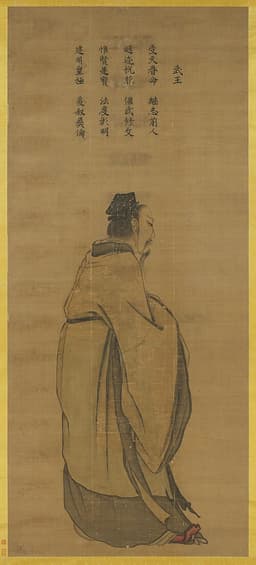
King Wu of Zhou
Emperor · Ancient
67.0Total
Basic Information
Born
-604
-1076
Died
—
-1043
Era
Ancient
Ancient
Nationality
Korea
China
Occupation
Emperor
Emperor
Civilization
Eastern
Eastern
Score Comparison
Military (10%)
65.0
82.0
Political (20%)
68.0
55.0
Influence (20%)
54.1
65.0
Legacy (20%)
50.0
80.0
Leadership (15%)
40.0
51.9
Strategy (15%)
52.5
65.4
TOTAL
54.0
67.0
King Muyeol — Complete Timeline
654 AD
Ascended to the Throne of SillaPolitical Action◆ Major
Muyeol became king of Silla, beginning a period of alliance with Tang China that would lead to the unification of the Korean Peninsula.
AccessionSillaKorea
Impact: regional
655 AD
Formed Alliance with Tang ChinaPolitical Action
Muyeol secured a military alliance with the Tang dynasty of China, agreeing to jointly conquer Baekje and Goguryeo. This alliance was crucial for Silla's unification efforts.
AllianceTangSilla
Impact: regionalconstructive
660 AD
Conquered BaekjeWar
Muyeol led Silla forces, in coordination with the Tang army, to conquer Baekje. The fall of Baekje was a major step toward the unification of the Korean Peninsula under Silla.
ConquestBaekjeUnification
Impact: regional
661 AD
Died Before Goguryeo's FallOther◆ Major
Muyeol died before the conquest of Goguryeo was completed. His son, Munmu, succeeded him and finished the unification process.
DeathSuccessionSilla
Impact: regional
King Wu of Zhou — Complete Timeline
1046 BC
Battle of MuyeWar
King Wu of Zhou led a coalition of tribes and states to defeat the Shang army at Muye, near the Shang capital. The Shang king Zhou committed suicide, ending the Shang dynasty and establishing the Zhou dynasty as the ruling power in China.
Zhou DynastyBattleDynastic Change
Impact: regional
Founding of the Zhou DynastyPolitical Action◆ Major
King Wu established the Zhou dynasty, with its capital at Haojing (near modern Xi'an). He implemented the feudal system, granting land to relatives and allies, which became the basis for Zhou governance for centuries.
Zhou DynastyFoundingFeudal System
Impact: regionalconstructive
Distribution of FiefsPolitical Action◆ Major
King Wu divided the conquered Shang territories into fiefs granted to his brothers, allies, and descendants of earlier sage-kings. This system of enfeoffment created a network of semi-autonomous states loyal to the Zhou king.
Zhou DynastyFeudal SystemGovernance
Impact: regionalconstructive
Expert Analysis
Origins
King Muyeol (born Kim Chunchu, 604 AD) was a prince of Silla, one of the Three Kingdoms of Korea. His father was Kim Yongchun, a high-ranking official, and his mother was Princess Cheonmyeong, daughter of King Jinpyeong. Educated in the Silla court, he was exposed to the complex diplomatic and military rivalries among Silla, Baekje, and Goguryeo. His early life was marked by the constant threat of invasion, especially from Goguryeo and Baekje, which shaped his strategic outlook.
King Wu of Zhou (born Ji Fa, 11th century BC) was the son of King Wen of Zhou, a powerful vassal of the Shang dynasty. The Zhou clan had long been a dominant force in the Wei River valley. Ji Fa inherited a well-organized state with a strong military tradition. His father had already begun challenging Shang hegemony, and Ji Fa was trained from youth in governance and warfare. The Shang dynasty under King Zhou (Di Xin) was known for its decadence and tyranny, providing the moral justification for rebellion.
Rise to Power
Muyeol rose to prominence through a combination of diplomacy and military prowess. In 642 AD, he visited Tang China as a prince, securing a personal relationship with Emperor Taizong. This laid the groundwork for the Silla-Tang alliance. In 654 AD, he ascended the Silla throne after the death of King Jinpyeong, with the support of the pro-Tang faction. His key turning point was the formal alliance with Tang in 655 AD, which promised joint action against Baekje and Goguryeo. Muyeol's political maneuvering neutralized internal opposition and secured external backing.
King Wu's rise was more direct. After his father King Wen's death, Ji Fa assumed leadership and prepared for war against Shang. He built a coalition of eight tribes and states, including the Shu, Qiang, and others, leveraging grievances against Shang oppression. The Battle of Muye in 1046 BC was the decisive turning point: King Wu led 45,000 troops against a Shang army of 70,000, but many Shang troops defected. The Shang king Zhou committed suicide, and King Wu entered the capital, establishing the Zhou dynasty. He then distributed fiefs to his allies and relatives, cementing control.
Leadership & Governance
Muyeol's leadership was characterized by pragmatic alliance-building. He maintained the Silla-Tang alliance through careful diplomacy, even as Tang sought to dominate the peninsula. He implemented reforms to centralize power, such as reorganizing the military and adopting Tang-style bureaucratic practices. However, his governance was limited by his early death; he ruled only 7 years. His son Munmu completed the unification. Muyeol's score of 40.0 in Leadership reflects his short reign and reliance on Tang.
King Wu of Zhou scored 51.9 in Leadership. He established the feudal system (fengjian), granting land to relatives and allies, which created a stable but decentralized governance model. He also promoted the concept of the Mandate of Heaven, justifying his rule as moral and righteous. Wu's governance focused on consolidating control over the vast territory. He died two years after the conquest, but his institutions endured. His political score of 55.0 reflects the foundational nature of his policies, though the feudal system later led to fragmentation.
Triumph & Tragedy
Muyeol's greatest triumph was the conquest of Baekje in 660 AD, achieved with Tang assistance. This was a critical step in Korean unification. His tragedy was dying before seeing the fall of Goguryeo (668 AD) and full unification. He also faced criticism for subordinating Silla to Tang, as the alliance required Silla to accept Tang suzerainty. His military score of 65.0 reflects success in coalition warfare but not independent conquest.
King Wu's triumph was the overthrow of the Shang dynasty and founding of the Zhou, which lasted over 800 years. His tragedy was his short reign; he died shortly after the conquest, leaving his young son King Cheng to be regent under the Duke of Zhou. This led to the Rebellion of the Three Guards, which threatened the dynasty. His military score of 82.0 reflects a decisive victory at Muye, but the rebellion exposed weaknesses in his succession plan.
Character & Destiny
Muyeol was a shrewd diplomat and patient strategist. His decision to ally with Tang, despite the risk, was calculated. He knew Silla could not defeat Baekje and Goguryeo alone. His character—pragmatic and persistent—enabled the unification but also tied Silla's fate to Tang. His destiny was to lay the groundwork for his son's success, but his early death prevented him from seeing the final result.
King Wu was a decisive military leader and a visionary founder. He acted swiftly against Shang, capitalizing on the moral decay of the regime. His character combined martial prowess with political acumen, but he lacked the time to fully stabilize his realm. His destiny was to establish a dynasty that would define Chinese civilization, but his untimely death shifted the burden to his brother, the Duke of Zhou.
Legacy
Muyeol's legacy is the unification of Korea under Silla, which ended the Three Kingdoms period. He scored 54.1 in Influence and 50.0 in Legacy. The Silla-Tang alliance set a precedent for Korean-Chinese relations. However, his dependence on Tang meant that Korean unification was partially owed to foreign intervention. His son Munmu is often more celebrated as the actual unifier.
King Wu of Zhou scored 65.0 in Influence and 80.0 in Legacy. The Zhou dynasty's feudal system influenced Chinese governance for centuries, and the Mandate of Heaven concept became a central political philosophy. The Zhou also saw the flourishing of classical Chinese culture, including the I Ching and early Confucian texts. King Wu is revered as a founder and sage-king in Chinese history.
Conclusion
King Wu of Zhou had greater impact than King Muyeol. Wu's total score of 67.0 against Muyeol's 54.0 reflects his higher military achievement (82.0 vs 65.0), legacy (80.0 vs 50.0), and influence (65.0 vs 54.1). While Muyeol's unification of Korea was historically significant, it was a regional event within a limited timeframe. Wu's founding of the Zhou dynasty shaped the political and philosophical foundations of Chinese civilization for millennia. The Mandate of Heaven and feudal system had enduring influence across East Asia. Muyeol's accomplishments, though crucial for Korea, were more dependent on external forces and shorter-lived. Thus, King Wu of Zhou stands as a more transformative figure in world history.
Rankings
🥇
King Wu of ZhouLeader
Mil: 82.0Pol: 55.0Inf: 65.0
67.0
🥈
King Muyeol
Mil: 65.0Pol: 68.0Inf: 54.1
54.0
+13.0 behind
How This Comparison Works
Algorithm
Each figure is scored on 6 dimensions (0—100 scale) based on structured historical data: Military (10%), Political (20%), Influence (20%), Legacy (20%), Leadership (15%), Strategy (15%). The weighted total produces the final ranking.
Data Sources
Scores are computed from structured sub-indicators in the database. Scale factors adjust for era (Ancient ×0.85, Modern ×1.0) and civilization size (Eastern ×1.05, Other ×0.80) to account for differences in population and military scale.
Maximum 3 Figures
Comparisons are limited to 2—3 figures to ensure readability and statistical meaningfulness.
Error Margins
±5 points per dimension — Sub-scores are derived from historical records with inherent uncertainty. Two figures within 5 points on a dimension should be considered roughly equivalent in that area.
Total Score Accuracy
±3 points overall — The weighted combination of 6 dimensions produces a total score with approximately ±3 points of uncertainty. Differences of less than 3 points are not statistically significant— the figures are effectively tied.
Known Limitations
- Historical records are incomplete and uneven across civilizations
- Figures from oral-tradition societies may be underrepresented
- Occupation labels can misclassify multi-role figures
- Scores measure capability and impact, not moral character
- Quantitative scoring is a comparison tool, not absolute truth
Capability Radar
Military (10%) — Battles & Warfare
Battles
55
60
Win Rate
60
85
Expansion
70
70
Political (20%) — Governance & Reform
Reform
55
80
Diplomacy
75
75
Economy
50
60
Influence (20%) — Cultural & Global Reach
Cultural
45
85
Global
40
70
Legacy (20%) — Historical Impact
Historical
60
90
Longevity
50
95
Leadership (15%) — Power & Stability
Tenure
60
15
Stability
55
50
Strategy (15%) — Tactics & Innovation
Strategy
65
75
Tactics
50
70
Reform
40
65
Similar Comparisons
Comments & Discussion
No comments yet. Be the first to share your thoughts!